Results by title
134 books match the query 'Transformation' and 5 start with c

Coining for Capital
Movies, Marketing, and the Transformation of ChildhoodKapur, Jyotsna
Rutgers University Press, 2005
Since the 1980s, a peculiar paradox has evolved in American film. Hollywood’s children have grown up, and the adults are looking and behaving more and more like children. In popular films such as Harry Potter, Toy Story, Pocahantas, Home Alone, and Jumanji, it is the children who are clever, savvy, and self-sufficient while the adults are often portrayed as bumbling and ineffective.
Is this transformation of children into "little adults" an invention of Hollywood or a product of changing cultural definitions more broadly? In Coining for Capital, Jyostna Kapur explores the evolution of the concept of childhood from its portrayal in the eighteenth century as a pure, innocent, and idyllic state—the opposite of adulthood—to its expression today as a mere variation of adulthood, complete with characteristics of sophistication, temptation, and corruption. Kapur argues that this change in definition is not a media effect, but rather a structural feature of a deeply consumer-driven society.
Providing a new and timely perspective on the current widespread alarm over the loss of childhood, Coining for Capital concludes that our present moment is in fact one of hope and despair. As children are fortunately shedding false definitions of proscribed innocence both in film and in life, they must now also learn to navigate a deeply inequitable, antagonistic, and consumer-driven society of which they are both a part and a target.

Country Comes to Town
The Music Industry and the Transformation of NashvilleHill Jeremy
University of Massachusetts Press, 0

Country Comes to Town
The Music Industry and the Transformation of NashvilleJeremy Hill
University of Massachusetts Press, 2016
Country music evokes a simple, agrarian past, with images of open land and pickup trucks. While some might think of the genre as a repository of nostalgia, popular because it preserves and reveres traditional values, Jeremy Hill argues that country music has found such expansive success because its songs and its people have forcefully addressed social and cultural issues as well as geographic change. Hill demonstrates how the genre and its fans developed a flexible idea of “country,” beyond their rural roots, and how this flexibility allowed fans and music to “come to town,” to move into and within urban spaces, while retaining a country “character.”
To understand how the genre has become the far-reaching commercial phenomenon that it is today, Hill explores how various players within the country music fold have grappled with the notion of place. He shows both how the industry has transformed the city of Nashville and how country music—through song lyrics, imagery associated with the music, and branding—has reshaped ideas about the American landscape and character. As the genre underwent significant change in the last decades of the twentieth century, those who sought to explain its new styles and new locations relied on a traditional theme: “You can take the boy out of the country, but you can't take the country out of the boy.” Hill demonstrates how this idea—that you can still be “country” while no longer living in a rural place—has been used to expand country's commercial appeal and establish a permanent home in the urban space of Nashville.
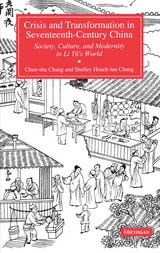
Crisis and Transformation in Seventeenth-Century China
Society, Culture, and Modernity in Li Yu's WorldChun-shu Chang and Shelley Hsueh-lun Chang
University of Michigan Press, 1998
The main thread of the book follows the life and works of a remarkable figure of the period, Li Yü (1611-80), whose vast array of accomplishments and experiences mirror seventeenth-century China in all its complexity and excitement. Li Yü's China was a world of unprecedented changes in almost all spheres of life. A thriving commercial and industrial economy, stupendous population growth, and the emergence of a new age of science and technology were accompanied by intense urbanization, radical views on money, wealth, and luxury, liberal attitudes toward sexuality, and developments that would change the nature of the literary and intellectual world. The Changs' exhaustive exploration of Chinese historical and literary sources of the sixteenth and seventeenth centuries is combined with a selective application of interpretive insights and analytic techniques from the major theoretical schools.
An important resource for scholars in history, literature, and Asian studies, Crisis and Transformation extends its appeal to those interested in the history of science, issues of gender and social transformation, and popular culture movements.
Chun-shu Chang is Professor of History, University of Michigan, and Honorary Professor of Chinese History, China. Shelley Hsueh-lun Chang is Visiting Associate Professor of History and Research Associate, Center for Chinese Studies, University of Michigan.

Czechs and Germans 1848-2004
The Sudeten Question and the Transformation of Central EuropeVáclav Houzvicka
Karolinum Press, 2013