Results by title
96 books match the query 'Truth' and 4 start with c
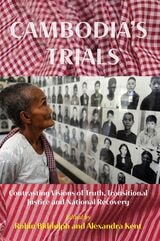
Cambodia's Trials
Contrasting Visions of Truth, Transitional Justice and National RecoveryEdited by Robin Biddulph and Alexandra Kent
National University of Singapore Press, 2023
New insights into understanding how Cambodia grapples with its traumatic historical past.
More than four decades have passed since the end of Khmer Rouge rule in Cambodia in 1979. Even so, the country is still coming to terms with the destruction wrought by the Khmer Rouge during both the time they were in power and during the period of guerrilla resistance that lasted until 1998. The Khmer Rouge Tribunal, or the Extraordinary Chambers in the Court of Cambodia (ECCC), was established in 2006 to bring the Khmer Rouge leadership to justice. In many ways a product of the 1990s, when liberal democracy appeared to be on the rise both in Cambodia and internationally, the ECCC was imagined as a transitional justice initiative that would help ease the transition to liberal democracy.
The ECCC has long been the focus of scholarly attention in Cambodia’s recovery, but this compelling study argues that such an approach is dated, noting that the political circumstances in which the ECCC was born have since changed profoundly, both globally and locally. Cambodia’s current situation can no longer be analyzed solely in terms of transitional justice narratives or the work of the ECCC, and other ways in which Cambodians have come to terms with their past and built new lives must be considered. By decentering the ECCC in the scholarly narrative of Cambodia’s recovery, the volume’s authors offer fascinating new insights into the Khmer Rouge period and more recent years of social, cultural, and political change in Cambodia.
[more]
Climate Machines, Fascist Drives, and Truth
William E. Connolly
Duke University Press, 2019
In this new installation of his work, William E. Connolly examines entanglements between volatile earth processes and emerging cultural practices, highlighting relays among extractive capitalism, self-amplifying climate processes, migrations, democratic aspirations, and fascist dangers. In three interwoven essays, Connolly takes up thinkers in the "minor tradition" of European thought who, unlike Cartesians and Kantians, cross divisions between nature and culture. He first offers readings of Sophocles and Mary Shelley, asking whether close attention to the Anthropocene could perhaps have arrived earlier had subsequent humanists absorbed their lessons. He then joins Deleuze and Guattari's notion of an abstract machine with contemporary earth sciences, doing so to compare the Antique Little Ice Age of the late Roman empire to contemporary relays between extractive capitalism and accelerating climate processes. The final essay stages a dramatic dialogue between Alfred North Whitehead and Michel Foucault about the pursuit of truth during a time of planetary turbulence. With Climate Machines Fascist Drives, and Truth, Connolly forges incisive interventions into key issues of our time.
[more]
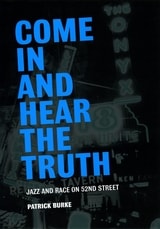
Come In and Hear the Truth
Jazz and Race on 52nd StreetPatrick Burke
University of Chicago Press, 2008
Between the mid-1930s and the late ’40s, the center of the jazz world was a two-block stretch of 52nd Street in Manhattan. Dozens of crowded basement clubs between Fifth and Seventh avenues played host to legends such as Billie Holiday and Charlie Parker, as well as to innumerable professional musicians whose names aren’t quite so well known. Together, these musicians and their audiences defied the traditional border between serious art and commercial entertainment—and between the races, as 52nd Street was home to some of the first nightclubs in New York to allow racially integrated bands and audiences. Patrick Burke argues that the jazz played on 52nd Street complicated simplistic distinctions between musical styles such as Dixieland, swing, and bebop. And since these styles were defined along racial lines, the music was itself a powerful challenge to racist ideology.
Come In and Hear the Truth uses a range of materials, from classic photographs to original interviews with musicians, to bring the street’s vibrant history to life and to shed new light on the interracial contacts and collaborations it generated.
[more]
Criticism and Truth
On Method in Literary StudiesJonathan Kramnick
University of Chicago Press, 2023
A defense and celebration of the discipline of literary studies and its most distinctive practice—close reading.
Does literary criticism offer truths about the world? In Criticism and Truth, Jonathan Kramnick offers a new and surprising account of criticism’s power by zeroing in on its singular method: close reading. Long recognized as the distinctive technique of literary studies, close reading is the critic’s way of pursuing arguments and advancing knowledge, as well as the primary skill taught in the English major. But it is also more than that—a creative, immersive, and transformative writing practice that fosters a unique kind of engagement with the world. Drawing on the rich and varied landscape of contemporary criticism, Kramnick changes how we think about the basic tools of literary analysis, including the art of in-text quotation, summary, and other reading methods, helping us to see them as an invaluable form of humanistic expertise. Criticism and Truth is a call to arms, making a powerful case for the necessity of both literature and criticism within a multidisciplinary university.
As the humanities fight for survival in contemporary higher education, the study of literature doesn’t need more plans for reform. Rather, it needs a defense of the work already being done and an account of why it should flourish. This is what Criticism and Truth offers, in vivid and portable form.
[more]