Results by title
57 books match the query 'United States. Congress. House' and 6 start with c
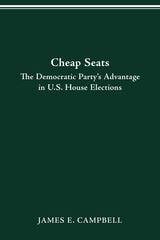
CHEAP SEATS
The Democratic Party’s Advantage in U.S. House ElectionsJames E. Campbell
The Ohio State University Press, 1996
The longest continuous majority in the history of the U.S. House of Representatives came to a dramatic close with the 1994 midterm elections. The Democratic Party had controlled the House for forty years—two and a half times as long as any previous majority. In Cheap Seats, James E. Campbell considers the reasons why the Democrats dominated House elections for four decades and why they ultimately lost that control.
Examining the structural advantages that helped congressional Democrats, Campbell finds that their unprecedented success in the House was due in no small measure to a favorable election system, an advantage in the way in which votes are translated into House seats. His straightforward analysis indicates that Democrats consistently win most of the very-low-turnout districts, or “cheap seats.” In fact, because of the party's continued hold on such districts, the new Democratic minority is considerably larger than it would otherwise have been.
Cheap Seats is a thorough and innovative investigation into the electoral system's impact on partisan politics and representation in Congress. Campbell presents an impressive array of evidence, including both quantitative analysis of election returns from 1936 to 1994 and in-depth studies of several cheap-seat districts. He also explores the important theoretical issues of representation that cheap seats raise and offers several proposals to reform the system. This well-written and provocative volume is accessible to anyone interested in American politics, in addition to scholars especially interested in the areas of Congress, elections, electoral systems, and political parties.

Catch and Release
An Oregon Life in PoliticsLes AuCoin
Oregon State University Press, 2019
In this compelling collection of life stories, AuCoin traces his unlikely rise from a fatherless childhood in Central Oregon to the top ranks of national power. Then came a painful defeat in one of the most controversial races in US Senate history, against incumbent Bob Packwood.
A fly fisher, AuCoin uses “catch and release” as a metaphor for succeeding and letting go of loss with dignity and equanimity. His memories are in turn funny, suspenseful, and revealing. AuCoin takes us to the Kremlin, pre-industrial China, the Arctic National Wildlife Refuge, and into the tortuous politics of the Northwest spotted owl crisis. He interacted with world figures like Mikhail Gorbachev, Ronald Reagan, House Speakers Tip O’Neill and Jim Wright, and Oregon legends Tom McCall and Mark Hatfield. Closer to home, AuCoin allied himself with activists like Sidney Lasseigne of the Newport Fishermen’s Wives.
Catch and Release offers readers a revealing glimpse behind the scenes of congressional life, as lived by the 535 souls who inhabit the US House and Senate—including the author, who assesses his own strengths and foibles with humility and candor.

Clear It with Sid!
Sidney R. Yates and Fifty Years of Presidents, Pragmatism, and Public ServiceMichael C. Dorf and George Van Dusen
University of Illinois Press, 2022
Michael C. Dorf and George Van Dusen draw on scores of interviews and unprecedented access to private papers to illuminate the life of an Illinois political icon. Wise, energetic, charismatic, petty, stubborn--Sid Yates presented a complicated character to constituents and colleagues alike. Yet his get-it-done approach to legislation allowed him to bridge partisan divides in the often-polarized House of Representatives. Following Yates from the campaign trail to the negotiating table to the House floor, Dorf and Van Dusen offer a rich portrait of a dealmaker extraordinaire and tireless patriot on a fifty-year journey through postwar American politics.

Congressional Realignment, 1925-1978
By Barbara Sinclair
University of Texas Press, 1982
Ronald Reagan's election in 1980 brought with it a major shift in the composition of the U.S. Congress for the first time in several decades. The subsequent introduction of an enormous amount of new legislation sparked debate among many political observers that a new coalition was being built in American politics and that a significant change in the issues on the agenda before Congress heralded a Republican realignment.
Barbara Sinclair's study is a major contribution to our understanding of realignment politics in the House of Representatives. It also provides important insight into the changes in American political life in the late twentieth century.
Congressional Realignment poses three basic, related questions: What are the sources of agenda change? What determines congressional voting alignments and alignment change? Under what conditions are the barriers to major policy change overcome? Sinclair's answers are impressive both in their scholarship and in the depth and intelligence of her insights.
Congressmen's Voting Decisions
John W. Kingdon
University of Michigan Press, 1989
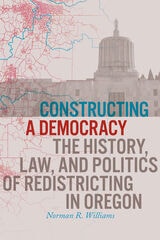
Constructing a Democracy
The History, Law, and Politics of Redistricting in OregonNorman R. Williams
Oregon State University Press, 2023
In Constructing a Democracy, legal scholar Norman Williams presents a comprehensive history of legislative and congressional redistricting in Oregon. Because redistricting impacts the representativeness of the ensuing legislative body, Oregon’s constitutional framers, legislators, and courts alike have understandably focused on developing legal rules to constrain the redistricting process. Williams is primarily interested in identifying and understanding the scope of those rules: What legal constraints have existed over time? How aggressively have the courts enforced those restraints? How have political actors undertaken the redistricting task in light of the various rules and the judicial pronouncements regarding those constraints?
The redistricting process in Oregon has not drawn national attention the way it has in states like North Carolina and Pennsylvania. But the process in Oregon is notable in several ways, including an early attention to malapportionment, the use of the initiative to reform the process, and and the impact of women leaders on the redistricting process. The Oregon process, however, has also notably lagged behind other states, particularly in considering issues of race and minority representation and preventing gerrymandering.