Results by title
75 books match the query 'United States. Supreme Court' and 3 start with c

Case Selection in the United States Supreme Court
Doris Marie Provine
University of Chicago Press, 1980
This concise and accessible study provides an intimate view of the Court's case-selection process through an analysis of the docket books and other papers of Justice Harold H. Burton, who kept scrupulous records of the Court's work from 1945 to 1957. In her analysis of these invaluable records—the only records of case-selection votes made public since the advent of discretionary review in 1925—Provine provides two perspectives on the problematic issue of judicial motivation in case selection. The first perspective is an institutional one in which the Court is treated as the unit of analysis: the second is personal, in which differences among decision makers are the focus of analysis. Provine suggests that judicial role perceptions go far to explain both agreement and disagreement in case selection. She also considers the impact of the process upon litigants, since the system seems to favor petitioners with litigation expertise, especially the U.S. government. Yet, she claims, the secrecy of case selection fosters the popular misperception that any worthwhile case can be appealed "all the way to the Supreme Court." The Court thus maintains its image as a forum equally available to all litigants.
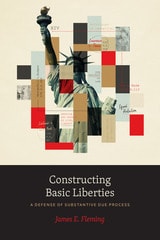
Constructing Basic Liberties
A Defense of Substantive Due ProcessJames E. Fleming
University of Chicago Press, 2022
From reproductive rights to marriage for same-sex couples, many of our basic liberties owe their protection to landmark Supreme Court decisions that have hinged on the doctrine of substantive due process. This doctrine is controversial—a battleground for opposing views around the relationship between law and morality in circumstances of moral pluralism—and is deeply vulnerable today.
Against recurring charges that the practice of substantive due process is dangerously indeterminate and irredeemably undemocratic, Constructing Basic Liberties reveals the underlying coherence and structure of substantive due process and defends it as integral to our constitutional democracy. Reviewing the development of the doctrine over the last half-century, James E. Fleming rebuts popular arguments against substantive due process and shows that the Supreme Court has constructed basic liberties through common law constitutional interpretation: reasoning by analogy from one case to the next and making complex normative judgments about what basic liberties are significant for personal self-government.
Elaborating key distinctions and tools for interpretation, Fleming makes a powerful case that substantive due process is a worthy practice that is based on the best understanding of our constitutional commitments to protecting ordered liberty and securing the status and benefits of equal citizenship for all.
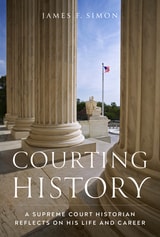
Courting History
A Supreme Court Historian Reflects on His Life and CareerJames F. Simon
University of Texas Press, 2025
A Supreme Court historian’s memoir places court events in the larger context of American history.
Legal scholar James F. Simon has written many acclaimed books on the history of the US Supreme Court, but in this memoir, he turns his attention to a more personal subject: himself. Simon, a native of Fort Worth, details what it was like growing up in segregated Texas. He left home for college and law school at Yale, interspersed with travels abroad to build a schoolhouse in Ghana, work at an Israeli kibbutz, and spend a year on a fellowship in India.
Simon worked as a legal journalist for Time magazine before embarking on a career as a Supreme Court historian. He later was appointed professor of constitutional law and served as dean of New York Law School. Meanwhile, he continued his work on what became his specialty, well-researched books on the history of the Supreme Court that place events at the court in the larger context of American history. Much of this research is included in his papers, which are now housed at the Briscoe Center for American History.
In this engaging memoir, Simon describes the challenges of interviewing Supreme Court justices and researching constitutional history for his books and juggling his law school and family responsibilities, all the while reflecting on changing American perspectives on civil rights and liberties.