Results by title
57 books match the query 'Victorian Era (1837-1901)' and 3 start with c
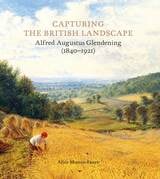
Capturing the British Landscape
Alfred Augustus Glendening (1840–1921)Alice Munro-Faure
Paul Holberton Publishing, 2022
Though critics often reviewed Alfred Augustus Glendening’s exhibitions, very little has been written about the artist himself. Here, new and extensive research removes layers of mystery and misinformation about his life, family, and career, accurately placing him amid the British art world during much of the nineteenth and into the twentieth century. Glendening was a man from humble origins, working full-time as a railway clerk when he managed to make his London exhibition debut at the age of twenty—a feat that would have been almost impossible before the Victorian era ushered in new possibilities of social mobility. Although his paintings show a tranquil and unspoiled landscape, his environment was rapidly being transformed by social, scientific, and industrial developments, while advances in transport, photography, and other technical discoveries undoubtedly influenced him and his fellow painters.
Celebrating his uniquely Victorian story, the book places Glendening within his proper historical context. Running alongside the main text is a timeline outlining significant landmarks, from political and social events to artistic and technical innovations. Thoroughly researched, the narrative explores why and for whom he painted, his artistic training, and his various inspirations. The book uncovers new information about the Victorian art world and embraces such aspects as Royal Academy prejudices, the popularity of Glendening’s work at home and abroad, his use of photography, and the sourcing of his art materials.
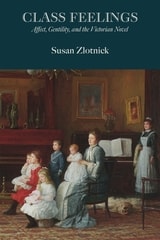
Class Feelings
Affect, Gentility, and the Victorian NovelSusan Zlotnick
Ohio University Press, 0
Drawing on new insights from affect theorists, Class Feelings reenergizes class as an analytic category. While the interest in gender, race, and sexuality as well as the increasingly global focus of nineteenth-century British literary studies have produced critically important new scholarship, class as a primary category of analysis has receded as a major topic of inquiry. This volume focuses on the work of three widely read Victorian novelists—Charles Dickens, Margaret Oliphant, and George Eliot—who were born into families best characterized as lower middle class and who shared structures of feeling common to upwardly mobile members of the mid-Victorian middle class. More particularly, Class Feelings charts class-specific emotions as they developed in relation to the practices of gentility, which had taken hold of the Anglophone world in the first half of the nineteenth century. Born in the 1810s and 1820s, all three novelists came of age during the early period of gentility’s reign and represented its practices within their novels. The self-consciousness associated with gentility—and particularly with its injunction against emotional display—left traces in the plots and characters of their novels and in the formal strategies the authors adopted. These formal features are attempts to manage the hard-to-control emotions linked to the lived experience of class, and they reveal a new way in which social class structures the nineteenth-century British novel. Middle-class gentility made fierce demands on individuals to discipline not only their bodies (through regular bathing, upright posture, moderate eating and drinking) but also their emotions. Outsiders to the increasingly elite social spheres they came to inhabit, Dickens, Oliphant, and Eliot represent in their novels the class emotions, such as shame, embarrassment, envy, anger, and pride, generated by inequalities and exclusions, but they also try to suppress those affective disturbances in the name of gentility. Nonetheless, class feelings churn throughout their texts, especially those written in the 1860s and 1870s, and those feelings are evident in the shame that haunts Dickens’s autobiographical writings, in the anger that bubbles up in Oliphant’s Carlingford tales, and in Eliot’s characteristic sensitivity. Bringing together affect theory, class studies, and Victorian literary criticism, Class Feelings demonstrates that social class is not only a material condition but also an emotional experience that fundamentally shapes literary form and cultural life.
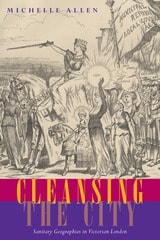
Cleansing the City
Sanitary Geographies in Victorian LondonMichelle Allen
Ohio University Press, 2008
From the novels of Charles Dickens and George Gissing to anonymous magazine articles and pamphlets, resistance to reform found expression in the nostalgic appreciation of a threatened urban landscape and anxiety about domestic autonomy in an era of networked sanitary services. Cleansing the City emphasizes the disruptions and disorientation occasioned by purification—a process we are generally inclined to see as positive. By recovering these sometimes oppositional, sometimes ambivalent responses, Michelle Allen elevates a significant undercurrent of Victorian thought into the mainstream and thus provides insight into the contested nature of sanitary modernization.