Results by title
133 books match the query 'Vietnam War, 1961-1975' and 5 start with c
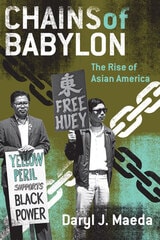
Chains of Babylon
The Rise of Asian AmericaDaryl J. Maeda
University of Minnesota Press, 2009
In Chains of Babylon, Daryl J. Maeda presents a cultural history of Asian American activism in the late 1960s and early 1970s, showing how the movement created the category of "Asian American" to join Asians of many ethnicities in racial solidarity. Drawing on the Black Power and antiwar movements, Asian American radicals argued that all Asians in the United States should resist assimilation and band together to oppose racism within the country and imperialism abroad.
As revealed in Maeda's in-depth work, the Asian American movement contended that people of all Asian ethnicities in the United States shared a common relationship to oppression and exploitation with each other and with other nonwhite peoples. In the early stages of the civil rights era, the possibility of assimilation was held out to Asian Americans under a model minority myth. Maeda insists that it was only in the disruption of that myth for both African Americans and Asian Americans in the 1960s and 1970s that the full Asian American culture and movement he describes could emerge. Maeda challenges accounts of the post-1968 era as hopelessly divisive by examining how racial and cultural identity enabled Asian Americans to see eye-to-eye with and support other groups of color in their campaigns for social justice.
Asian American opposition to the war in Vietnam, unlike that of the broader antiwar movement, was predicated on understanding it as a racial, specifically anti-Asian genocide. Throughout he argues that cultural critiques of racism and imperialism, the twin "chains of Babylon" of the title, informed the construction of a multiethnic Asian American identity committed to interracial and transnational solidarity.
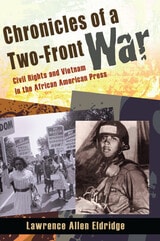
Chronicles of a Two-Front War
Civil Rights and Vietnam in the African American PressLawrence Allen Eldridge
University of Missouri Press, 2011
Eldridge reveals how the black press not only reported the war but also weighed its significance in the context of the civil rights movement.
Eldridge examines not only the role of reporters during the war, but also those of editors, commentators, and cartoonists. Especially enlightening is the research drawn from extensive oral histories by prominent journalist Ethel Payne, the first African American woman to receive the title of war correspondent. She described a widespread practice in black papers of reworking material from major white papers without providing proper credit, as the demand for news swamped the small budgets and limited staffs of African American papers. The author analyzes both the strengths of the black print media and the weaknesses in their coverage.
The black press ultimately viewed the Vietnam War through the lens of African American experience, blaming the war for crippling LBJ’s Great Society and the War on Poverty. Despite its waning hopes for an improved life, the black press soldiered on.
Combat Chaplain
A Thirty-Year Vietnam BattleJames D. Johnson
University of North Texas Press, 2001
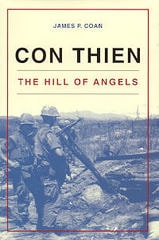
Con Thien
The Hill of AngelsJames P. Coan
University of Alabama Press, 2007
Holding the Hill of Angels: A Marine’s Fight for Survival at the DMZ.
Throughout much of 1967, a remote United States Marine firebase only two miles from the demilitarized zone (DMZ) captured the attention of the world’s media. That artillery-scarred outpost was the linchpin of the so-called McNamara Line intended to deter incursions into South Vietnam by the North Vietnamese Army. As such, the fighting along this territory was particularly intense and bloody, and the body count rose daily.
Con Thien combines James P. Coan’s personal experiences with information taken from archives, interviews with battle participants, and official documents to construct a powerful story of the daily life and combat on the red clay bulls-eye known as "The Hill of Angels." As a tank platoon leader in Alpha Company, 3d Tank Battalion, 3d Marine Division, Coan was stationed at Con Thien for eight months during his 1967-68 service in Vietnam and witnessed much of the carnage.
Con Thien was heavily bombarded by enemy artillery with impunity because it was located in politically sensitive territory and the U.S. government would not permit direct armed response from Marine tanks. Coan, like many other soldiers, began to feel as though the government was as much the enemy as the NVA, yet he continued to fight for his country with all that he had. In his riveting memoir, Coan depicts the hardships of life in the DMZ and the ineffectiveness of much of the U.S. military effort in Vietnam.
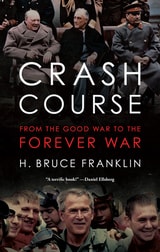
Crash Course
From the Good War to the Forever WarFranklin, H. Bruce
Rutgers University Press, 2024
Now, after fifty years as a renowned cultural historian, Franklin offers a set of hard-learned lessons about modern American history. Crash Course is essential reading for anyone who wonders how America ended up where it is today: with a deeply divided and disillusioned populace, led by a dysfunctional government, and mired in unwinnable wars. It also finds startling parallels between America’s foreign military exploits and the equally brutal tactics used on the home front to crush organized labor, antiwar, and civil rights movements.
More than just a memoir or a history book, Crash Course gives readers a unique firsthand look at the building of the American empire and the damage it has wrought. Shocking and gripping as any thriller, it exposes the endless deception of the American public, and reveals from inside how and why many millions of Americans have been struggling for decades against our own government in a fight for peace and justice.