Results by title
71 books match the query 'Voice' and 3 start with c
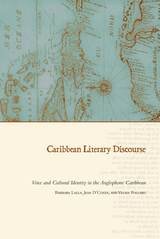
Caribbean Literary Discourse
Voice and Cultural Identity in the Anglophone CaribbeanBarbara Lalla
University of Alabama Press, 2013
A study of the multicultural, multilingual, and Creolized languages that characterize Caribbean discourse, especially as reflected in the language choices that preoccupy creative writers
Caribbean Literary Discourse opens the challenging world of language choices and literary experiments characteristic of the multicultural and multilingual Caribbean. In these societies, the language of the master— English in Jamaica and Barbados—overlies the Creole languages of the majority. As literary critics and as creative writers, Barbara Lalla, Jean D’Costa, and Velma Pollard engage historical, linguistic, and literary perspectives to investigate the literature bred by this complex history. They trace the rise of local languages and literatures within the English speaking Caribbean, especially as reflected in the language choices of creative writers.
The study engages two problems: first, the historical reality that standard metropolitan English established by British colonialists dominates official economic, cultural, and political affairs in these former colonies, contesting the development of vernacular, Creole, and pidgin dialects even among the region’s indigenous population; and second, the fact that literary discourse developed under such conditions has received scant attention.
Caribbean Literary Discourse explores the language choices that preoccupy creative writers in whose work vernacular discourse displays its multiplicity of origins, its elusive boundaries, and its most vexing issues. The authors address the degree to which language choice highlights political loyalties and tensions; the politics of identity, self-representation, and nationalism; the implications of code-switching—the ability to alternate deliberately between different languages, accents, or dialects—for identity in postcolonial society; the rich rhetorical and literary effects enabled by code-switching and the difficulties of acknowledging or teaching those ranges in traditional education systems; the longstanding interplay between oral and scribal culture; and the predominance of intertextuality in postcolonial and diasporic literature.
[more]
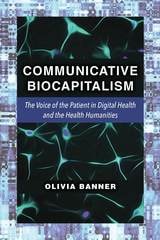
Communicative Biocapitalism
The Voice of the Patient in Digital Health and the Health HumanitiesOlivia Banner
University of Michigan Press, 2017
The Precision Medicine Initiative, Apple’s HealthKit, the FitBit—the booming digital health industry asserts that digital networks, tools, and the scientific endeavors they support will usher in a new era of medicine centered around “the voice of the patient.” But whose “voices” do such tools actually solicit? And through what perspective will those voices be heard? Digital health tools are marketed as neutral devices made to help users take responsibility for their health. Yet digital technologies are not neutral; they are developed from an existing set of assumptions about their potential users and contexts for use, and they reflect dominant ideologies of health, dis/ability, gender, and race. Using patient-networking websites, the Quantified Self, and online breast cancer narratives, Communicative Biocapitalism examines the cultural, technological, economic, and rhetorical logics that shape the “voice of the patient” in digital health to identify how cultural understandings and social locations of race, gender, and disability shape whose voices are elicited and how they are interpreted.
[more]
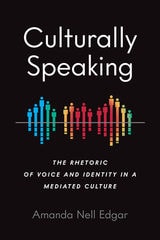
Culturally Speaking
The Rhetoric of Voice and Identity in a Mediated CultureAmanda Nell Edgar
The Ohio State University Press, 2019
Winner, 2020 Outstanding Book Award, Critical/Cultural Studies Division of the National Communication Association
Recent pieces by NPR, the BBC, and Forbes have called attention to the power of voice—positing that “your voice is the secret to getting hired” and that “voice can accelerate or hold back a career.” While it has become clearer that such things as pitch and intonation can be tied to assumptions about one’s gender, race/ethnicity, and class, studying voice as a socially constructed artifact carries with it unique challenges. In response, Culturally Speaking: The Rhetoric of Voice and Identity in a Mediated Culture presents an innovative approach to studying the spoken voice in media, showing how racial and gendered oppression bubble beneath the surface of American culture’s most recognized speaking voices, spreading invisible messages about which kinds of vocal identities are privileged and which kinds should be silenced.
Through her analysis of prominent voices in American culture—including Morgan Freeman, Tina Fey, Barack Obama, Adele, Dave Chappelle, Richard Pryor, and George Lopez—Amanda Nell Edgar argues that voices carry a residue of the particular cultural environments in which they are formed, and that these environments can be traced and analyzed to add a sonic dimension to our understanding of race and gender as rhetorically situated identities—pushing back against the often-unnoticed systems of sound-based discrimination.
[more]