Results by title
81 books match the query 'Volume 3' and 6 start with c
Chemical Demonstrations, Volume 3
A Handbook for Teachers of ChemistryBassam Z. Shakhashiri
University of Wisconsin Press, 1989
The demonstrations capture interest, teach, inform, fascinate, amaze, and perhaps, most importantly, involve students in chemistry. Nowhere else will you find books that answer, "How come it happens? . . . Is it safe? . . . What do I do with all the stuff when the demo is over?"
Shakhashiri and his collaborators offer 282 chemical demonstrations arranged in 11 chapters. Each demonstration includes seven sections: a brief summary, a materials list, a step-by-step account of procedures to be used, an explanation of the hazards involved, information on how to store or dispose of the chemicals used, a discussion of the phenomena displayed and principles illustrated by the demonstration, and a list of references. You'll find safety emphasized throughout the book in each demonstration.
Commentaries on the Laws of England, Volume 3
A Facsimile of the First Edition of 1765-1769William Blackstone
University of Chicago Press, 1979
Previously available only in an expensive hardcover set, Commentaries on the Laws of England is published here in four separate volumes, each one affordably priced in a paperback edition. These works are facsimiles of the eighteenth-century first edition and are undistorted by later interpolations. Each volume deals with a particular field of law and carries with it an introduction by a leading contemporary scholar.
Introducing this third volume, Of Private Wrongs, John H. Langbein discusses Blackstone's account of procedure and jurisdiction, jury trial, and equity. He also examines Blackstone's uneasy attitude toward the celebrated legal frictions of English civil procedure.
Commentary on the Twelve Prophets, Volume 3
Catholic University of America Press, 2012
Conversations
Volume 3Jorge Luis Borges and Osvaldo Ferrari
Seagull Books, 2017
In Conversations: Volume 3, Borges and Ferrari discuss subjects as diverse as film criticism, fantastic literature, science fiction, the Argentinian literary tradition, and the works of writers such as Bunyan, Wilde, Joyce, and Yeats, among others. With his signature wit, Borges converses on the philosophical basis of his writing, his travels, and his fascination with religious mysticism. He also ruminates on more personal themes, including the influence of his family on his intellectual development, his friendships, and living with blindness.
The recurrent theme of these conversations, however, is a life lived through books. Borges draws on the resources of a mental library that embraces world literature, both ancient and modern. He recalls the works that were a constant presence in his memory and maps his changing attitudes to a highly personal canon. These conversations are a testimony to the supple ways that Borges explored his own relation to numerous traditions—the conjunction of his life, his lucidity, and his imagination.
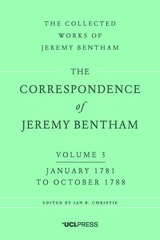
Correspondence of Jeremy Bentham, Volume 3
January 1781 to October 1788Jeremy Bentham, edited by Ian R. Christie, and series edited by J.H. Burns
University College London, 2017

Crime and Justice, Volume 3
An Annual Review of ResearchEdited by Michael Tonry and Norval Morris
University of Chicago Press Journals, 1982