67 books match the query 'War and society' and 3 start with c

cover of Citizen, Invert, Queer: Lesbianism and War in Early Twentieth-Century Britain

Citizen, Invert, Queer

Lesbianism and War in Early Twentieth-Century Britain

Deborah Cohler

University of Minnesota Press, 2010
In late nineteenth-century England, “mannish” women were considered socially deviant but not homosexual. A half-century later, such masculinity equaled lesbianism in the public imagination. How did this shift occur? Citizen, Invert, Queer illustrates that the equation of female masculinity with female homosexuality is a relatively recent phenomenon, a result of changes in national and racial as well as sexual discourses in early twentieth-century public culture.
 
Incorporating cultural histories of prewar women’s suffrage debates, British sexology, women’s work on the home front during World War I, and discussions of interwar literary representations of female homosexuality, Deborah Cohler maps the emergence of lesbian representations in relation to the decline of empire and the rise of eugenics in England. Cohler integrates discussions of the histories of male and female same-sex erotics in her readings of New Woman, representations of male and female suffragists, wartime trials of pacifist novelists and seditious artists, and the interwar infamy of novels such as Radclyffe Hall’s The Well of Loneliness and Virginia Woolf’s Orlando.
 
By examining the shifting intersections of nationalism and sexuality before, during, and after the Great War, this book illuminates profound transformations in our ideas about female homosexuality.
[more]
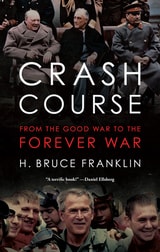
cover of Crash Course: From the Good War to the Forever War

Crash Course

From the Good War to the Forever War

Franklin, H. Bruce

Rutgers University Press, 2024

Growing up during the Second World War, H. Bruce Franklin believed what he was told: that America’s victory would lead to a new era of world peace. Like most Americans, he was soon led to believe in a world-wide Communist conspiracy that menaced the United States, forcing the nation into a disastrous war in Korea. But once he joined the U.S. Air Force and began flying top-secret missions as a navigator and intelligence officer, what he learned was eye-opening. He saw that even as the U.S. preached about peace and freedom, it was engaging in an endless cycle of warfare, bringing devastation and oppression to fledgling democracies across the globe.
 
Now, after fifty years as a renowned cultural historian, Franklin offers a set of hard-learned lessons about modern American history. Crash Course is essential reading for anyone who wonders how America ended up where it is today: with a deeply divided and disillusioned populace, led by a dysfunctional government, and mired in unwinnable wars. It also finds startling parallels between America’s foreign military exploits and the equally brutal tactics used on the home front to crush organized labor, antiwar, and civil rights movements.
 
More than just a memoir or a history book, Crash Course gives readers a unique firsthand look at the building of the American empire and the damage it has wrought. Shocking and gripping as any thriller, it exposes the endless deception of the American public, and reveals from inside how and why many millions of Americans have been struggling for decades against our own government in a fight for peace and justice.  
[more]
cover of Cultures of Fear: A Critical Reader

Cultures of Fear

A Critical Reader

Edited by Uli Linke and Danielle Taana Smith

Pluto Press, 2009

In Cultures of Fear, a truly world-class line up of scholars explore the formation and normalisation of fear in the context of war and terrorism.

"Freedom from fear" is a universal right and fundamental for human well-being. People often look to governments, humanitarian agencies, and other institutions to further this aim. However, this book shows that these organisations often use the same "logic of fear" to monitor, control, and contain human beings in zones of violence.

This is an excellent interdisciplinary reader for students of anthropology, sociology and politics. Contributors include Noam Chomsky, Slavoj Zizek, Jean Baudrillard, Catharine MacKinnon, Neil Smith, Cynthia Enloe, David L. Altheide, Cynthia Cockburn and Carolyn Nordstrum.

[more]