Results by title
107 books match the query 'Water' and 7 start with c
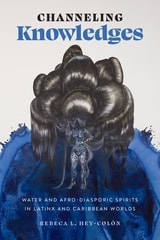
Channeling Knowledges
Water and Afro-Diasporic Spirits in Latinx and Caribbean WorldsRebeca L. Hey-Colón
University of Texas Press, 2023
2024 Honorable Mention, Isis Duarte Book Prize, Haiti/ Dominican Republic section, Latin American Studies Association
How water enables Caribbean and Latinx writers to reconnect to their pasts, presents, and futures.
Water is often tasked with upholding division through the imposition of geopolitical borders. We see this in the construction of the Rio Grande/Río Bravo on the US-Mexico border, as well as in how the Caribbean Sea and the Pacific Ocean are used to delineate the limits of US territory. In stark contrast to this divisive view, Afro-diasporic religions conceive of water as a place of connection; it is where spiritual entities and ancestors reside, and where knowledge awaits.
Departing from the premise that water encourages confluence through the sustainment of contradiction, Channeling Knowledges fathoms water’s depth and breadth in the work of Latinx and Caribbean creators such as Mayra Santos-Febres, Rita Indiana, Gloria Evangelina Anzaldúa, and the Border of Lights collective. Combining methodologies from literary studies, anthropology, history, and religious studies, Rebeca L. Hey-Colón’s interdisciplinary study traces how Latinx and Caribbean cultural production draws on systems of Afro-diasporic worship—Haitian Vodou, La 21 División (Dominican Vodou), and Santería/Regla de Ocha—to channel the power of water, both salty and sweet, in sustaining connections between past, present, and not-yet-imagined futures.
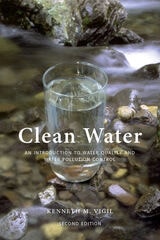
Clean Water, 2nd ed
An Introduction to Water Quality and Water Pollution ControlKenneth M. Vigil
Oregon State University Press, 2003
Most other books on water quality and pollution control are highly technical and very specific, and are aimed at engineers, scientists, or attorneys. Clean Water, on the other hand, is a comprehensive discussion of the subject intended for a wider audience of science students, educators, and the general public.
Vigil avoids the use of technical jargon and uses many photos and diagrams to illustrate and explain concepts. He provides sufficient detail to educate readers about many broad topics and includes additional references at the end of each chapter for exploring specific topics in more detail.
Clean Water summarizes the basic fundamentals of water chemistry and microbiology and outlines important water quality rules and regulations, all in concise, understandable prose. It describes the basic scientific principles behind water pollution control and the broader approach of addressing water pollution problems through watershed management. There are sections on drinking water and on citizen involvement in water pollution control efforts at home and in the community.
Colorado Water Law for Non-Lawyers
P. Andrew Jones
University Press of Colorado, 2009
This book will appeal to at students, non-lawyers involved with water issues, and general readers interested in Colorado’s complex water rights law.
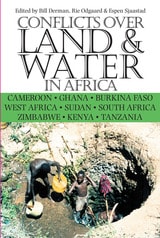
Conflicts Over Land & Water in Africa
Cameroon, Ghana, Burkina Faso, West Africa, Sudan, South Africa, Zimbabwe, Kenya, TanzaniaBill Derman
Michigan State University Press, 2007
This is an examination of the broader context for the re-emergence of land reform and resource conflicts in Africa. Efforts to change the race based systems of land ownership and land tenure in Namibia, South Africa, and Zimbabwe have pushed land issues to the forefront of social and economic discourses in Africa. This collection examines the broader context for the re-emergence of land reform and resource conflicts.
The case studies examine the links between identity maintenance, tenurial changes, state intervention, and forms and modes of conflict. The authors emphasize the need for a deeper understanding of local histories, cultures, and motivations if efforts to attain a more just distribution of resources are to succeed. The book contributes to a field that has been developing rapidly in the decade since the publication of Melissa Leach and Robin Mearns' collection The Lie of the Land and Mahmood Mamdani's Citizen and Subject. Those two books started a wide ranging discussion of the political reasons for failed development in Africa, as well as the environmental and natural resource dimensions of that failure.
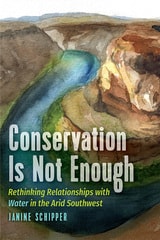
Conservation is not Enough
Rethinking Relationships with Water in the Arid SouthwestJanine Schipper
University of Wyoming Press, 2025
Using an exploratory and qualitative approach, the book draws on more than ninety-five interviews conducted over three years, revealing the complex relationships people have with water in the Southwest, and prominently features the voices of participants, effectively illustrating multiple perspectives and diverse ways of thinking about and relating to water. Schipper highlights various perspectives—including a water manager making conservation decisions, a Hopi elder emphasizing our connection to the water cycle, and a ski instructor reflecting on human-made snow—and interweaves personal experiences and reflections on her own relationship with water and conservation efforts.
Conservation Is Not Enough encourages readers to reflect on their personal connections to water and consider new possibilities, and it also urges readers to think beyond conventional conservation approaches. This book helps to transform the collective approach to water and cultivate fresh ways of engaging with and relating to water and is of great interest to scholars, students, and residents concerned with water issues in the Colorado River Basin.
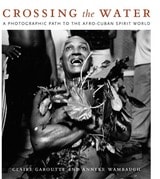
Crossing the Water
A Photographic Path to the Afro-Cuban Spirit WorldClaire Garoutte and Anneke Wambaugh
Duke University Press, 2007
A book of more than 150 striking photographs in both black and white and color, Crossing the Water includes images of elaborate Santería altars and Palo spirit cauldrons, as well as of Santiago and his religious “family” engaged in ritual practices: the feeding of the spirits, spirit possession, and private and collective healing ceremonies. As the charismatic head of a large religious community, Santiago helps his godchildren and others who consult him to cope with physical illness, emotional crises, contentious relationships, legal problems, and the hardships born of day-to-day survival in contemporary Cuba. He draws on the distinct yet intertwined traditions of Santería, Palo Monte, and Espiritismo to foster healing of both mind and body—the three religions form a coherent theological whole for him.
Santiago eventually became Garoutte’s and Wambaugh’s spiritual godfather, and Crossing the Water is informed by their experiences as initiates of Santería and Palo Monte. Their text provides nuanced, clear explanations of the objects and practices depicted in the images. Describing the powerful intensity of human-spirit interactions, and evoking the sights, smells, sounds, and choreography of ritual practice, Crossing the Water takes readers deep inside the intimate world of Afro-Cuban spirituality.
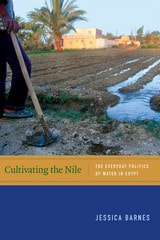
Cultivating the Nile
The Everyday Politics of Water in EgyptJessica Barnes
Duke University Press, 2014