Results by title
127 books match the query 'World politics' and 12 start with c
Can Politics Be Thought?
Alain Badiou
Duke University Press, 2018
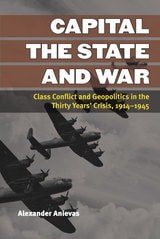
Capital, the State, and War
Class Conflict and Geopolitics in the Thirty Years' Crisis, 1914-1945Alexander Anievas
University of Michigan Press, 2014
The history of the modern social sciences can be seen as a series of attempts to confront the challenges of social disorder and revolution wrought by the international expansion of capitalist social relations. Alexander Anievas focuses on one particularly significant aspect of this story: the intersocietal or geosocial origins of the two world wars, and, more broadly, the confluence of factors behind the Thirty Years’ Crisis between 1914 and 1945.
Anievas presents the Thirty Years’ Crisis as a result of the development of global capitalism with all its destabilizing social and geopolitical consequences, particularly the intertwined and co-constitutive nature of imperial rivalries, social revolutions, and anti-colonial struggles. Building on the theory of uneven and combined development, he unites geopolitical and sociological explanations into a single framework, thereby circumventing the analytical stalemate between primacy of domestic politics and primacy of foreign policy approaches.
Chaos and Governance in the Modern World System
Giovanni Arrighi
University of Minnesota Press, 1999
China’s Challenges and International Order Transition
Beyond “Thucydides's Trap”Edited by Huiyun Feng and Kai He
University of Michigan Press, 2020
China’s Challenges and International Order Transition introduces an integrated conceptual framework of “international order” categorized by three levels (power, rules, and norms) and three issue-areas (security, political, and economic). Each contributor engages one or more of these analytical dimensions to examine two questions: (1) Has China already challenged this dimension of international order? (2) How will China challenge this dimension of international order in the future?
The contested views and perspectives in this volume suggest it is too simple to assume an inevitable conflict between China and the outside world. With different strategies to challenge or reform the many dimensions of international order, China’s role is not a one-way street. It is an interactive process in which the world may change China as much as China may change the world.
The aim of the book is to broaden the debate beyond the “Thucydides Trap” perspective currently popular in the West. Rather than offering a single argument, this volume offers a platform for scholars, especially Chinese scholars vs. Western scholars, to exchange and debate their different views and perspectives on China and the potential transition of international order.
Chinese Visions of World Order
Tianxia, Culture, and World PoliticsBan Wang, editor
Duke University Press, 2017
Contributors. Daniel A. Bell, Chishen Chang, Kuan-Hsing Chen, Prasenjit Duara, Hsieh Mei-yu, Haiyan Lee, Mark Edward Lewis, Lin Chun, Viren Murthy, Lisa Rofel, Ban Wang, Wang Hui, Yiqun Zhou
Churchill's "Iron Curtain" Speech Fifty Years Later
Edited & Intro by James W. Muller
University of Missouri Press, 1999
Winston Churchill's visit to Fulton, Missouri, on March 5, 1946, marked the first public recognition of the cold war that was to follow World War II. Churchill delivered his most famous speech, "The Sinews of Peace," which became best known by the phrase he used to describe the cold-war division of Europe, the "iron curtain."
In the United States and Britain, wartime alliances had fostered favorable feelings toward the Soviet Union. By 1946 democratic citizens on both sides of the Atlantic had begun to consider communist Russia a friend. In his speech at Fulton, Churchill exhibited breathtaking flexibility and a clear recognition of the main threat as he reminded the public that true friendship must be reserved for countries sharing a common love of liberty. The "Iron Curtain" speech defined postwar relations with the Soviet Union for citizens of Western democracies. Although it initially provoked intense controversy in the United States and Britain, criticism soon gave way to wide public agreement to oppose Soviet imperialism.
Opening with the full text of the address Churchill delivered in Fulton and concluding with Margaret Thatcher's fiftieth-anniversary address surveying the challenges facing Western democracies in this post-cold war climate, the book brings together essays that reflect on the past fifty years, recognizing Churchill's speech as a carefully conceived herald of the cold war for the Western democracies. These powerful essays offer a fresh appreciation of the speech's political, historical, diplomatic, and rhetorical significance.
Claiming Impartiality
Peacebuilding Organizations as Actors in Multiple Fields of Global GovernanceAndrea Warnecke
University of Michigan Press, 2026
Drawing on and expanding a Bourdieusian field perspective, the book examines international organizations as actors in multiple fields of global governance. Using the case studies of Bosnia and Herzegovina and Timor-Leste, it traces the emergence and transformation of peacebuilding practices by leading international and bilateral organizations during the first two decades of the field’s existence. The organizational lens highlights the tensions that exist between the objectives of simultaneously acting as a peacebuilding organization and as a peacekeeping, humanitarian, or development organization whose practices are to varying degrees committed to observing the twin principles of impartiality and neutrality. By thinking through these sometimes contradictory roles, the book offers new insights into how these organizations sideline questions of political agency in favor of expanding their influence into related fields of global governance. Claiming Impartiality discusses the future of peacebuilding and explores avenues for addressing political challenges to peace itself.
Coalition of the unWilling and unAble
European Realignment and the Future of American GeopoliticsJohn R. Deni
University of Michigan Press, 2022
Why does the United States need European allies, and why is it getting more difficult for those allies to partner with Washington in standing up to China, pushing back against Russia, and pursuing other common interests around the world? This book addresses the economic, demographic, political, and military trends that are fundamentally upending the ability and willingness of European allies to work with Washington. Brexit and its impact on Britain’s economy and its military, Germany’s seemingly relentless economic and political rise, France’s continuing economic malaise, Italy’s aging population and its withdrawal from major overseas operations, and Poland’s demographic decline and single-minded obsession with Russia will combine to make partnership with Washington nearly impossible. In short, the constellation of allies and partners the United States has relied on since 9/11 will look very different a decade from now. How should Washington respond? It doesn’t hold all the cards, but this book offers an array of practical recommendations for American leaders. By leveraging these proposals, U.S. policy-makers can avoid the worst-case scenarios and make the most of limited opportunities.
Cold War Camera
Thy Phu, Erina Duganne, and Andrea Noble, editors
Duke University Press, 2023
Contributors. Ariella Azoulay, Jennifer Bajorek, Erina Duganne, Evyn Lê Espiritu Gandhi, Eric Gottesman, Tong Lam, Karintha Lowe, Ángeles Donoso Macaya, Darren Newbury, Andrea Noble, Sarah Parsons, Gil Pasternak, Thy Phu, Oksana Sarkisova, Olga Shevchenko, Laura Wexler, Guigui Yao, Donya Ziaee, Marta Ziętkiewicz

Collective Action
A Bad Subjects AnthologyEdited by Megan Shaw Prelinger and Joel Schalit
Pluto Press, 2004
Concepts at Work
On the Linguistic Infrastructure of World PoliticsPiki Ish-Shalom, Editor
University of Michigan Press, 2021
Concepts are socially and linguistically constructed and used for multiple purposes, such as justifying war in the name of democracy; or, using the idea of democracy to resist Western intervention and influence. In this fascinating and novel edited collection, Piki Ish-Shalom and the contributors interrogate the “conceptions of concepts” in international relations. Using theoretical frameworks from Gramsci and Bourdieu, among others, the authors show that not interrogating the meaning of the language we use to talk about international relations obscures the way we understand (or portray) IR. The authors examine self-determination, winning in war, avoidance of war, military design and reform agenda, vagueness in political discourse, “blue economy,” friendship, and finally, the very idea of the “international community” itself. As the author asserts, Bourdieu’s sociology of field and Gramsci’s political theory, combined, “offer us a socio-political theory of relations of power and domination concealed by doxic knowledge and taken-for-granted rules, in which essential contested concepts and political-serving conceptions can and do play an important role.”
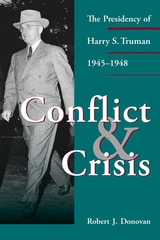
Conflict and Crisis
The Presidency of Harry S. Truman, 1945-1948Robert J. Donovan
University of Missouri Press, 1996
“It was a quiet on the second floor. The vice-president walked solemnly into Mrs. Roosevelt’s sitting room, where she waited, grave and calm. With her was her daughter, Mrs. Anna Roosevelt Boettiger, her husband, Colonel John Boettiger, and Stephan Early. Truman knew at a glance that his premonition had been true. Mrs. Roosevelt came forward directly and put her arm on his shoulder.
‘Harry, the President is dead.’”
Robert J. Donovan’s Conflict and Crisis presents a detailed account of Harry S. Truman’s presidency from 1945-1948.