Results by title
8642 books match the query '20th Century' and 580 start with c

Cultural Conservatism, Political Liberalism
From Criticism to Cultural StudiesJames Seaton
University of Michigan Press, 1996
Chapters on Lionel Trilling, H. L. Mencken and Irving Babbitt, Ralph Ellison, Dwight Macdonald, Diana Trilling, and Edmund Wilson affirm the continuing pertinence of their work to today's concerns. Seaton then turns to the careers of Leslie Fiedler and Susan Sontag to explore the impact of the cultural radicalism of the sixties on literary criticism. Subsequent chapters analyze the successes and failures of contemporary cultural studies through the writings of Richard Rorty, Edward Said, Stanley Fish and Fredric Jameson.
Separately, these chapters provide provocative readings of the individual critics; together they make a case for the tradition exemplified by these critics as an alternative to contemporary cultural studies. The issues the book discusses extend beyond literary criticism and the academic world to the political-religious- cultural conflicts of today's culture wars.
"These lively, closely argued essays explain very clearly what the issues are, how they arose, and why they are important." --Christopher Lasch
"A forceful argument about the relationship between literary studies and politics that will add something important to the vigorous, and often fierce, discussion of the canon, the politics of literature, and educational reform."--William Cain, Wellesley College
James Seaton is Professor of English, Michigan State University. He is co-editor, with William K. Buckley, of Beyond Cheering and Bashing: New Perspectives on the Closing of the American Mind.
Cultural Considerations
Essays on Readers, Writers, and Musicians in Postwar AmericaJoan Shelley Rubin
University of Massachusetts Press, 2013
Focusing on aspects of American literary and musical culture in the decades after World War II, Rubin examines the contests between critics and their readers over the authority to make aesthetic judgments; the effort of academics to extend the university outward by bringing the humanities to a wide public; the politics of setting poetic texts to music; the role of ideology in the practice of commissioning and performing choral works; and the uses of reading in the service of both individualism and community. Specific topics include the 1957 attack by the critic John Ciardi on the poetry of Anne Morrow Lindbergh in the Saturday Review; the radio broadcasts of the classicist Gilbert Highet; Dwight Macdonald's vitriolic depiction of the novelist James Gould Cozzens as a pernicious middlebrow; the composition and reception of Howard Hanson's "Song of Democracy"; the varied career of musician Gunther Schuller; the liberal humanism of America's foremost twentieth-century choral conductor, Robert Shaw; and the place of books in the student and women's movements of the 1960s.
What unites these essays is the author's ongoing concern with cultural boundaries, mediation, and ideology--and the contradictions they frequently entail.
Cultural Excursions
Marketing Appetites and Cultural Tastes in Modern AmericaNeil Harris
University of Chicago Press, 1990
The essays fall into three general sections: the first treats the history of cultural institutions, highlighting the role of museums; the second section focuses on some literary, artistic, and entrepreneurial responses to the new mass culture; and the final group of essays explores the social history of art and architecture. Throughout Harris's diverse writings certain themes recur—the redefining of boundaries between high art and popular culture, the relationship between public taste and technological change, and the very notion of what constitutes a shared social experience. Harris's pioneering work has broadened the field of cultural history and encouraged whole new areas of inquiry. Cultural Excursions will be useful for those in American and culture studies, as well as for the general reader trying to make sense of the culture in which we live.
Cultural Genocide
Davidson, Lawrence
Rutgers University Press, 2012
Most scholars of genocide focus on mass murder. Lawrence Davidson, by contrast, explores the murder of culture. He suggests that when people have limited knowledge of the culture outside of their own group, they are unable to accurately assess the alleged threat of others around them. Throughout history, dominant populations have often dealt with these fears through mass murder. However, the shock of the Holocaust now deters today’s great powers from the practice of physical genocide. Majority populations, cognizant of outside pressure and knowing that they should not resort to mass murder, have turned instead to cultural genocide as a “second best” politically determined substitute for physical genocide.
In Cultural Genocide, this theory is applied to events in four settings, two events that preceded the Holocaust and two events that followed it: the destruction of American Indians by uninformed settlers who viewed these natives as inferior and were more intent on removing them from the frontier than annihilating them; the attack on the culture of Eastern European Jews living within Russian-controlled areas before the Holocaust; the Israeli attack on Palestinian culture; and the absorption of Tibet by the People’s Republic of China.
In conclusion, Davidson examines the mechanisms that may be used to combat today’s cultural genocide as well as the contemporary social and political forces at work that must be overcome in the process.
Cultural Marxism in Postwar Britain
History, the New Left, and the Origins of Cultural StudiesDennis Dworkin
Duke University Press, 1997
Limited to neither a single discipline nor a particular intellectual figure, this book comprehensively views British cultural Marxism in terms of the dialogue between historians and the originators of cultural studies and in its relationship to the new left and feminist movements. From the contributions of Eric Hobsbawm, Christopher Hill, Rodney Hilton, Sheila Rowbotham, Catherine Hall, and E. P. Thompson to those of Perry Anderson, Barbara Taylor, Raymond Williams, Dick Hebdige, and Stuart Hall, Dworkin examines the debates over issues of culture and society, structure and agency, experience and ideology, and theory and practice. The rise, demise, and reorganization of journals such as The Reasoner, The New Reasoner, Universities and Left Review, New Left Review, Past and Present, are also part of the history told in this volume. In every instance, the focus of Dworkin’s attention is the intellectual work seen in its political context. Cultural Marxism in Postwar Britain captures the excitement and commitment that more than one generation of historians, literary critics, art historians, philosophers, and cultural theorists have felt about an unorthodox and critical tradition of Marxist theory.
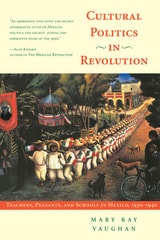
Cultural Politics in Revolution
Teachers, Peasants, and Schools in Mexico, 1930-1940Mary Kay Vaughan
University of Arizona Press, 1997
To show the significance of this facet of the Revolution, Mary Kay Vaughan analyzes the educational effort of the state during the 1930s, locating it within the broader sweep of Mexican history to illustrate how the government sought to nationalize and modernize rural society. Vaughan focuses on activities in rural schools, where central state policy makers, teachers, and people of the countryside came together to forge a national culture. She examines the cultural politics of schooling in four rural societies in the states of Sonora and Puebla that are representative of the peasant societies in revolutionary Mexico, and she shows how the state's program of socialist education became an arena for intense negotiations over power, culture, knowledge, rights, and gender practices. The real cultural revolution, Vaughan observes, lay not in the state's efforts at socialist education but in the dialogue between state and society that took place around this program. In the 1930s, rural communities carved out a space to preserve their local identities while the state succeeded in nurturing a multi-ethnic nationalism based on its promise of social justice and development.
Vaughan brings to her analysis a comparative understanding of peasant politics and educational history, extensive interviews, and a detailed examination of national, regional, and local archives to create an evocative and informative study of Mexican politics and society during modern Mexico's formative years. Cultural Politics in Revolution clearly shows that only by expanding the social arena in which culture was constructed and contested can we understand the Mexican Revolution's real achievements.
Cultural Residues
Chile In TransitionNelly Richard
University of Minnesota Press, 2004
A complex portrait of postdictatorial Chile by one of that country’s most incisive cultural critics, this book uses memoirs, photographs, the plastic arts, novels, and other texts—the “residues” of a culture—to analyze the political-cultural Chilean landscape in the wake of Augusto Pinochet’s seventeen-year military rule. Such residual areas reveal the flaws and lapses in Chile’s transition from violent military dictatorship to electoral democracy.
Nelly Richard's analysis ranges from an exploration of false memories of the recent past—especially memories of violence—to a discussion of the university under neoliberalism; from debates about the use of the word “gender” to an examination of refractory texts and cultural activities such as Diamela Eltit’s “testimonio” of a schizophrenic vagabond, Eugenio Dittborn’s use of photography in art installations, and transvestite performances. In Cultural Residues, each instance becomes a suggestive metaphor for understanding a rapidly modernizing Chile attempting to re-democratize its public life.
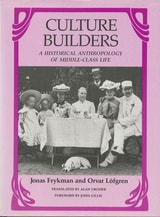
Culture Builders
A Historical Anthropology of Middle Class LifeFrykman, Jonas
Rutgers University Press, 1987
Culture Builders deals primarily with the ways in which ideas about the good and proper life are anchored in the trivialities and routines of everyday life: in the sharing of a meal, in holiday-making, and in the upbringing of children. The authors describe how the attitudes of the bourgeoisie toward. Time and time-keeping set them apart from the peasantry. Uses and perceptions of naturals increasingly divided the classes. For peasants, nature consisted of natural resources to be used. Fr the bourgeoisie, nature had only non-productive connotations. Another change was the growing importance of home over the community. Life became a romantic ideal, not an economic necessity. For the first time, parents became self-conscious about how to raise their children.
Frykman and Lögnen also show how the middle-class developed new perceptions of dirt, pollution, orderliness, health, sexuality, and bodily functions, and how they disdained the filth of peasant households. By stressing refinement, rationality, morality, and discipline, the middle classes were able to differentiate themselves not only from the peasants, but also from the degenerate aristocracy and the disordered and uncontolled emerging working class. The bourgeoisie viewed their own form of culture as the highest on the evolutionary ladder, and turned it into a national culture against which all other groups would be measured.
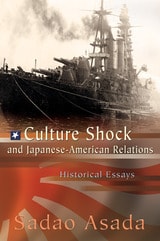
Culture Shock and Japanese-American Relations
Historical EssaysSadao Asada
University of Missouri Press, 2007
Ever since Commodore Perry sailed into Uraga Channel, relations between the United States and Japan have been characterized by culture shock. Now a distinguished Japanese historian critically analyzes contemporary thought, public opinion, and behavior in the two countries over the course of the twentieth century, offering a binational perspective on culture shock as it has affected their relations.
In these essays, Sadao Asada examines the historical interaction between these two countries from 1890 to 2006, focusing on naval strategy, transpacific racism, and the atomic bomb controversy. For each topic, he offers a rigorous analysis of both American and Japanese perceptions, showing how cultural relations and the interchange of ideas have been complex—and occasionally destructive.
Culture Shock and Japanese-American Relations contains insightful essays on the influence of Alfred Mahan on the Japanese navy and on American images of Japan during the 1920s. Other essays consider the progressive breakdown of relations between the two countries and the origins of the Pacific War from the viewpoint of the Japanese navy, then tackle the ultimate shock of the atomic bomb and Japan’s surrender, tracing changing perceptions of the decision to use the bomb on both sides of the Pacific over the course of sixty years. In discussing these subjects, Asada draws on Japanese sources largely inaccessible to Western scholars to provide a host of eye-opening insights for non-Japanese readers.
After studying in America for nine years and receiving degrees from both Carleton College and Yale University, Asada returned to Japan to face his own reverse culture shock. His insights raise important questions of why people on opposite sides of the Pacific see things differently and adapt their perceptions to different purposes. This book marks a major effort toward reconstructing and understanding the conflicted course of Japanese-American relations during the first half of the twentieth century.
Culture Wars and Enduring American Dilemmas
Irene Taviss Thomson
University of Michigan Press, 2010
"Irene Taviss Thomson gives us a nuanced portrait of American social politics that helps explain both why we are drawn to the idea of a 'culture war' and why that misrepresents what is actually going on."
---Rhys H. Williams, Professor and Chair, Department of Sociology, Loyola University Chicago
"An important work showing---beneath surface conflict---a deep consensus on a number of ideals by social elites."
---John H. Evans, Department of Sociology, University of California, San Diego
The idea of a culture war, or wars, has existed in America since the 1960s---an underlying ideological schism in our country that is responsible for the polarizing debates on everything from the separation of church and state, to abortion, to gay marriage, to affirmative action. Irene Taviss Thomson explores this notion by analyzing hundreds of articles addressing hot-button issues over two decades from four magazines: National Review, Time, The New Republic, and The Nation, as well as a wide array of other writings and statements from a substantial number of public intellectuals.
What Thomson finds might surprise you: based on her research, there is no single cultural divide or cultural source that can account for the positions that have been adopted. While issues such as religion, homosexuality, sexual conduct, and abortion have figured prominently in public discussion, in fact there is no single thread that unifies responses to each of these cultural dilemmas for any of the writers.
Irene Taviss Thomson is Professor Emeritus of Sociology, having taught in the Department of Social Sciences and History at Fairleigh Dickinson University for more than 30 years. Previously, she taught in the Department of Sociology at Harvard University.
Culture Wars in Brazil
The First Vargas Regime, 1930–1945Daryle Williams
Duke University Press, 2001
Williams draws on a rich selection of textual, pictorial, and architectural sources in his exploration of the dynamic nature of educational film and radio, historical preservation, museum management, painting, public architecture, and national delegations organized for international expositions during the unsettled era in which modern Brazil’s cultural canon took definitive form. In his close reading of the tensions surrounding official policies of cultural management, Williams both updates the research of the pioneer generation of North American Brazilianists, who examined the politics of state building during the Vargas era, and engages today’s generation of Brazilianists, who locate the construction of national identity of modern Brazil in the Vargas era.
By integrating Brazil into a growing body of literature on the cultural dimensions of nations and nationalism, Culture Wars in Brazil will be important reading for students and scholars of Latin American history, state formation, modernist art and architecture, and cultural studies.

Culture Wars
School and Society in the Conservative RestorationIra Shor
University of Chicago Press, 1992
"An outstanding work of educational theory and history."—John Coatsworth, University of Chicago
Culture across Borders
Mexican Immigration and Popular CultureEdited by David R. Maciel and María Herrera-Sobek
University of Arizona Press, 1998
Culture and Revolution
Violence, Memory, and the Making of Modern MexicoBy Horacio Legrás
University of Texas Press, 2017
In the twenty years of postrevolutionary rule in Mexico, the war remained fresh in the minds of those who participated in it, while the enigmas of the revolution remained obscured. Demonstrating how textuality helped to define the revolution, Culture and Revolution examines dozens of seemingly ahistorical artifacts to reveal the radical social shifts that emerged in the war’s aftermath.
Presented thematically, this expansive work explores radical changes that resulted from postrevolution culture, including new internal migrations; a collective imagining of the future; popular biographical narratives, such as that of the life of Frida Kahlo; and attempts to create a national history that united indigenous and creole elite society through literature and architecture. While cultural production in early twentieth-century Mexico has been well researched, a survey of the common roles and shared tasks within the various forms of expression has, until now, been unavailable. Examining a vast array of productions, including popular festivities, urban events, life stories, photographs, murals, literature, and scientific discourse (including fields as diverse as anthropology and philology), Horacio Legrás shows how these expressions absorbed the idiosyncratic traits of the revolutionary movement.
Tracing the formation of modern Mexico during the 1920s and 1930s, Legrás also demonstrates that the proliferation of artifacts—extending from poetry and film production to labor organization and political apparatuses—gave unprecedented visibility to previously marginalized populations, who ensured that no revolutionary faction would unilaterally shape Mexico’s historical process during these formative years.
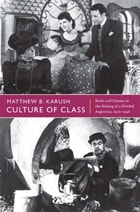
Culture of Class
Radio and Cinema in the Making of a Divided Argentina, 1920-1946Matthew B. Karush
Duke University Press, 2012
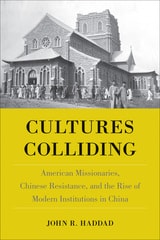
Cultures Colliding
American Missionaries, Chinese Resistance, and the Rise of Modern Institutions in ChinaJohn R. Haddad
Temple University Press, 2023
As incredible as it may seem, the American missionaries who journeyed to China in 1860 planning solely to spread the Gospel ultimately reinvented their entire enterprise. By 1900, they were modernizing China with schools, colleges, hospitals, museums, and even YMCA chapters. In Cultures Colliding, John R. Haddad nimbly recounts this transformative institution-building—how and why it happened—and its consequences.
When missionaries first traveled to rural towns atop mules, they confronted populations with entrenched systems of belief that embraced Confucius and rejected Christ. Conflict ensued as these Chinese viewed missionaries as unwanted disruptors. So how did this failing movement eventually change minds and win hearts? Many missionaries chose to innovate. They built hospitals and established educational institutions offering science and math. A second wave of missionaries opened YMCA chapters, coached sports, and taught college. Crucially, missionaries also started listening to Chinese citizens, who exerted surprising influence over the preaching, teaching, and caregiving, eventually running some organizations themselves. They embraced new American ideals while remaining thoroughly Chinese.
In Cultures Colliding, Haddad recounts the unexpected origins and rapid rise of American institutions in China by telling the stories of the Americans who established these institutions and the Chinese who changed them from within. Today, the impact of this untold history continues to resonate in China.
Cultures of Border Control
Schengen and the Evolution of European FrontiersRuben Zaiotti
University of Chicago Press, 2011
In recent years, a number of European countries abolished national border controls in favor of Europe’s external frontiers. In doing so, they challenged long-established conceptions of sovereignty, territoriality, and security in world affairs.
Setting forth a new analytic framework informed by constructivism and pragmatism, Ruben Zaiotti traces the transformation of underlying assumptions and cultural practices guiding European policymakers and postnational Europe, shedding light on current trends characterizing its politics and relations with others. The book also includes a fascinating comparison to developments in North America, where the United States has pursued more restrictive border control strategies since 9/11. As a broad survey of the origins, evolution, and implications of this remarkable development in European integration, Cultures of Border Control will be of interest to students and scholars of international relations and political geography.
Cultures of Modernism
Marianne Moore, Mina Loy, and Else Lasker-SchulerCristanne Miller
University of Michigan Press, 2005
Cultures of Modernism explores how the structure and location of literary communities significantly influence who writes, what they write about, and their openness to formal experimentation. These influences particularly affect women writers. Author Cristanne Miller notes striking patterns of similarity in the concerns and lives of women living in geographically distant centers of modernist production. She looks at three significant poets---the American Marianne Moore, the British expatriate Mina Loy, and the German Else Lasker-Schüler---in the context of cultural, national, and local elements to argue that location significantly affected their performances of subjectivity, gender, race, and religion. The first book of its kind, Cultures of Modernism breaks new ground while it contributes to the ongoing reconception of the modernist period.
"A fascinating, provocative, and genuinely original study of a 'different' modernism in poetry---namely, the Modernism of women poets."
---Marjorie Perloff, Stanford University
"An important and ambitious work that makes major contributions to the fields of gender studies and modernist studies, and to the study of modernist poetry."
---Robin Schulze, Pennsylvania State University
"Offers a welcome corrective to the unreflective critical tendency . . . to make broad claims about the historical experiences and cultural conundrums of 'women,' and particularly 'women writers.' Miller offers tour-de-force comparative readings . . . threading together the world-historical with the personal, poetics with the political, and wielding the instruments of scansion as deftly as a surgeon."
---Modernism/modernity, The Official Journal of the Modernist Studies Association
Cristanne Miller is Edward H. Butler Professor of English and Chair of the English Department at the University of Buffalo, State University of New York.
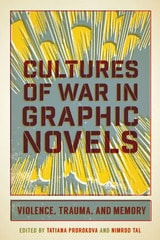
Cultures of War in Graphic Novels
Violence, Trauma, and MemoryProrokova, Tatiana
Rutgers University Press, 2018
Cultures of War in Graphic Novels examines the representation of small-scale and often less acknowledged conflicts from around the world and throughout history. The contributors look at an array of graphic novels about conflicts such as the Boxer Rebellion (1899-1901), the Irish struggle for national independence (1916-1998), the Falkland War (1982), the Bosnian War (1992-1995), the Rwandan genocide (1994), the Israel-Lebanon War (2006), and the War on Terror (2001-). The book explores the multi-layered relation between the graphic novel as a popular medium and war as a pivotal recurring experience in human history. The focus on largely overlooked small-scale conflicts contributes not only to advance our understanding of graphic novels about war and the cultural aspects of war as reflected in graphic novels, but also our sense of the early twenty-first century, in which popular media and limited conflicts have become closely interrelated.
Cultures of Yusin
South Korea in the 1970sYoungju Ryu, Editor
University of Michigan Press, 2018
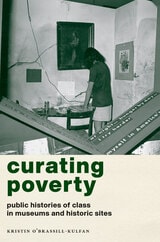
Curating Poverty
Public Histories of Class in Museums and Historic SitesKristin O'Brassill-Kulfan
University of Massachusetts Press, 2027
Asking how Americans’ fraught relationship with class has played out in public history
In 1966, a Smithsonian curator proposed recreating a “slum” dwelling inside the Museum of History and Technology, complete with rats in the walls, synthesized smells, and heat in summer and cold in winter. The public was not pleased. One editorialist called it “preserving a very insignificant aspect of civilization.” A Life magazine reporter worried that schoolchildren on field trips might find the exhibit’s horrors “pretty tame compared to their own homes.” The proposal was shelved. But the debate it ignited over whether poverty could or should be presented in museums cast a long shadow in US public history.
In Curating Poverty, Kristin O’Brassill-Kulfan examines how public historians have curated, preserved, and interpreted the experiences of people living in poverty—and how different publics have responded to these efforts. Poverty and economic inequality have shaped the lives of millions of Americans since the colonial period. For most of the nation’s history, welfare institutions such as almshouses and poor farms could be found in nearly every county in the United States. Yet explicit interpretation of poverty, welfare, and inequality remains an outlier in public history.
Documenting attempts to incorporate histories of poverty and class into exhibitions from the 1930s to the present, O’Brassill-Kulfan interrogates institutions of varying sizes and missions, paying particular attention to museums within the Smithsonian network. She traces how communities and public historians have remembered, neglected, erased, and sometimes reclaimed the surviving landscapes of poverty relief—from preserved almshouses and poor farm cemeteries to tenement museums and public housing sites. By placing poverty at the center of public history, Curating Poverty reveals how Americans have constructed, contested, and obscured histories of class and inequality and what it might look like to finally tell those stories honestly.

Curie
Sarah Dry
Haus Publishing, 2025
Marie Curie is most famous for her pioneering work in the field of radioactivity and for discovering two new elements, polonium and radium. Curie not only broke scientific barriers but defied the gender expectations of her time amidst a male-dominated scientific community.
This revised edition of Curie, with a new introduction from the author, debunks myths about Curie, rejecting the notion of her as cold and reserved and recasting her as the dynamic and lively woman she truly was. Sarah Dry illuminates Curie’s personal and professional struggles: the demands of motherhood, the public scrutiny she faced, the grief she suffered after the loss of her husband, and her exposure to radiation. Ultimately, Curie emerges as an astonishingly resilient figure whose contributions to science and courage during adversity make her an enduring example, and a woman whose powerful legacy continues to inspire today.
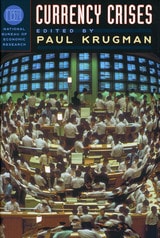
Currency Crises
Edited by Paul Krugman
University of Chicago Press, 2000
Reflecting the latest thinking on the subject, this offering from the NBER will serve as a useful basis for further debate on the theory and practice of speculative attacks, as well as a valuable resource as new crises loom.
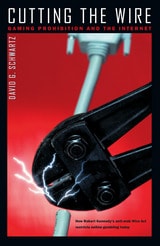
Cutting The Wire
Gaming Prohibition And The InternetDavid G. Schwartz
University of Nevada Press, 2005
The story of the Wire Act and how Robert Kennedy’s crusade against the Mob is creating a new generation of Internet gaming outlaws.
Gambling has been part of American life since long before the existence of the nation, but Americans have always been ambivalent about it. What David Schwartz calls the “pell-mell history of legal gaming in the United States” is a testament to our paradoxical desire both to gamble and to control gambling. It is in this context that Schwartz examines the history of the Wire Act, passed in 1961 as part of Attorney General Robert F. Kennedy’s crusade against organized crime and given new life in recent efforts to control Internet gambling. Cutting the Wire presents the story of how this law first developed, how it helped fight a war against organized crime, and how it is being used today. The Wire Act achieved new significance with the development of the Internet in the early 1990s and the growing popularity of online wagering through offshore facilities. The United States government has invoked the Wire Act in a vain effort to control gambling within its borders, at a time when online sports betting is soaring in popularity. By placing the Wire Act into the larger context of Americans’ continuing ambivalence about gambling, Schwartz has produced a provocative analysis of a national habit and the vexing predicaments that derive from it. In America today, 48 of 50 states currently permit some kind of legal gambling. Schwartz’s historical unraveling of the Wire Act exposes the illogic of an outdated law intended to stifle organized crime being used to set national policy on Internet gaming. Cutting the Wire carefully dissects two centuries of American attempts to balance public interest with the technology of gambling. Available in hardcover and paperback.
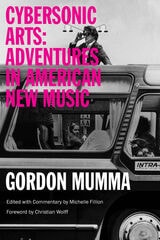
Cybersonic Arts
Adventures in American New MusicGodon Mumma, Edited by Michelle Fillion
University of Illinois Press, 2015
Musicologist Michelle Fillion curates a collection of Mumma's writings, presenting revised versions of his classic pieces as well as many unpublished works from every stage of his storied career. Here, through words and astonishing photos, is Mumma's chronicle of seminal events in the musical world of the twentieth century: his cofounding the Cooperative Studio for Electronic Music; his role in organizing the historic ONCE Festivals of Contemporary Music; performances with the Sonic Arts Union; and working alongside John Cage and David Tudor as a composer-musician with the Merce Cunningham Dance Company. In addition, Mumma describes his collaborations with composers, performers, dancers, and visual artists ranging from Robert Ashley and Pauline Oliveros to Marcel Duchamp and Robert Rauschenberg.
Candid and insightful, Cybersonic Arts is the eye-opening account of a broad artistic community by an active participant and observer.
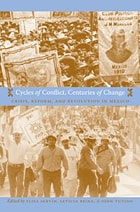
Cycles of Conflict, Centuries of Change
Crisis, Reform, and Revolution in MexicoElisa Servín, Leticia Reina, and John Tutino, eds.
Duke University Press, 2007
Leading Mexicanists—historians and social scientists from Mexico, the United States, and Europe—examine the three fin-de-siècle eras of crisis. They focus on the role of the country’s communities in advocating change from the eighteenth century to the present. They compare Mexico’s revolutions of 1810 and 1910 and consider whether there might be a twenty-first-century recurrence or whether a globalizing, urbanizing, and democratizing world has so changed Mexico that revolution is improbable. Reflecting on the political changes and social challenges of the late twentieth century, the contributors ask if a democratic transition is possible and, if so, whether it is sufficient to address twenty-first-century demands for participation and justice.
Contributors. Antonio Annino, Guillermo de la Peña, François-Xavier Guerra, Friedrich Katz, Alan Knight, Lorenzo Meyer, Leticia Reina, Enrique Semo, Elisa Servín, John Tutino, Eric Van Young

Czech Refugees in Cold War Canada
Jan Raska
University of Manitoba Press, 2018
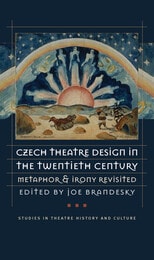
Czech Theatre Design in the Twentieth Century
Metaphor and Irony RevisitedJoe Brandesky
University of Iowa Press, 2007
Essays by Vera Ptacková, Dennis Christilles, Delbert Unruh, and, Marie Zdenková their full texts restored and reedited for this volume since their initial publication in exhibit catalogs, provide historical and linguistic insights into contemporary Czech scenography as well as comparisons to the major art movements affecting the designers. Brandesky’s informative introductory essay contextualizes the shifting tenets of Czech theatre design. Also included are biographies of the designers, a bibliography, and thirty black-and-white photographs.
The accompanying CD provides access to the vibrant and sophisticated images of the Czech theatrical world: 138 richly colorful paintings and drawings of costumes, models, and set designs and in situ photos of exhibited designs plus 27 color and black-and-white photos of the designers. The CD also includes the full text of the book with links to all the art and to the designers’ biographies. Book and CD together showcase the Czech Republic as a center of international stage design.

Czechoslovakia at the World’s Fairs
Behind the FaçadeMarta Filipová
Central European University Press, 2024
Established in 1918, as a new state the First Czechoslovak Republic was keen to project a distinct image. Participation in World Fairs offered the perfect opportunity-. In this comprehensive account of Czechoslovak participation in international exhibitions of the interwar period Marta Filipová looks beyond the sleek façade of the modernist pavilions to examine the intersections of architecture, art and design with commercial interests, state agendas, individual action and the public, offering a complex insight into the production and reception of national displays.
The rich collection of images – mainly photographs – provides a close look at the Czechoslovak pavilions. The design, content and context of the displays convey an idealized narrative that was created for the fairs and the myths on which the Czechoslovak nation and state were built. Heavy machinery, modern art, tourist destinations, and food and drink were presented as Czechoslovak, while many aspects of social life – particularly women or ethnic minorities – were strikingly underrepresented or absent. The book argues that the objects and ideas that the pavilion organizers put on display legitimized and validated the existence of the new state through the inclusion and exclusion of exhibits, people, and ideas.
While Marta Filipová primarily focuses on Czechoslovakia, she also offers insights into how other emerging nations projected and sustained their image during this historical period and how interwar world’s fairs accommodated them.
César Chávez, the Catholic Bishops, and the Farmworkers’ Struggle for Social Justice
Marco G. Prouty
University of Arizona Press, 2006