Results by title
775 books match the query 'Germany' and 55 start with c
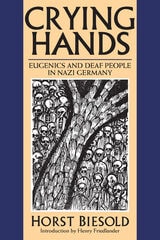
Crying Hands
Eugenics and Deaf People in Nazi GermanyHorst Biesold
Gallaudet University Press, 2003
When the Nazis assumed power in Germany in 1933, they wasted no time in implementing their radical policies, first by securing passage of the Law for the Prevention of Offspring with Hereditary Diseases. Among those designated by this law as “congenitally disabled” were deaf people. Horst Biesold’s newly translated book examines this neglected aspect of Nazi “racial hygiene” through interviews with more than 1,000 deaf survivors of this brutal law that authorized forced sterilizations, abortions, and eventually murder.
Crying Hands meticulously delineates the antecedents of Nazi eugenics, beginning with Social Darwinism (postulated in the mid-nineteenth century) and tracing the various sterilization laws later initiated throughout the world, including many passed and practiced in the United States. This exceptional scholarship is movingly paralleled by the human faces fixed to the numbing statistics, as in story after story those affected recount their irretrievable loss, pain, and misplaced shame imposed upon them by the Nazi regime. Through their stories, told to Biesold in German Sign Language, they have given voice to the countless others who died from the specious science practiced by the Third Reich. And now their own trials have finally been acknowledged.

Cultural Revolution in Berlin
Jews in the Age of EnlightenmentShmuel Feiner and Natalie Naimark-Goldberg
Bodleian Library Publishing, 2011

Culture Incorporated
Museums, Artists, And Corporate SponsorshipsMark W. Rectanus
University of Minnesota Press, 2002
An exposé of the hidden costs of corporate funding of the arts
Photographer Annie Leibowitz collaborates with American Express on a portrait exhibition. Absolut Vodka engages artists for their advertisements. Philip Morris mounts an "Arts Against Hunger" campaign in partnership with prominent museums. Is it art or PR, and where is the line that separates the artistic from the corporate? According to Mark Rectanus, that line has blurred. These mergers of art, business, and museums, he argues, are examples of the worldwide privatization of cultural funding.
In Culture Incorporated, Rectanus calls for full disclosure of corporate involvement in cultural events and examines how corporations, art institutions, and foundations are reshaping the cultural terrain. In turn, he also shows how that ground is destabilized by artists subverting these same institutions to create a heightened awareness of critical alternatives. Rectanus exposes how sponsorship helps maintain social legitimation in a time when corporations are the target of significant criticism. He provides wide-ranging examples of artists and institutions grappling with corporate sponsorship, including artists’s collaboration with sponsors, corporate sponsorship of museum exhibitions, festivals, and rock concerts, and cybersponsoring. Throughout, Rectanus analyzes the convergence of cultural institutions with global corporate politics and its influence on our culture and our communities.
Culture in the Anteroom
The Legacies of Siegfried KracauerEdited by Gerd Gemünden and Johannes von Moltke
University of Michigan Press, 2012
Culture in the Anteroom introduces an English-speaking readership to the full range of Siegfried Kracauer's work as novelist, architect, journalist, sociologist, historian, exile critic, and theorist of visual culture. This interdisciplinary anthology---including pieces from Miriam Bratu Hansen, Andreas Huyssen, Noah Isenberg, Lutz Koepnick, Eric Rentschler, and Heide Schlüpmann---brings together literary and film scholars, historians and art historians, sociologists, and architects to address the scope and current relevance of a body of work dedicated to investigating all aspects of modernism and modernity. The contributors approach Kracauer's writings from a variety of angles, some by placing them in dialogue with his contemporaries in Weimar Germany and the New York Intellectuals of the 1940s and '50s; others by exploring relatively unknown facets of Kracauer's oeuvre by considering his contributions to architectural history, the history of radio as well as other new media, and museum and exhibition culture.
Cultures of Modernism
Marianne Moore, Mina Loy, and Else Lasker-SchulerCristanne Miller
University of Michigan Press, 2005
Cultures of Modernism explores how the structure and location of literary communities significantly influence who writes, what they write about, and their openness to formal experimentation. These influences particularly affect women writers. Author Cristanne Miller notes striking patterns of similarity in the concerns and lives of women living in geographically distant centers of modernist production. She looks at three significant poets---the American Marianne Moore, the British expatriate Mina Loy, and the German Else Lasker-Schüler---in the context of cultural, national, and local elements to argue that location significantly affected their performances of subjectivity, gender, race, and religion. The first book of its kind, Cultures of Modernism breaks new ground while it contributes to the ongoing reconception of the modernist period.
"A fascinating, provocative, and genuinely original study of a 'different' modernism in poetry---namely, the Modernism of women poets."
---Marjorie Perloff, Stanford University
"An important and ambitious work that makes major contributions to the fields of gender studies and modernist studies, and to the study of modernist poetry."
---Robin Schulze, Pennsylvania State University
"Offers a welcome corrective to the unreflective critical tendency . . . to make broad claims about the historical experiences and cultural conundrums of 'women,' and particularly 'women writers.' Miller offers tour-de-force comparative readings . . . threading together the world-historical with the personal, poetics with the political, and wielding the instruments of scansion as deftly as a surgeon."
---Modernism/modernity, The Official Journal of the Modernist Studies Association
Cristanne Miller is Edward H. Butler Professor of English and Chair of the English Department at the University of Buffalo, State University of New York.