Results by title
936 books match the query 'LGBTQ+ Studies' and 57 start with c
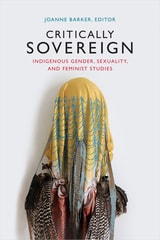
Critically Sovereign
Indigenous Gender, Sexuality, and Feminist StudiesJoanne Barker, editor
Duke University Press, 2017
Critically Sovereign traces the ways in which gender is inextricably a part of Indigenous politics and U.S. and Canadian imperialism and colonialism. The contributors show how gender, sexuality, and feminism work as co-productive forces of Native American and Indigenous sovereignty, self-determination, and epistemology. Several essays use a range of literary and legal texts to analyze the production of colonial space, the biopolitics of “Indianness,” and the collisions and collusions between queer theory and colonialism within Indigenous studies. Others address the U.S. government’s criminalization of traditional forms of Diné marriage and sexuality, the Iñupiat people's changing conceptions of masculinity as they embrace the processes of globalization, Hawai‘i’s same-sex marriage bill, and stories of Indigenous women falling in love with non-human beings such as animals, plants, and stars. Following the politics of gender, sexuality, and feminism across these diverse historical and cultural contexts, the contributors question and reframe the thinking about Indigenous knowledge, nationhood, citizenship, history, identity, belonging, and the possibilities for a decolonial future.
Contributors. Jodi A. Byrd, Joanne Barker, Jennifer Nez Denetdale, Mishuana Goeman, J. Kēhaulani Kauanui, Melissa K. Nelson, Jessica Bissett Perea, Mark Rifkin
Contributors. Jodi A. Byrd, Joanne Barker, Jennifer Nez Denetdale, Mishuana Goeman, J. Kēhaulani Kauanui, Melissa K. Nelson, Jessica Bissett Perea, Mark Rifkin
[more]
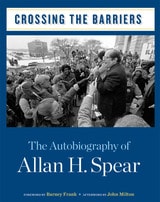
Crossing the Barriers
The Autobiography of Allan H. SpearAllan H. Spear
University of Minnesota Press, 2010
Allan Spear had a long and distinguished career as a historian and as a Minnesota state senator. Perhaps best known for coming out as openly gay during his first term in the Minnesota Senate-becoming one of the first elected officials in the nation to do so-Spear was also a leader of Eugene McCarthy's run for the presidency, an organizer against the war in Vietnam, and a key proponent for the establishment of the African-American studies department at the University of Minnesota.
Spear's memoirs are fascinating and moving: in early chapters on his childhood and college years, he writes with great introspection about his growing self-awareness of being gay. Later he writes about his development as an intellectual, particularly as a white man fighting to win legitimacy for the study of African-American history and culture. During his time at the University of Minnesota, Spear became deeply involved with the Minnesota Democratic-Farmer-Labor Party (DFL) and the antiwar movement. At the same time, Spear became increasingly active in the emerging gay rights movement and began the process of coming out to his friends and colleagues.
After a failed run for the Minnesota House in 1968, Spear was elected to the Minnesota Senate in 1972 and served as Senate president from 1993-2000. In 1993, he was instrumental in the passage of the Minnesota Human Rights Act, which protected LGBT people from discrimination in housing, education, and employment-an achievement he considered one of the finest of his career. A skilled parliamentarian, he remained a progressive leader in the legislature until his retirement in 2000.
Spear passed away on October 11, 2008, leaving his memoir slightly incomplete. A stirring afterword by John Milton completes the story of Spear's life, chronicling the recognition of his accomplishments as a politician and activist during his final years.
[more]
Crossings
Creative Ecologies of CruisingJoão Florêncio
Rutgers University Press, 2025
It’s difficult to pinpoint the origins of cruising. While the term was used by men seeking casual encounters with other men in the parks and streets of New York City as early as the 1920s, historical records show the practice is much older. Cruising has existed for as long as anyone outside the dominant sex and gender systems has sought sexual encounters outside of sanctioned norms. This book offers a serious exploration of queer sex and sex cultures, exploring cruising as a mode of thinking with the body and communicating through sexuality.
A creative dialogue between a queer artist and a queer academic reminiscing about and thinking with their cruising experiences, Crossings takes queer sex practices and cultures seriously as ways of knowing and world-making. The result is an erotic hybrid form hovering between scholarship and avant-garde experimentation, between critical manifesto and sex memoir. Here, the voices of each author, merged together in one, invite the reader to inhabit the erotic spacetime between self and other, the familiar and the strange, desire and pleasure, climax and release. That is, the spaces and temporalities of cruising itself.
A creative dialogue between a queer artist and a queer academic reminiscing about and thinking with their cruising experiences, Crossings takes queer sex practices and cultures seriously as ways of knowing and world-making. The result is an erotic hybrid form hovering between scholarship and avant-garde experimentation, between critical manifesto and sex memoir. Here, the voices of each author, merged together in one, invite the reader to inhabit the erotic spacetime between self and other, the familiar and the strange, desire and pleasure, climax and release. That is, the spaces and temporalities of cruising itself.
[more]
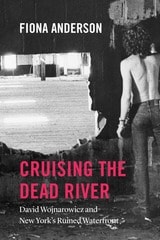
Cruising the Dead River
David Wojnarowicz and New York's Ruined WaterfrontFiona Anderson
University of Chicago Press, 2019
In the 1970s, Manhattan’s west side waterfront was a forgotten zone of abandoned warehouses and piers. Though many saw only blight, the derelict neighborhood was alive with queer people forging new intimacies through cruising. Alongside the piers’ sexual and social worlds, artists produced work attesting to the radical transformations taking place in New York. Artist and writer David Wojnarowicz was right in the heart of it, documenting his experiences in journal entries, poems, photographs, films, and large-scale, site-specific projects. In Cruising the Dead River, Fiona Anderson draws on Wojnarowicz’s work to explore the key role the abandoned landscape played in this explosion of queer culture. Anderson examines how the riverfront’s ruined buildings assumed a powerful erotic role and gave the area a distinct identity. By telling the story of the piers as gentrification swept New York and before the AIDS crisis, Anderson unearths the buried histories of violence, regeneration, and LGBTQ activism that developed in and around the cruising scene.
[more]
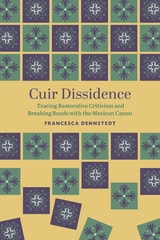
Cuir Dissidence
Tracing Restorative Criticism and Breaking Bonds with the Mexican CanonFrancesca Dennstedt
Vanderbilt University Press, 2025
In Cuir Dissidence, Francesca Dennstedt uses affect and queer feminist theory to rethink the boundaries and hierarchies of the Mexican literary canon. Steeped in ideas of male genius and intrinsic aesthetic quality, the canon has long marginalized women writers by overlooking their contributions or placing their work into literary categories that perpetuate stereotypes about femininity. In response to this history of erasure and neglect, Dennstedt shows how women writers who identify as non-heterosexual or whose work is focused on critique of heteropatriarchal power structures have challenged the very idea of the canon through affect and non-conformity. Over the course of four chapters, she examines how writers like Inés Arredondo, Rosa Maria Roffiel, and Cristina Rivera Garza employ alternative sexual intimacies, gender dissidence, collective authorship, and experimental blending of genres to actively reject the canon. In addition to these creative readings of Mexican women writers, Dennstedt centers her own affective response to these texts to further challenge the traditional boundaries of literary criticism. The book thus prompts readers to see the intellectual project of these writers as a premeditated act of rebellion, one that can help deconstruct the power structures deeply ingrained in Mexican literature written in Spanish and create a space for these voices to flourish across time.
[more]

Cultural Erotics in Cuban America
Ricardo L. Ortíz
University of Minnesota Press, 2006
Miami is widely considered the center of Cuban-American culture. However vital to the diasporic communities’ identity, Miami is not the only—or necessarily the most profound—site of cultural production. Looking beyond South Florida, Ricardo L. Ortíz addresses the question of Cuban-American diaspora and cultural identity by exploring the histories and self-sustaining practices of smaller communities in such U.S. cities as Los Angeles, Chicago, and New York.
In this wide-ranging work Ortíz argues for the authentically diasporic quality of postrevolutionary, off-island Cuban experience. Highlighting various forms of cultural expression, Cultural Erotics in Cuban America traces underrepresented communities’ responses to the threat of cultural disappearance in an overwhelming and hegemonic U.S. culture. Ortíz shows how the work of Cuban-American writers and artists challenges the heteronormativity of both home and host culture. Focusing on artists who have had an ambivalent, indirect, or nonexistent connection to Miami, he presents close readings of such novelists as Reinaldo Arenas, Roberto G. Fernández, Achy Obejas, and Cristina García, the playwright Eduardo Machado, the poet Rafael Campo, and musical performers Albita Rodríguez and Celia Cruz.
Ortíz charts the legacies of sexism and homophobia in patriarchal Cuban culture, as well as their influence on Cuban-revolutionary and Cuban-exile ideologies. Moving beyond the outdated cultural terms of the Cold War, he looks forward to envision queer futures for Cuban-American culture free from the ties to restrictive—indeed, oppressive—constructions of nation, place, language, and desire.
Ricardo L. Ortíz is associate professor of English at Georgetown University.
[more]
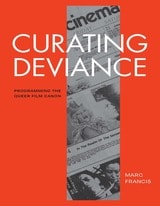
Curating Deviance
Programming the Queer Film CanonMarc Francis
Duke University Press, 2026
In Curating Deviance, Marc Francis scavenges film history for signs of vibrant, wayward life in the film programming of US art house and repertory cinemas between 1968 and 1989. Francis examines how creative and savvy programmers screened films by the likes of John Waters, Pier Paolo Pasolini, Russ Meyer, Rainer Werner Fassbinder, and a bevy of others in major cities across the United States, forming intertextual constellations in their repertory calendars. These programs allied a dizzying range of sexual and gendered outlaws, including stigmatized practices often overlooked by LGBT-focused queer theory. Curating Deviance reveals how repertory and art cinemas built a coalition of outcasts stigmatized for their taboo desires or identities, rekindling queer utopian imaginaries.
[more]