Results by title
2817 books match the query 'Nature' and 144 start with c

Christmas Trees for Pleasure and Profit
Third EditionChapman, Arthur
Rutgers University Press, 1985
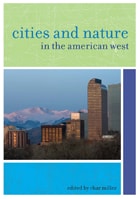
Cities and Nature in the American West
Char Miller
University of Nevada Press, 2010
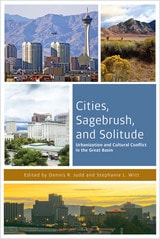
Cities, Sagebrush, and Solitude
Urbanization and Cultural Conflict in the Great BasinDennis R. Judd
University of Nevada Press, 2015
The blooming of cities in a fragile desert region poses a host of environmental challenges. The policies required to manage their impact, however, often collide with an entrenched political culture that has long resisted cooperative or governmental effort. The alchemical mixture of three ingredients--cities, aridity, and a libertarian political outlook--makes the Great Basin a compelling place to study. This book addresses a pressing question: are large cities ultimately sustainable in such a fragile environment?
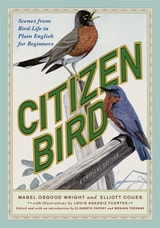
Citizen Bird
Scenes from Bird-Life in Plain English for Beginners, A Critical EditionMabel Osgood Wright
Rutgers University Press, 2025
Born of a collaboration between naturalist Mabel Osgood Wright, ornithologist Elliott Coues, and bird artist Louis Agassiz Fuertes, the book is vital to the history of birding and the broader study of nineteenth-century American culture and literature. This new edition of Citizen Bird preserves the original book’s 111 drawings and adds explanatory footnotes, supplemental historical material, and a new introduction. More than a century and a quarter after its original publication, Elizabeth Cherry and Meghan Freeman contextualize the book in the tradition and history of birding and discuss the roles of its authors and illustrator in birding history. A landmark text in the history of American conservationism, Citizen Bird is a timeless classic that will bring joy to birdwatchers of all ages.
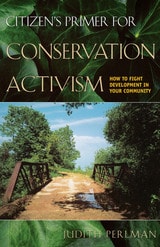
Citizen's Primer for Conservation Activism
How to Fight Development in Your CommunityBy Judith Perlman
University of Texas Press, 2004
Is there anything you can do when development threatens your local forest, beach, prairie, or wetland? Yes, there is. Across America, citizen activists are fighting and winning battles against unwanted development in their own communities. To help you resist the urban sprawl and absentee landowners that can wreck small towns and cities alike, this book is a practical, hands-on guide for building a grassroots campaign to defeat undesirable development.
Written by a successful activist, Citizen's Primer for Conservation Activism takes you through all the steps necessary to stop unplanned development in your community:
- Identifying the issues at stake
- Getting involved and developing leadership
- Devising a strategy
- Hiring and working with legal counsel
- Building coalitions and partnerships
- Influencing local government
- Conducting a media campaign
- Raising money
- Countering developer tactics
- Managing the whole process
With the proven strategies in this easy-to-access book, you can quickly gear up to challenge unwanted development and preserve the character of your local community.
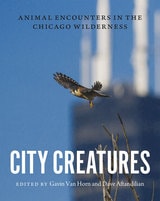
City Creatures
Animal Encounters in the Chicago WildernessEdited by Gavin Van Horn and Dave Aftandilian
University of Chicago Press, 2015
We usually think of cities as the domain of humans—but we are just one of thousands of species that call the urban landscape home. Chicago residents knowingly move among familiar creatures like squirrels, pigeons, and dogs, but might be surprised to learn about all the leafhoppers and water bears, black-crowned night herons and bison, beavers and massasauga rattlesnakes that are living alongside them. City Creatures introduces readers to an astonishing diversity of urban wildlife with a unique and accessible mix of essays, poetry, paintings, and photographs.
The contributors bring a story-based approach to this urban safari, taking readers on birding expeditions to the Magic Hedge at Montrose Harbor on the North Side, canoe trips down the South Fork of the Chicago River (better known as Bubbly Creek), and insect-collecting forays or restoration work days in the suburban forest preserves.
The book is organized into six sections, each highlighting one type of place in which people might encounter animals in the city and suburbs. For example, schoolyard chickens and warrior wasps populate “Backyard Diversity,” live giraffes loom at the zoo and taxidermy-in-progress pheasants fascinate museum-goers in “Animals on Display,” and a chorus of deep-freeze frogs awaits in “Water Worlds.” Although the book is rooted in Chicago’s landscape, nature lovers from cities around the globe will find a wealth of urban animal encounters that will open their senses to a new world that has been there all along. Its powerful combination of insightful narratives, numinous poetry, and full-color art throughout will help readers see the city—and the creatures who share it with us—in an entirely new light.
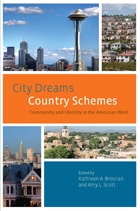
City Dreams, Country Schemes
Community and Identity in the American WestKathleen A. Brosnan
University of Nevada Press, 2011
The American West, from the beginning of Euro-American settlement, has been shaped by diverse ideas about how to utilize physical space and natural environments to create cohesive, sometimes exclusive community identities. When westerners developed their towns, they constructed spaces and cultural identities that reflected alternative understandings of modern urbanity. The essays in City Dreams, Country Schemes utilize an interdisciplinary approach to explore the ways that westerners conceptualized, built, and inhabited urban, suburban, and exurban spaces in the twentieth century.
The contributors examine such topics as the attractions of open space and rural gentrification in shaping urban development; the role of tourism in developing national parks, historical sites, and California's Napa Valley; and the roles of public art, gender, and ethnicity in shaping urban centers. City Dreams, Country Schemes reveals the values and expectations that have shaped the West and the lives of the people who inhabit it.
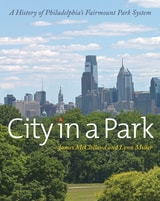
City in a Park
A History of Philadelphia's Fairmount Park SystemLynn Miller
Temple University Press, 2015
Fairmount Park is the municipal park system of Philadelphia, Pennsylvania. It consists of more than one hundred parks, squares, and green spaces totaling about 11,000 acres, and is one of the largest landscaped urban park systems in the world. In City in a Park, James McClelland and Lynn Miller provide an affectionate and comprehensive history of this 200-year-old network of parks.
Originated in the nineteenth century as a civic effort to provide a clean water supply to Philadelphia, Fairmount Park also furnished public pleasure grounds for boat races and hiking, among other activities. Millions travel to the city to view its eighteenth-century villas, attend boat races on the Schuylkill River, hike the Wissahickon Creek, visit the Philadelphia Zoo, hear concerts in summer, stroll the city’s historic squares and the Benjamin Franklin Parkway, and enjoy its enormous collection of public art. Green initiatives flower today; Philadelphia lives amidst its parks.
Filled with nearly 150 gorgeous full-color photographs, City in a Park chronicles the continuing efforts to create what founder William Penn desired: a “greene countrie town.”
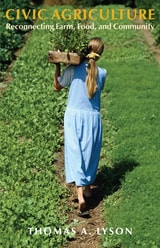
Civic Agriculture
Reconnecting Farm, Food, and CommunityThomas A. Lyson
University Press of New England, 2004
Civilizing Natures
Race, Resources, and Modernity in Colonial South IndiaPhilip, Kavita
Rutgers University Press, 2003
Science was a central pillar of colonialism, but the converse holds true as well: colonialism profoundly shaped the character of nineteenth-century science. Civilizing Natures unravels unexpected relationships between science, technology, and administrative systems in colonial India from the 1850s to the 1930s, deepening our perspective on continuing conflicts over race, resources, and empire.
Botanists, anthropologists, and foresters had their most important sources of data—nature and natives—located at colonial sites. In the hilly, forested regions of Madras Presidency, tribal populations were studied by ethnographers, managed by revenue officials, recruited by plantation contractors, and modernized by missionaries. Racial constructions of nature and modernity helped criminalize and domesticate unruly natives. This is a story about the construction of nature in southern India that is deeply local and irreducibly global.
Through detailed case studies, Kavita Philip shows how race and nature are fundamental to understanding colonial modernities. Through its insightful combination of methodologies from both the humanities and the social sciences, Civilizing Natures complicates our understandings of the relationships between science and religion, pre-modern and civilized, environment and society.
Clean Air and Good Jobs
U.S. Labor and the Struggle for Climate JusticeTodd E. Vachon
Temple University Press, 2023
The labor–climate movement in the U.S. laid the groundwork for the Green New Deal by building a base within labor for supporting climate protection as a vehicle for good jobs. But as we confront the climate crisis and seek environmental justice, a “jobs vs. environment” discourse often pits workers against climate activists. How can we make a “just transition” moving away from fossil fuels, while also compensating for the human cost when jobs are lost or displaced?
In his timely book, Clean Air and Good Jobs, Todd Vachon examines the labor–climate movement and demonstrates what can be envisioned and accomplished when climate justice is on labor’s agenda and unions work together with other social movements to formulate bold solutions to the climate crisis. Vachon profiles the workers and union leaders who have been waging a slow, but steadily growing revolution within their unions to make labor as a whole an active and progressive champion for both workers and the environment.
Clean Air and Good Jobs examines the “movement within the movement” offering useful solutions to the dual crises of climate and inequality.
Clear Creek
Toward a Natural PhilosophyErik Reece
West Virginia University Press, 2023
A critic once wrote that Rebecca West’s Black Lamb and Grey Falcon was about two things: Yugoslavia and everything else. Something similar might be said about Clear Creek. In this boundary-defying work, Erik Reece spends a year beside the stream in his rural Kentucky homeplace, tracking the movements of the seasons, the animals, and the thoughts passing through his mind.
Clear Creek is a series of vignettes that calls us out of our frenzied, digitized world to a slower, more contemplative way of being. Reece’s subjects range from solitude and solidarity to the intricacies of forest communities, and from the genius of songwriter Tom T. Hall to reforestation projects on abandoned strip mines. A work of close observation and carefully grounded insights, Clear Creek articulates a nature-based philosophy for pondering humanity’s current plight.
Clear-Cutting Eden
Ecology and the Pastoral in Southern LiteratureChristopher Rieger
University of Alabama Press, 2009
Examines how Southern literary depictions of the natural world were influenced by the historical, social, and ecological changes of the 1930s and 1940s
Rieger studies the ways that nature is conceived of and portrayed by four prominent Southern writers of the era: Erskine Caldwell, Marjorie Kinnan Rawlings, Zora Neale Hurston, and William Faulkner. Specifically, he argues that these writers created new versions of an old literary mode—the pastoral—in response to the destabilizing effects of the Great Depression, the rise of Southern modernism, and the mechanization of agricultural jobs.
Mass deforestation, soil erosion, urban development, and depleted soil fertility are issues that come to the fore in the works of these writers. In response, each author depicts a network model of nature, where humans are part of the natural world, rather than separate, over, or above it, as in the garden pastorals of the Old South, thus significantly revising the pastoral mode proffered by antebellum and Reconstruction-era writers.
Each writer, Rieger finds, infuses the pastoral mode with continuing relevance, creating new versions that fit his or her ideological positions on issues of race, class, and gender. Despite the ways these authors represent nature and humankind’s place in it, they all illustrate the idea that the natural environment is more than just a passive background against which the substance of life, or fiction, is played out.
Clearing the Coastline
The Nineteenth-Century Ecological & Cultural Transformations of Cape CodMatthew McKenzie
University Press of New England, 2011
Climate Change Fiction and Ecocultural Crisis
The Industrial Revolution to the PresentTatiana Konrad
University of Nevada Press, 2024
Focusing on a diverse range of issues, including fossil fuels, cheap energy, the intricacies of human–more-than-human relationships, and postcolonial geographies, Konrad illustrates how cli-fi transcends mere storytelling. The genre ultimately emerges as an important means to forecast, imagine, and contemplate climatic events.
The book invites a broadening of the environmental humanities discourse, asking readers not only to deepen their understanding of the current climate crisis, but also to consider how cli-fi culture can be viewed as an effective method to address climate change.

Climate Change and the Production of Knowledge
Ian Baucom and Matthew Omelsky, special issue editors
Duke University Press, 2017
Contributors. Ian Baucom, Rosi Braidotti, David Buckland, Matthew Burtner, Noel Castree, Dipesh Chakrabarty, Tom Cohen, Claire Colebrook, Olivia Gray, Willis Jenkins, Catherine Malabou, Matthew Omelsky, Michael Segal, Bently Spang, Gary Tomlinson, Astrid Ulloa, Lucy Wood
Climate Change
The Point of No ReturnMojib Latif
Haus Publishing, 2009
Climate Freedoms
Julie Sze
University of Minnesota Press, 2027
A bold reimagining of climate justice as a collective struggle for freedom, grounded in hope, resistance, and transformative change
In Climate Freedoms, Julie Sze reframes climate justice as a freedom movement, offering a new lens on one of the defining crises of our time. Rather than treating despair as inevitable, Sze argues that denial is a prison and despair sustains the status quo, reinforcing systems built on domination and extraction. Alternatively, climate justice movements can advance a positive vision of collective freedom—one rooted in care, reciprocity, and the possibility of livable worlds.
Centering the perspectives of those most impacted and least responsible for climate disasters, Sze engages climate reparations and traces the connections between climate justice and abolitionist, decolonial, Indigenous, feminist, and Black radical traditions. By analyzing movement stories sparked by climate change–induced disasters specifically affecting frontline communities in the Caribbean, Small Island States in the Pacific, Southeast Asia, and Indigenous communities across the United States, Sze explores how environmental harm is inseparable from colonialism and racial capitalism. These community-based movements challenge narrow, individualist notions of freedom, emphasizing shared responsibility and interconnected futures across local and global scales.
Sze develops three interrelated freedoms: the epistemic freedom to recognize injustice, the imaginative freedom to envision alternatives, and the transformative freedom to create change. These freedoms illuminate how climate justice movements cultivate resistance, survivance, and collective continuance in the face of crisis. The result is a form of grounded hope: clear-eyed about ongoing harm, yet committed to building life-affirming futures.
Retail e-book files for this title are screen-reader friendly.
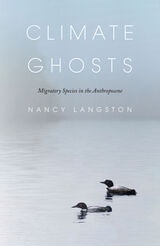
Climate Ghosts
Migratory Species in the AnthropoceneNancy Langston
Brandeis University Press, 2021
Environmental historian Nancy Langston explores three “ghost species” in the Great Lakes watershed—woodland caribou, common loons, and lake sturgeon. Ghost species are those that have not gone completely extinct, although they may be extirpated from a particular area. Their traces are still present, whether in DNA, in small fragmented populations, in lone individuals roaming a desolate landscape in search of a mate. We can still restore them if we make the hard choices necessary for them to survive. In this meticulously researched book, Langston delves into how climate change and human impact affected these now ghost species. Climate Ghosts covers one of the key issues of our time.
Climate Lyricism
Min Hyoung Song
Duke University Press, 2022
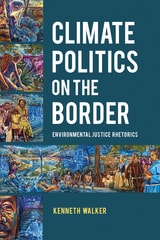
Climate Politics on the Border
Environmental Justice RhetoricsKenneth Walker
University of Alabama Press, 2022
Explores the ways climate change and extreme weather are negotiated politically in a border community
As a borderland city with generations of slow violence and extreme weather events like flash flooding and intense heat waves, San Antonio, Texas, speaks directly to global issues in climate politics. In Climate Politics on the Border: Environmental Justice Rhetorics, Kenneth Walker takes a place-based approach to his study of San Antonio to explore how extreme weather events and responses to them shape local places, publics, and politics, with an eye toward a future characterized by severe climate breakdown.
Attending to the local histories and micropolitics of San Antonio, Walker examines the effects of extreme weather events as they are experienced across radically inequitable social categories. These local histories serve as a guide, not just for future climates, which stand to be unprecedented, but for the necessary public and political responses to them. He shows how extreme weather events in the past have reinforced colonial social orders that weaken democratic goals of pluralism and equity. Conversely, he also shows how diverse coalitions have resisted and responded to these forces.
Walker examines the ethics of Latinx and Anglo relations within state-sponsored productions of racial inequity and environmental degradation, the coalitional capacities of environmental activists and second-wave Chicana/o organizations to protect clean water and transform local political representation, the obligations of place-keeping in Latinx urban design and ecological restoration, and the need to foster pluriversal worlds in city-level climate action and adaptation plans. Collectively these chapters rethink tropes of adaptation, resilience, and coalition as rhetorical and ecological capacities for public and political responses to extractivism.
Based on years of archival work and fieldwork, Climate Politics on the Border demonstrates vividly why ecological and anticolonial approaches to rhetoric are essential for grappling with climate politics. Overall, this is a timely study of how environmental degradation, pollution, and climate change are disputed and negotiated at the local political level in a borderland community.
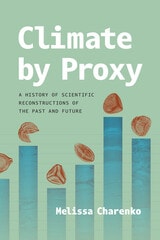
Climate by Proxy
A History of Scientific Reconstructions of the Past and FutureMelissa Charenko
University of Chicago Press, 2025
Unlike our daily reckoning with the weather, our experience of climate must be mediated through methods that measure the ebb and flow of climate, such as computer models, instruments like thermometers, and organic and inorganic remains known as “proxies.” Climate by Proxy by Melissa Charenko explores how scientists read the record of past climates and how their readings have engendered particular understandings of climate. Charenko focuses on the twentieth century, a period when scientists in Europe and North America began to believe that climate had a dynamic history worth studying. Scientists in this period developed several techniques to infer past climate from fossil pollen, tree rings, pieces of vegetation, and other organic remains imprinted upon by former climates. Climate by Proxy examines how these techniques helped shape notions of climate itself.
Charenko also shows how these varied interpretations of climate played an outsized role in explanations of human history and destiny. Geologists, botanists, ecologists, and other scientists interested in climate over long timescales routinely discussed how climate influenced plants, animals, and, notably, people. By following the scientists who reconstructed climate using natural archives, Climate by Proxy demonstrates how material objects worked with scientists’ perceptions of human groups to compel, constrain, and reinforce their understandings of climate, history, and the future.

Climate of Alaska
Martha Shulski and Gerd Wendler
University of Alaska Press, 2007
Replete with striking photos, maps, and charts, The Climate of Alaska presents a detailed picture of what to expect in this state of climate extremes. From the 40-below temperatures of the Interior to the twenty-four hours of daylight in a northern summer, Alaska’s climate presents challenges to its inhabitants on a daily basis. Readers will find accessible descriptions of temperature, humidity, precipitation, and climate change that will enrich a visit to the state and provide insight on the living conditions of this fascinating place.
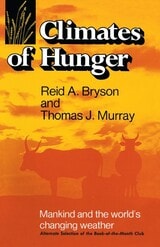
Climates of Hunger
Mankind and the World's Changing WeatherReid A. Bryson
University of Wisconsin Press, 1979
In recent years, world climate changes have drawn more attention than at any other time in history. What we once called "crazy weather," just a few years ago, is now beginning to be seen as a part of a logical and, in part, predictable pattern, an awesome natural force that we must deal with if man is to avoid disaster of unprecedented proportions.
Climates of Hunger is a book of paramount importance for our time. It will be essential reading not only for professionals in the field—including agricultural meteorologists, political scientists, geographers, sociologists, and business counselors—but for all who are concerned in any way with environmental trends, world and domestic food supplies, and their effects on human institutions.
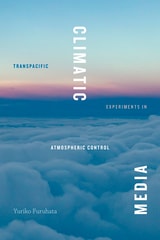
Climatic Media
Transpacific Experiments in Atmospheric ControlYuriko Furuhata
Duke University Press, 2022

Climber’s Guide to Devil’s Lake
Sven Olof Swartling
University of Wisconsin Press, 2008
•a summary of the geologic and natural history of the Baraboo hills by Patricia K. Armstrong
•locations and updated descriptions of nearly 1,800 climbs
•landmark photographs from most major climbing areas
•GPS waypoints, map coordinates, altimeter readings, and approach information
•detailed diagrams locating climbing routes at most major climbing areas
•6 new diagrams, 5 new climbing areas, and 120 new routes
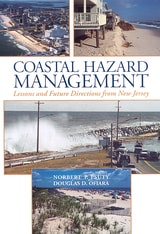
Coastal Hazard Management
Lessons and Future Directions from New JerseyPsuty, Norbert P.
Rutgers University Press, 2002
As with most shorelines around the world, New Jersey beaches are slowly, but inexorably, being eroded, threatening coastal structures and development. In some years more sand is deposited than removed, but all of the state’s monitoring devices show that sea level is gradually rising and pushing the New Jersey shoreline inland. The shore is a valuable resource, and its natural, cultural, and economic attractions draw a multitude of permanent and temporary residents each year, extending housing and commercial development onto areas that were once swampland. Not surprisingly, development at the water’s edge has been accompanied by an increasing exposure to the natural hazards of the coastal zone--erosion, flooding, and wind damage.
In this book, Norbert Psuty and Douglas Ofiara incorporate perspectives from the areas of coastal sciences, economics, public policy, and land-use planning in creating a systematic plan for coastal management and protection. It has been more than a decade since New Jersey developed the nation’s first state shore protection plan, and this volume provides a timely evaluation of its achievements and future challenges. This self-contained book provides all of the relevant theories, models, and examples so the reader will not need to refer to any other literature to gain an understanding of the issues and policies surrounding shore protection. It is the authoritative handbook for practitioners and policy makers in many fields, including coastal science and management and engineering, as well as public policy and economics.
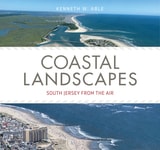
Coastal Landscapes
South Jersey from the AirKenneth W. Able
Rutgers University Press, 2023
Based on numerous aerial images from helicopter and drone flights between 2015 and 2021, this book provides extensive photographs and maps of the New Jersey coast, from the Pine Barrens to the ocean beaches. The text associated with each exceptional image describes it in detail, including its location, ecological setting, and relative position within the larger landscape. Author Kenneth Able, director of the Rutgers University Marine Field Station for over thirty years, has thoroughly ground-truthed each image by observations made through kayaks, boats, and wading through marshes. Calling upon his decades of expertise, Able paints a compelling portrait of coastal New Jersey’s stunning natural features, resources, history, and possible futures in an era of rising sea levels.
Coastal Lives
Nature, Capital, and the Struggle for Artisanal Fisheries in PeruMaximilian Viatori and Héctor Bombiella
University of Arizona Press, 2019
In Coastal Lives, Maximilian Viatori and Héctor Bombiella argue that this has not made Peru’s fisheries more sustainable. Through a fine-grained ethnographic and historical account of Lima’s fisheries, the authors reveal that new government regimes of entrepreneurial agency have placed overwhelming burdens on the city’s impoverished artisanal fishers to demonstrate that they are responsible producers and have created failures that can be used to justify closing these fishers’ traditional use areas and to deny their historically sanctioned rights. The result is a critical examination of how neoliberalized visions of nature and individual responsibility work to normalize the dispossessions that have enabled ongoing capital accumulation at the cost of growing social dislocations and ecological degradation.
The authors’ innovative approach to the politics of constructing and degrading coastal lives will interest a wide range of scholars in cultural anthropology, environmental humanities, and Latin American studies, as well as policymakers and anyone concerned with inequality, global food systems, and multispecies ecologies.

Coastal Marshes
Ecology and Wildlife ManagementRobert H. Chabreck
University of Minnesota Press, 1988
Coastal Marshes was first published in 1988. Minnesota Archive Editions uses digital technology to make long-unavailable books once again accessible, and are published unaltered from the original University of Minnesota Press editions.
The coastal regions of the United States form a highly diversified environment. In addition to sandy beaches and rocky shorelines, there are lagoons, rivers, estuaries, and marshes. The last are a dominant features of many coastal areas and serve as a transition between sea and uplands. Coastal marshes have been a zone for human development, attractive to industrial and residential building because they provide water frontage. But the public is becoming aware of the great value of these wetlands to fisheries and wildlife and to the local economy that depends on them.
This book describes coastal marshes in terms of form, function, ecology, wildlife value, and management. Robert H. Chabreck's emphasis is on the marshes of the northern coast of the Gulf of Mexico (there are 5,500 square miles of marshland in Louisiana alone), but he also deals with marshes on the Atlantic and Pacific coasts. Plant and animal communities are each given a chapter, and the book concludes with considerations of future uses and needs. The author provides references, a glossary, and a list of scientific names, along with numerous illustrations, including a section of color photographs.
For thirty years, Robert H. Chabreck has been engaged in research and management of coastal marshes and has often served as a consultant in wetland ecology. He is a professor of wildlife at Louisiana State University.

Cold Running River
David N. Cassuto
University of Michigan Press, 1994
Collared
Politics and Personalities in Oregon's Wolf CountryAimee Lyn Eaton
Oregon State University Press, 2013
Teeming with the tension and passion that accompany one of North America’s most controversial apex predators, Collared tracks the events that unfolded when wolves from the reintroduced population of the northern Rocky Mountains dispersed west across state lines into Oregon.
In a forthright and personal style, Aimee Lyn Eaton takes readers from meeting rooms in the state capitol to ranching communities in the rural northeast corner of the state. Using on-the-ground inquiry, field interviews, and in-depth research, she shares the story of how wolves returned to Oregon and the repercussions of their presence in the state.
Collared: Politics and Personalities in Oregon’s Wolf Country introduces readers to the biologists, ranchers, conservationists, state employees, and lawyers on the front lines, encouraging a deeper, multifaceted understanding of the controversial and storied presence of wolves in Oregon.

Coloniality in the Cliff Swallow
The Effect of Group Size on Social BehaviorCharles R. Brown and Mary Bomberger Brown
University of Chicago Press, 1996
Drawing on their twelve-year study of a population of cliff swallows in Nebraska, the Browns investigate twenty-six social and ecological costs and benefits of coloniality, many never before addressed in a systematic way for any species. They explore how these costs and benefits are reflected in reproductive success and survivorship, and speculate on the evolution of cliff swallow coloniality.
This work, the most comprehensive and detailed study of vertebrate coloniality to date, will be of interest to all who study social animals, including behavioral ecologists, population biologists, ornithologists, and parasitologists. Its focus on the evolution of coloniality will also appeal to evolutionary biologists and to psychologists studying decision making in animals.
Colonizing Paradise
Landscape and Empire in the British West IndiesJefferson Dillman
University of Alabama Press, 2015
Explores how perceptions and depictions of the physical landscape both reflected and influenced the history of the British colonial Caribbean
In Colonizing Paradise, historian Jefferson Dillman charts the broad spectrum of sentiments that British citizens and travelers held regarding their colonial possessions in the West Indies. Myriad fine degrees of ambivalence separated extreme views of the region as an idyllic archipelago or a nest of Satanic entrapments. Dillman shows the manner in which these authentic or spontaneous depictions of the environment were shaped to form a narrative that undergirded Britain’s economic and political aims in the region.
Because British sentiments in the Caribbean located danger and evil not just in indigenous populations but in Spanish Catholics as well, Dillman’s work begins with the arrival of Spanish explorers and conquistadors. Colonizing Paradise spans the arrival of English ships and continues through the early nineteenth century and the colonial era. Dillman shows how colonial entrepreneurs, travelers, and settlers engaged in a disquieted dialogue with the landscape itself, a dialogue the examination of which sheds fresh light on the culture of the Anglophone colonial Caribbean.
Of particular note are the numerous mythical, metaphorical, and biblical lenses through which Caribbean landscapes were viewed, from early views of the Caribbean landscape as a New World paradise to later depictions of the landscape as a battleground between the forces of Christ and Satan. The ideal of an Edenic landscape persisted, but largely, Dillman argues, as one that needed to be wrested from the forces of darkness, principally through the work of colonization, planting, cataloguing, and a rational ordering of the environment.
Ultimately, although planters and their allies continued to promote pastoral and picturesque views of the Caribbean landscape, the goal of such narratives was to rationalize British rule as well as to mask and obscure emerging West Indian problems such as diseases, slavery, and rebellions. Colonizing Paradise offers much to readers interested in Caribbean, British, and colonial history.
Colorado Flora
Eastern Slope, Fourth Edition <br>A Field Guide to the Vascular PlantsWilliam A. Weber
University Press of Colorado, 2011
The revised and updated editions reflect current taxonomic knowledge. The authors describe botanical features of this unparalleled biohistorical region and its mountain ranges, basins, and plains and discuss plant geography, giving detailed notes on habitat, ecology, and range. The keys recount interesting anecdotes and introductions for each plant family. The book is rounded out with historical background of botanical work in the state, suggested readings, glossary, index to scientific and common names, references, and hundreds of illustrations. The books also contain a new contribution from Donald R. Farrar and Steve J. Popovich on moonworts. The fourth editions of both Colorado Flora: Eastern Slope and Colorado Flora: Western Slope are ideal for both student and scientist and essential for readers interested in Colorado's plant life.
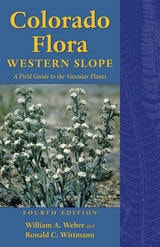
Colorado Flora
Western Slope, Fourth Edition <br>A Field Guide to the Vascular PlantsWilliam A. Weber
University Press of Colorado, 2011
These thoroughly revised and updated editions reflect current taxonomic knowledge. The authors describe botanical features of this unparalleled biohistorical region and its mountain ranges, basins, and plains and discuss plant geography, giving detailed notes on habitat, ecology, and range. The keys contain interesting anecdotes and introductions for each plant family. The book is rounded out with historical background of botanical work in the state, suggested readings, glossary, index to scientific and common names, references, and hundreds of illustrations. The books also contain a new contribution from Donald R. Farrar and Steve J. Popovich on moonworts. The fourth editions of Colorado Flora: Eastern Slope and Colorado Flora: Western Slope are ideal for both student and scientist and essential for readers interested in Colorado's plant life.

Colorado River Reader
Richard F. Fleck
University of Utah Press, 2000
"This canyon world where water yearns toward the ocean is a place so large I can’t take it in. Instead, I am taken in, traveling a near dream as we journey by water, contained by rock walls. In order to see this shorn-away world, I narrow my vision to the small and nearly secret. Never mind the stone’s illusion of permanence or the great strength of water. I look to the most fragile of things here, to the plant world of the canyon. The other river travelers seem taken in by stone, time, and water, and do not see the small things that tempt my attention, the minute fern between stones, the tiny black snails in a pond of water. I am drawn in by the growing life and not by the passing."
- from 'Plant Journey' by Linda Hogan
The mystique of the Colorado River is no less enduring and powerful than is its physical presence in the landscape of the West. Little wonder that narratives about the Colorado still arouse and intrigue readers, or that the river continues to inspire new writing among contemporary authors. What is surprising is that no anthology offering a comprehensive introduction to these works existed - until now.
A Colorado River Reader spans hundreds of years and many cultures and voices to capture an array of responses to this mighty river and tributaries. The collection opens with a Paiute creation myth set in the Grand Canyon and progresses through time, encompassing the Spanish and American exploration narratives of the eighteenth and nineteenth centuries and culminating in the adventure and nature writings of the twentieth.
This is a book that deserves a place next to every armchair and in a pocket of every backpack.
Colorado Trail in Crisis
A Naturalist’s Field Report on Climate Change in Mountain EcosystemsKarl Ford
University Press of Colorado, 2024
Using his hike along the popular five-hundred-mile Colorado Trail to present his personal observations about more than a hundred miles of dead and dying forest, Karl Ford presents a brief environmental history of these areas of the state, weaving in scientific studies about forest mortality caused by insect infestations, wildfire, drought, and loss of snowpack, and describes the poor current prospects for reforestation as the climate continues to warm. His own Lakota ancestry, as well as historical references to local Tabeguache Ute Chief Ouray and displaced Ute populations, meaningfully frames important conversations about caretaking and connection to place. Ford also proposes potential solutions to drought and forest mortality problems, as well as varying approaches and limitations to mitigation efforts.
The Colorado Trail in Crisis appeals to hikers and nature lovers seeking to learn about the natural history, beauty, and serenity of the Colorado Trail, as well as students, conservationists, and scientists researching climate change effects on Colorado mountain ecosystems.
Combating Mountaintop Removal
New Directions in the Fight against Big CoalBryan T. McNeil
University of Illinois Press, 2012
Common Ground
Encounters with Nature at the Edges of LifeRob Cowen
University of Chicago Press, 2016
That’s what Rob Cowen discovered after moving to a new home in northern England. After ten years in London he was suddenly adrift, searching for a sense of connection. He found himself drawn to a square-mile patch of waste ground at the edge of town. Scrappy, weed-filled, this heart-shaped tangle of land was the very definition of overlooked—a thoroughly in-between place that capitalism no longer had any use for, leaving nature to take its course. Wandering its meadows, woods, hedges, and fields, Cowen found it was also a magical, mysterious place, haunted and haunting, abandoned but wildly alive—and he fell in fascinated love.
Common Ground is a true account of that place and Cowen’s transformative journey through its layers and lives, but it’s much more too. As the land’s stories intertwine with events in his own life—and he learns he is to become a father for the first time—the divisions between human and nature begin to blur and shift. The place turns out to be a mirror, revealing what we are, what we’re not and how those two things are ultimately inseparable.
This is a book about discovering a new world, a forgotten world on the fringes of our daily lives, and the richness that comes from uncovering the stories and lives—animal and human—contained within. It is an unforgettable piece of nature writing, part of a brilliant tradition that stretches from Gilbert White to Robert Macfarlane and Helen Macdonald.
“I am dreaming of the edge-land again,” Cowen writes. Read Common Ground, and you, too, will be dreaming of the spaces in between, and what—including us—thrives there.
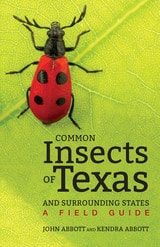
Common Insects of Texas and Surrounding States
A Field GuideBy John Abbott and Kendra Abbott
University of Texas Press, 2020
Thanks to its size and geographic position, Texas is home to nearly 30,000 species of insects, likely making its insect population the most diverse in the nation. Ranging from eastern and western to temperate and tropical species, this vast array of insects can be difficult to identify. In Common Insects of Texas and Surrounding States, John and Kendra Abbott have created the state's most comprehensive field guide to help readers recognize and understand these fascinating creatures.
Containing 1,300 species and more than 2,700 photographs, this guide offers a wealth of information about the characteristics and behaviors of Texas's insects. Each chapter introduces an order with a discussion of general natural history and a description of other qualities helpful in distinguishing its various species, while every species' entry provides a state map showing where it is most likely to be found, a key displaying its seasonal distribution, information about its habitat, and corresponding photos. Featuring colored tabs for quick reference, a glossary, and information about other arthropods, this guide is the perfect companion for anyone wanting to identify and learn more about the many insects of Texas.
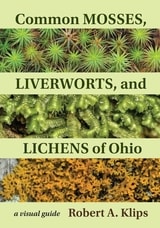
Common Mosses, Liverworts, and Lichens of Ohio
A Visual GuideRobert Klips
Ohio University Press, 2022
This engaging illustrated guidebook reveals the fascinating mosses and lichens that homeowners, outdoorspeople, and nature lovers encounter every day in Ohio and the Midwest.
In this guide to the most common and distinctive moss, liverwort, and lichen species in Ohio, readers will find concise physical descriptions, facts about natural history and ecology, and tips to distinguish look-alike species, all presented in a friendly, conversational tone.
Featuring detailed photographs of the plant and plantlike species in their natural settings, the book covers 106 mosses, thirty liverworts, and one hundred lichens and offers several avenues to match a specimen to its description page. “Where They Grow” chapters spotlight species commonly encountered on field outings, and field keys to help readers quickly identify unfamiliar samples.
While designed primarily as an identification tool, this guide also frames moss and lichen spotting in a scientific context. The two main sections—bryophytes and lichens—detail their respective taxonomic kingdoms, explain their life cycles and means of reproduction, and illustrate variation in the traits used for identification. The book is an introduction to the biology of these intriguing but too-often-overlooked organisms and a means to enjoy, identify, and catalog the biodiversity all around us.
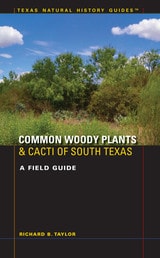
Common Woody Plants and Cacti of South Texas
A Field GuideBy Richard B. Taylor with Texas Parks & Wildlife Department
University of Texas Press, 2014
Woody plants and cacti are vital staple foods for cattle, deer, and other wildlife in drought-prone South Texas. Ranchers, hunters, and land managers who need to identify these plants relied on A Field Guide to Common South Texas Shrubs (published by Texas Parks & Wildlife Press and distributed by UT Press), which is no longer in print. Responding to ongoing demand for the book, Richard B. Taylor has completely updated and expanded it with seven new species, new photographs, and a quick plant identification key.
Common Woody Plants and Cacti of South Texas is an easy-to-use plant identification field guide to fifty species that comprise an estimated 90 percent of the region’s woody canopy cover north of the Rio Grande Valley. The species accounts include photographs, descriptions, values to livestock and wildlife, and nutritional information. The book also provides historical perspectives and information on brush management techniques and strategies, as well as habitat appraisal. All of these resources will enable readers to analyze stocking rates for deer and cattle, evaluate a prospective hunting lease, or buy property.
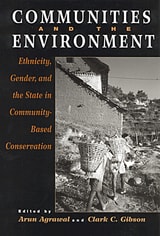
Communities and The Environment
Ethnicity, Gender, and the State in Community-Based ConservationAgrawal, Arun
Rutgers University Press, 2001
For years environmentalists thought natural resources could be best protected by national legislation. But the poor outcomes of this top-down policy have led conservation professionals today to regard local communities as the agents of conservation efforts. According to a recent survey, more than fifty countries report that they pursue partnerships with local communities in an effort to protect their forests. Despite the recent popularity of a community-based approach, the concept of community rarely receives the attention it should get from those concerned with resource management. This balanced volume redresses the situation, demonstrating both the promise and the potential dangers of community action.
Although the contributors advocate community-based conservation, they examine the record with a critical eye. They pay attention to the concrete political contexts in which communities emerge and operate. Understanding the nature of community requires understanding the internal politics of local regions and their relationship to external forces and actors. Especially critical are issues related to ethnicity, gender, and the state.
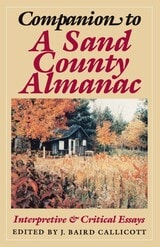
Companion to A Sand County Almanac
Interpretive and Critical EssaysJ. Baird Callicott
University of Wisconsin Press, 1987
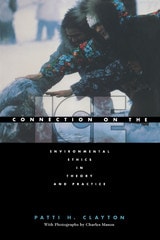
Connection On The Ice
Patti Clayton
Temple University Press, 1998
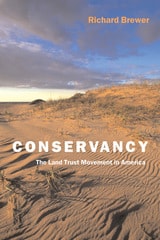
Conservancy
The Land Trust Movement in AmericaRichard Brewer
Dartmouth College Press, 2004
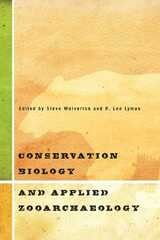
Conservation Biology and Applied Zooarchaeology
Edited by Steve Wolverton and R. Lee Lyman
University of Arizona Press, 2012
The case studies, which utilize palaeozoological data, cover a variety of animals and environments, including the marine ecology of shellfish and fish, potential restoration sites for Sandhill Cranes, freshwater mussel biogeography and stream ecology, conservation of terrestrial mammals such as American black bears, and even a consideration of the validity of the Pleistocene “rewilding” movement. The volume closes with an important new essay on the history, value, and application of applied zooarchaeology by R. Lee Lyman, which updates his classic 1996 paper that encouraged zooarchaeologists to apply their findings to present-day environmental challenges.
Each case study provides detailed analysis using the approaches of zooarchaeology and concludes with precise implications for conservation biology. Essays also address issues of political and social ecology, which have frequently been missing from the discussions of conservation scientists. As the editors note, all conservation actions occur in economic, social, and political contexts. Until now, however, the management implications of zooarchaeological research have rarely been spelled out so clearly.
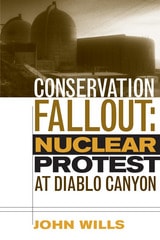
Conservation Fallout
Nuclear Protest At Diablo CanyonJohn Wills
University of Nevada Press, 2012
An unprecedented look at nuclear politics in California Vehement, widespread opposition accompanied the rise of the U.S. nuclear industry during the 1960s and 1970s. In Conservation Fallout, John Wills examines one of the most controversial atomic projects of the period: Pacific Gas and Electric Company’s decision to build its premier nuclear power plant at Diablo Canyon, a relatively unsettled, biologically rich, and especially scenic part of the central California coastline. Two competing visions of California emerged while the plant underwent construction. Environmentalists used Diablo as a symbol of impending ecological doomsday, while PG&E envisioned it as the model that would usher in a new age of energy production. The Sierra Club almost disbanded over whether to condone or protest the reactor project. Divisions also emerged in the local community as residents and politicians, enticed by the promise of cheap electricity and lucrative tax revenues, found themselves pitted against others who feared the dangers of radiation in their own backyards. The controversy intensified when a fault line was discovered within three miles of the plant. Grassroots groups The Mothers for Peace, a local women’s group, and The Abalone Alliance, a statewide nonviolent direct-action organization, did their utmost to stop the plant from going on-line. In 1979, an Alliance rally in San Francisco attracted 25,000 people, while 40,000 others gathered in San Luis Obispo. During a two-week-long blockade of the Diablo plant in 1981, over 1,900 activists were jailed, the largest arrest in the history of American antinuclear protest. Despite its significance in the history of twentieth-century environmental issues and the continuing debate over the safety of nuclear power, the full story of Diablo Canyon has not been told until now. Wills bases his account on extensive interviews with the individuals involved, as well as on the archives of the Sierra Club, several protest organizations, public agencies, PG&E, and others. The result is an engaging, balanced examination of nuclear politics in California. By focusing on one of the last wild places in the state and its transformation into a major technological center, and on the evolution and strategies of the little-studied grassroots protest groups determined to protect California and resist the spread of nuclear technology, Wills has made a major contribution to our understanding of America’s nuclear age.
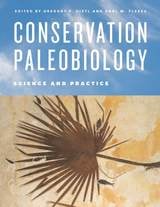
Conservation Paleobiology
Science and PracticeEdited by Gregory P. Dietl and Karl W. Flessa
University of Chicago Press, 2017
Studying endangered species is difficult. They are by definition rare, some exist only in captivity, and for those still in their native habitats any experimentation can potentially have a negative effect on survival. Moreover, a lack of long-term data makes it challenging to anticipate biotic responses to environmental conditions that are outside of our immediate experience. But in the fossil and prefossil records—from natural accumulations such as reefs, shell beds, and caves to human-made deposits like kitchen middens and archaeological sites—enlightening parallels to the Anthropocene can be found that might serve as a primer for present-day predicaments. Offering both deep-time and near-time perspectives and exploring a range of ecological and evolutionary dynamics and taxa from terrestrial as well as aquatic habitats, Conservation Paleobiology is a sterling demonstration of how the past can be used to manage for the future, giving new hope for the creation and implementation of successful conservation programs.