Results by title
3785 books match the query 'Poetry' and 202 start with c
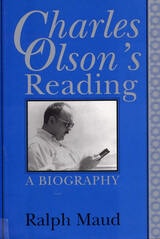
Charles Olson's Reading
A BiographyRalph Maud
Southern Illinois University Press, 1996
In this narrative account of the life and work of Charles Olson, Ralph Maud focuses on what the poet read as a basis for understanding the work he produced.
To an extraordinary degree, Olson’s reading and life were coextensive, according to Maud, who notes that Olson saw his written output over his lifetime as a total cosmology. An individual who rarely traveled, this major American poet explored the world and its history as well as the furthest reaches of the thought of his day through books.
Maud builds upon George Butterick’s annotated listing of Olson’s library, bought by the University of Connecticut after the poet’s death in 1970. The present volume, however, adds categories of books Butterick deliberately omitted: Olson’s childhood books and poetry by his own contemporaries.
Linking Olson’s books to his intellectual and poetic development at each stage of his career, Maud reveals such little-known but important connections as the contracted book project "Operation Red, White and Black" and Olson’s plan for the long poem "West"—two unrealized projects much later shaped into The Maximus Poems.
Maud also outlines the surprisingly multiple role of the painter Corrado Cagli, who brought home to Olson the significance of the Holocaust and introduced him both to the Tarot and to the theories of non-Euclidean geometry that Olson variously incorporated into his poems and essays. In discussing Olson’s relationship to Ezra Pound, Maud defines in some detail what Olson gained from Pound and what he repudiated.
Maud refutes the notion that Olson’s intellectual and creative powers declined during the last years of his life, demonstrating that during these years Olson developed his Jungian interest, his attention to early Greek thought, and a new concern for Northern mythology.
This chronicle of Olson’s reading from childhood to deathbed constitutes a critical biography of the larger-than-life author of Call Me Ishmael and The Maximus Poems. No modern poet is more revealed in his sources than Olson. Maud’s comprehensive and complete study provides a basis for new and fresh modes of thinking about Olson’s great achievement.
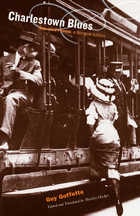
Charlestown Blues
Selected Poems, a Bilingual EditionGuy Goffette
University of Chicago Press, 2007
Curtains, blinds, draperies, shades, no, nothing
Madame, to conceal from your Cyclops’ eye
in the shadows from which it spies on me
this long pale body, false corpse tired out
with debauchery, which is swooning too
before your balcony, with your drying
stockings and scanties of a nun at bay—
poisonous flowers for a lonely man
whom death panics, draws erect, demarrows
in the night, riveted to your white thighs.
Readers who denounce most contemporary French poetry as self-referential experimentation, word games, exercises in deconstruction, or other kinds of incomprehensible writing disconnected from everyday life—brace yourselves for a revelation. Erotic and urbane, distinguished by formal skill yet marked by the subtlest shades of feeling, Guy Goffette’s unabashedly lyrical poems pay homage to both Verlaine and Rimbaud, whom he counts as his important forbears, with echoes of Auden and Pound, Pavese and Borges.
In Charlestown Blues, poet and translator Marilyn Hacker has chosen a tightly thematic selection of poems, all centering around the notion of “blue”—the color and the emotion, as well as that quintessentially American style of musical performance. Hacker’s crystalline and musical English renderings will show Anglophones why Goffette is considered one of the most important poets writing in French today.
Charon's Ferry
Fifty PoemsGyula Illyes
Northwestern University Press, 2000
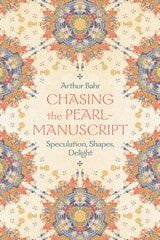
Chasing the Pearl-Manuscript
Speculation, Shapes, DelightArthur Bahr
University of Chicago Press, 2025
In this book, Arthur Bahr takes a fresh look at the four poems and twelve illustrations of the so-called “Pearl-Manuscript,” the only surviving medieval copy of two of the best-known Middle English poems: Pearl and Sir Gawain and the Green Knight. In Chasing the Pearl-Manuscript, Bahr explores how the physical manuscript itself enhances our perception of the poetry, drawing on recent technological advances (such as spectroscopic analysis) to show the Pearl-Manuscript to be a more complex piece of material, visual, and textual art than previously understood. By connecting the manuscript’s construction to the intricate language in the texts, Bahr suggests new ways to understand both what poetry is and what poetry can do.
Chattahoochee
PoemsPatrick Phillips
University of Arkansas Press, 2004
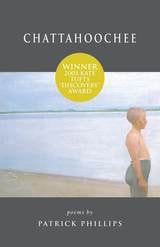
Winner of the 2005 Kate Tufts Discovery Award.
From the author of Blood at the Root: A Racial Cleansing in America and the National Book Award finalist Elegy for a Broken Machine: Poems, here is the first collection from award-winning poet Patrick Phillips.
A river runs through Patrick Phillips’s collection Chattahoochee, and through a family saga as powerful and poignant as the landscape in which it unfolds. Here are tales of a vanished South, elegies for the lost, and glimpses of what Flannery O’Connor called the “action of grace in territory held largely by the devil.” In language delicate and muscular, tender and raw-boned, Phillips writes of family, place, and that mythic conjunction of the two we call home.
Chaucer's Italian Tradition
Warren Ginsberg
University of Michigan Press, 2002
Because divergent political, municipal, and literary histories would have made the Italian cities--Genoa, Florence, and Milan--unfamiliar to an English poet from medieval London, Ginsberg argues that we must consider what Chaucer overlooked and mistook from his Italian models alongside the material he did appropriate. To make sense of premises in texts like Dante's Comedy that were peculiarly Italian, Chaucer would look to Boccaccio as a gloss; by reading these authors in conjunction with one another, Chaucer generates an "Italian tradition" that translates into the terms of his English experience works already mediated by a prior stage of transposition.
Ginsberg explores Chaucer's relationship to Italian poets not in terms of the interaction of individual talents with accredited authorities (Chaucer and Dante, Boccaccio and Petrarch, etc.). Rather, he focuses on the shifts in tension that occur when the civic engagements and disengagements of Florence's poets are brought into contact with Chaucer's growing metropolitanism and increasing reluctance to make London the locus of his poetic art.
Beyond its appeal to medievalists and those who study the Renaissance, Chaucer's Italian Tradition will be welcomed by readers interested in theoretical questions about translation and the development of tradition, including individuals who study history, literature, and the nature of the humanities.
Warren Ginsberg is Professor of English, University of Oregon.
Chaucer’s Fame in Britannia 1641–1700
Jackson C. Boswell
Arizona Center for Medieval and Renaissance Studies, 2021
Chaucer’s Queer Nation
Glenn Burger
University of Minnesota Press, 2003
Draws parallels between questions of identity in Chaucer’s time and our own.
Bringing the concerns of queer theory and postcolonial studies to bear on Chaucer’s Canterbury Tales, this ambitious book compels a rethinking not only of this most canonical of works, but also of questions of sexuality and gender in pre- and postmodern contexts, of issues of modernity and nation in historiography, and even of the enterprise of historiography itself. Glenn Burger shows us Chaucer uneasily situated between the medieval and the modern, his work representing new forms of sexual and communal identity but also enacting the anxieties provoked by such departures from the past.
Burger argues that, under the pressure of producing a poetic vision for a new vernacular English audience in the Canterbury Tales, Chaucer reimagines late medieval relations between the body and the community. In close readings that are at once original, provocative, and convincing, Chaucer’s Queer Nation helps readers to see the author and audience constructed with and by the Tales as subjects-in-process caught up in a conflicted moment of "becoming." In turn, this historicization unsettles present-day assumptions about identity with the realization that social organizations of the body can be done differently.
Chicago Poems
Carl Sandburg
University of Illinois Press, 1992
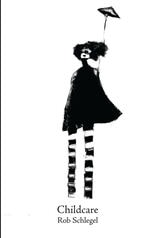
Childcare
Rob Schlegel
Four Way Books, 2023
Crackling with the hypervigilance of parenthood, Childcare explores the paradox at the root of raising kids: the joy of new life accompanies an awareness of potential loss. Rob Schlegel’s fourth collection observes the tangled emotions of fatherhood; even as he wonders at the strange intelligence of youth, he elegizes the present moment. The longitudinal wisdom of this collection appears in the choreography of its leaps — how it moves from the aside “[My son] needs my love the most when he least deserves it / Is something I read” to the reflection that “Death / Names my shape. I keep my clothes / From dust and ghosts and time. / I’m angry at my father for aging.” From Schlegel’s relentless curiosity and keen observations, the artistic crisis driving the book emerges: does poetry memorialize the ephemeral moment, saving something for us, or does it remove us from experience? The duality of language’s role — that it, ultimately, has the capacity to do both — doubles the significance of “childcare” in this collection, which comes to represent not just the work of child rearing but the dutiful care by adult children for their parents. Perhaps nothing can convey the scope and quality of family life like the concatenated dependencies of “(Un)conditional,” which terminate here: “If the cut draws blood / If life ends in desire // If it begins in love.”
Children in Tactical Gear
Peter Mishler
University of Iowa Press, 2024
Children with Enemies
Stuart Dischell
University of Chicago Press, 2017
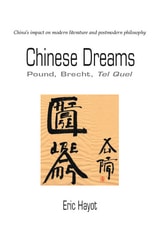
Chinese Dreams
Pound, Brecht, Tel QuelEric Hayot
University of Michigan Press, 2011
China’s profound influence on the avant-garde in the 20th century was nowhere more apparent than in the work of Ezra Pound, Bertolt Brecht, and the writers associated with the Parisian literary journal Tel quel. Chinese Dreams explores the complex, intricate relationship between various “Chinas”—as texts—and the nation/culture known simply as “China”—their context—within the work of these writers. Eric Hayot calls into question the very means of representing otherness in the history of the West and ultimately asks if it might be possible to attend to the political meaning of imagining the other, while still enjoying the pleasures and possibilities of such dreaming. The latest edition of this critically acclaimed book includes a new preface by the author.
“Lucid and accessible . . . an important contribution to the field of East-West comparative studies, Asian studies, and modernism.”
—Comparative Literature Studies
“Instead of trying to decipher the indecipherable ‘China’ in Western literary texts and critical discourses, Hayot chose to show us why and how ‘China’ has remained, and will probably always be, an enchanting, ever-elusive dream. His approach is nuanced and refreshing, his analysis rigorous and illuminating.”
—Michelle Yeh, University of California, Davis
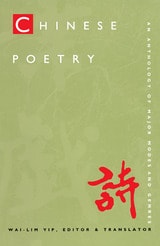
Chinese Poetry, 2nd ed., Revised
An Anthology of Major Modes and GenresWai-lim Yip, editor and translator
Duke University Press, 1997
Newly designed, the unique format of this volume will enhance its reputation as the definitive introduction to Chinese poetry, while its introductory essay on issues of Chinese aesthetics will continue to be an essential text on the problems of translating such works into English. Each poem is printed with the original Chinese characters in calligraphic form, coordinated with word-for-word annotations, and followed by an English translation. Correcting more than a century of distortion of the classical Chinese by translators unconcerned with the intricacies and aesthetics of the Chinese language, these masterful translations by Wai-lim Yip, a noted and honored translator and scholar, allow English readers to enter more easily into the dynamic of the original poems. Each section of the volume is introduced by a short essay on the mode or genre of poem about to be presented and is followed by a comprehensive bibliography.
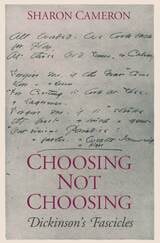
Choosing Not Choosing
Sharon Cameron
University of Chicago Press, 1992
Considering the poems in the context of the fascicles, Cameron argues that an essential refusal of choice pervades all aspects of Dickinson's poetry. Because Dickinson never chose whether she wanted her poems read as single lyrics or in sequence (nor is it clear where any fascicle text ends, or even how, in context, a poem is bounded), "not choosing" is a textual issue; it is also a formal issue because Dickinson refused to chose among poetic variants; it is a thematic issue; and, finally, it is a philosophical one, since what is produced by "not choosing" is a radical indifference to difference. Extending the readings of Dickinson offered in her earlier book Lyric Time, Cameron continues to enlarge our understanding of the work of this singular American poet.
Chord Box
PoemsElizabeth Lindsey Rogers
University of Arkansas Press, 2013
Chorizos in an Iron Skillet
Memories and Recipes from an American Basque DaughterMary Ancho Davis
University of Nevada Press, 2001
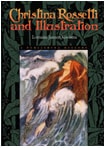
Christina Rossetti and Illustration
A Publishing HistoryLorraine Janzen Kooistra
Ohio University Press, 2002
Readers do not always take into account how books that combine image and text make their meanings. But for the Pre-Raphaelite poet Christina Rossetti, such considerations were central.
Christina Rossetti and Illustration maps the production and reception of Rossetti’s illustrated poetry, devotional prose, and work for children, both in the author’s lifetime and in posthumous twentieth-century reprints.
Lorraine Janzen Kooistra’s reading of Rossetti’s illustrated works reveals for the first time the visual-verbal aesthetic that was fundamental to Rossetti’s poetics. Her exhaustive archival research brings to light new information on how Rossetti’s commitment to illustration and attitudes to copyright and control influenced her transactions with publishers and the books they produced. Janzen Kooistra also tracks the poet’s reception in the twentieth century through a complex web of illustrated books produced for a wide range of audiences.
Analyzing an impressive array of empirical data, Janzen Kooistra shows how Rossetti’s packaging for commodity consumption—by religious presses, publishers of academic editions and children’s picture books, and makers of erotica and collectibles—influenced the reception of her work and her place in literary history.

Christina Rossetti
The Poetry of EnduranceDolores Rosenblum
Southern Illinois University Press, 1987
Christina Rossetti was considered the ideal female poet of her time. Her poetry was devotional, moral, and spoke of frustrated affection.
Dolores Rosenblum presents a fresh reading of Rossetti’s works and places them in the context of her life. Rosenblum shows that what was ostensibly devotional, moral, and loveless, was actually what Luce Irigaray calls “mimetism,” a subtle parody and subversion of the male tradition of literature.
Only with the coming of feminist criticism can Rossetti be meaningfully re-evaluated. Rosenblum calls Rossetti’s works the “poetry of endurance,” stating that it is similar, and at times identical, to the female “sentimental” tradition in literature. Rossetti endured the constraints of the Victorian female artistic spirit by becoming a “watcher.” Within this self-accepted role, Rossetti was able to carefully and deliberately choose artistic self-protection. In her religious poetry, Rossetti transcended, by aesthetic renunciation, the alienation and immobilization forced upon her.
Rossetti’s poetry is full of paradox; it sings about silence, exposes the poet’s oblivion. From the repining Victorian poet, there emerged a “stone woman.” Rosenblum discusses this passively enduring female figure’s alienation from knowledge and power, and how the myth of self strengthened the lyric voice within her. Because she was a woman, she was denied the male use of the lyric “I.”
Rossetti’s work is unified, Rosenblum argues, because she was a deliberate poet, and by accepting the “burden of womanhood,” she played out what men only symbolized as female in their art. By her mimicry and revision of the male tradition of literature, Christina Rossetti engaged the patriarchal tradition in ways that make it usable for the female experience, and that provide a critique of male objectification of women in art.
Chronicle of My Worst Years
Tino Villanueva
Northwestern University Press, 1994
Churches
Kevin Prufer
Four Way Books, 2014
Ciardi Himself
Fifteen Essays in the Reading, Writing, and Teaching of PoetryJohn Ciardi
University of Arkansas Press, 1989
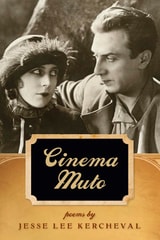
Cinema Muto
Jesse Lee Kercheval
Southern Illinois University Press, 2009
In Cinema Muto, Jesse Lee Kercheval examines the enduring themes of time, mortality, and love as revealed through the power of silent film. Following the ten days of the annual Le Giornate del Cinema Muto in Italy, this collection of ekphrastic poems are love letters to the evocative power of silent cinema. Kercheval’s poems elegantly capture the allure of these rare films, which compel hundreds of pilgrims from around the world—from scholars and archivists, to artists and connoisseurs—to flock to Italy each autumn. Cinema Muto celebrates the flickering tales of madness and adventure, drama and love, which are all too often left to decay within forgotten vaults. As reels of Mosjoukine and D. W. Griffith float throughout the collection, a portrait also emerges of the simple beauty of Italy in October and of two lovers who are drawn together by their mutual passion for an extinct art. Together they revel in recapturing “the black and white gestures of a lost world.”
Cinema Muto is a tender tribute to the brief yet unforgettable reign of silent film. Brimming with stirring images of dreams, desire, and the ghosts of cinema legends gone by, Kercheval’s verse is a testament to the mute beauty and timeless lessons that may still be discovered in a fragile roll of celluloid.
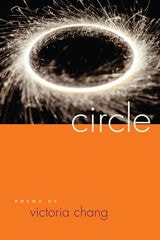
Circle
Victoria Chang
Southern Illinois University Press, 2005
Taking its concept of concentricity from the eponymous Ralph Waldo Emerson essay, Circle, the first collection from Victoria Chang, adopts the shape as a trope for gender, family, and history. These lyrical, narrative, and hybrid poems trace the spiral trajectory of womanhood and growth and plot the progression of self as it ebbs away from and returns to its roots in an Asian American family and context. Locating human desire within the helixes of politics, society, and war, Chang skillfully draws arcs between T’ang Dynasty suicides and Alfred Hitchcock leading ladies, between the Hong Kong Flower Lounge and an all-you-can-eat Sunday brunch, the Rape of Nanking and civilian casualties in Iraq.

Circle's Apprentice
Dan Beachy-Quick
Tupelo Press, 2011
After a series of book-length poems, Beachy-Quick’s new volume is as carefully structured as a suite of chamber music pieces, yet made of distinctly individual poems. Building upon the visceral and conceptual fascinations of Ralph Waldo Emerson’s essay, “Circles,” these poems trace patterned tensions to connections in existence on many levels, from molecular to millennial.
“Dan Beachy-Quick’s splendid new collection reveals the echoes between the measure of verse and the measure of time. If it is true, as Thoreau suggests, that the poem of creation is ongoing, this ambitious and prolific poet shows us that learning to listen for that music of daily life involves a lifetime. Circle’s Apprentice vividly reminds us that all our human life may be marked by ritual but is returned to us through song. ‘The minute gears mutely whir. / To put your ear / against it is to put your ear inside it.’”—Susan Howe
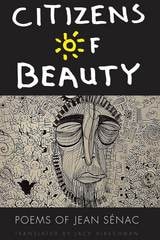
Citizens of Beauty
Poems of Jean SénacJean Sénac
Michigan State University Press, 2016
City Scattered
CABARET FOR FOUR VOICESTyler Mills
Tupelo Press, 2022
City of Ash
Eugenijus Alisanka
Northwestern University Press, 2000
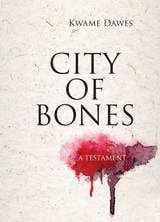
City of Bones
A TestamentKwame Dawes
Northwestern University Press, 2017
As if convinced that all divination of the future is somehow a re-visioning of the past, Kwame Dawes reminds us of the clairvoyance of haunting. The lyric poems in City of Bones: A Testament constitute a restless jeremiad for our times, and Dawes’s inimitable voice peoples this collection with multitudes of souls urgently and forcefully singing, shouting, groaning, and dreaming about the African diasporic present and future.
As the twentieth collection in the poet’s hallmarked career, City of Bones reaches a pinnacle, adding another chapter to the grand narrative of invention and discovery cradled in the art of empathy that has defined his prodigious body of work. Dawes’s formal mastery is matched only by the precision of his insights into what is at stake in our lives today. These poems are shot through with music from the drum to reggae to the blues to jazz to gospel, proving that Dawes is the ambassador of words and worlds.
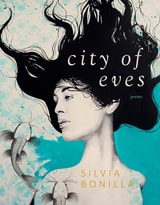
City of Eves
PoemsSilvia Bonilla
University of Arizona Press, 2026
Sonia and her two best friends grow up on the urban coast of Ecuador, sharing cigarettes, school uniforms, and a determination to overcome their circumstances even if the price to pay is exile. Full of fantasies and curiosity, the friends navigate hunger at home, absent parents, and religious pressures as they help each other through the pleasures and traumas of adolescence. As their desire for something greater changes from dreams into actions, they pursue escape routes that hover between choice and compulsion: forced marriages, early widowhood, and a death-haunted migration to the United States. Even in the throes of escape, the constraints of their reality always lie waiting.
Subtle and unsparing, Bonilla’s lyrical poems capture the wild inner horizons and vivid embodiment of youth as it shades into the reflective poignance of maturity marked by disappointment, compromise, and loss. Despite this, it is memories of deep friendship, bonded through shared understanding and aspiration, that lingers. Looking back on her life, Sonia recalls the courage and vitality of girls determined to shape their own futures: “We lifted Coca-Cola bottles to the / opened granadilla of our mouths.”
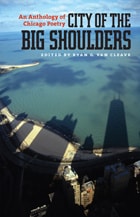
City of the Big Shoulders
An Anthology of Chicago PoetryRyan G. Van Cleave
University of Iowa Press, 2012
The cultural, ethnic, and aesthetic diversity in this gathering of poems springs from a variety of viewpoints, styles, and voices as multifaceted and energetic as the city itself. Cristin O’Keefe Aptowicz: “I want to eat / in a city smart enough to know that if you / are going to have that heart attack, you might / as well have the pleasure of knowing // you’ve really earned it”; Renny Golden: “In the heat of May 1937, my grandfather / sits in the spring grass of an industrial park / with hundreds of striking steelworkers”; Joey Nicoletti: “The wind pulls a muscle / as fans yell the vine off the outfield wall, / mustard-stained shirts, hot dog smiles, and all.”
The combined energies of these poems reveal the mystery and beauty that is Second City, the City by the Lake, New Gotham, Paris on the Prairie, the Windy City, the Heart of America, and Sandburg’s iconic City of the Big Shoulders.
Civil Bound
Myung Mi Kim
Omnidawn, 2019
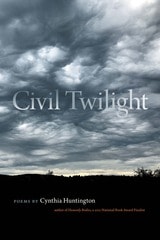
Civil Twilight
Cynthia Huntington, 2012 National Book Award Finalist
Southern Illinois University Press, 2024
New collection from National Book Award finalist
Civil twilight is the astronomical term for the minutes just before sunrise and just after sunset. If one took a snapshot, it would be impossible to tell whether the light was increasing or diminishing. The poems in Civil Twilight arise in this liminal space. With luminous precision, Cynthia Huntington examines the civil twilight we live in now, unsure of whether the darkness is closing in or whether the light is about to break.
Here the poet is both skeptic and seeker, for any hope worth discovering needs to withstand the facts at hand. Is everything getting worse, or are things about to improve? Or is this the way things have always been, both hopeful and terrifying, and it is our questions that need to change? In part one, the speaker strives for balance by maintaining light and warmth in a cold season. In part two, American scenes of construction and destruction are set beside moments from history: Rome, the British Empire, and American immigration. Part three enfolds questions of history and power within winter scenes and the artist’s imagination. In part four, the speaker looks back and admits answers remain elusive, yet points to the new ways of thinking and feeling about survival that have resulted from the work. And here, the half-light shifts. In a world teetering on the edge of collapse, Civil Twilight wrestles hard-won hope from disquiet, coming to rest in what is.
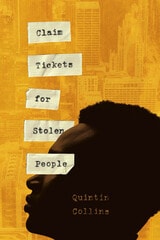
Claim Tickets for Stolen People
Quintin Collins
The Ohio State University Press, 2022
In Claim Tickets for Stolen People, Quintin Collins embraces a range of poetic forms and registers to show the resilience of Blackness in a colonized world. The tension between mortality and vitality is ever-present, whether Collins is charting his daughter’s emergence into being, cataloging the toll of white violence, or detailing the exuberance of community, family, and Chicago and Boston life. In Collins’s hands, the world is exquisitely physical and no element is without its own perspective, whether it is a truck sheared by a highway bridge or bees working through the knowledge that humans will kill them, burn their homes, and steal their honey. All goes toward honoring Black grief, Black anger, Black resistance, Black hope—and the persistence of Black love.
Claims for Poetry
Donald Hall, Editor
University of Michigan Press, 1982
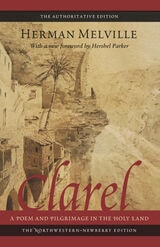
Clarel
A Poem and Pilgrimage in the Holy LandHerman Melville
Northwestern University Press, 2008
Melville’s long poem Clarel: A Poem and Pilgrimage in the Holy Land (1876) was the last full-length book he published. Until the mid-twentieth century even the most partisan of Melville’s advocates hesitated to endure a four-part poem of 150 cantos and almost 18,000 lines about a naive American named Clarel, on pilgrimage through the Palestinian ruins with a provocative cluster of companions.
But modern critics have found Clarel a much better poem than was ever realized. Robert Penn Warren called it a precursor of The Waste Land. It abounds with revelations of Melville’s inner life. Most strikingly, it is argued that the character Vine is a portrait of Melville’s friend Nathaniel Hawthorne. Clarel is one of the most complex theological explorations of faith and doubt in all of American literature, and this edition brings Melville’s poem to new life.
Clarel
Volume Twelve, Scholarly EditionHerman Melville
Northwestern University Press, 1991
But modern critics have found Clarel a much better poem than was ever realized. Robert Penn Warren called it a precursor of The Waste Land. It abounds with revelations of Melville's inner life. Most strikingly, it is argued that the character Vine is a portrait of Melville's friend Hawthorne. Based on the only edition published during Melville's lifetime, this scholarly edition adopts thirty-nine corrections from a copy marked by Melville and incorporates 154 emendations by the present editors, an also includes a section of related documents and extensive discussions.
This scholarly edition is an Approved Text of the Center for Editions of American Authors (Modern Language Association of America).

Claribel Alegría and Central American Literature
Critical EssaysSandra M. Boschetto-Sandoval
Ohio University Press, 1993
These essays examine the multifaceted work of the Central American author whom Latin American literary historians consider precursor of “cultural dialogism” in poetry and fiction. As poet, essayist, journalist, novelist, and writer of “quasi–testimonio,” Alegría’s multiple discourses transgress the boundaries between traditional and postmodern political theories and practices. Her work reveals an allegory of relation and negotiation between “intelligentsia” and subaltern peoples as well as the need for a more socially extensive literature, not exclusive of more elite “magical literatures.”
The essays in the fist section frame Alegría’s discourses within sociohistorical, political, and literary contexts in order to illuminate the author’s singular place in the literary and political history of Central America. The essays in the second section engage in a feminist dialogic in which the reader encounters various critical validations and valorizations of Alegría’s many female voices. The third section involves the reader in the pursuit of extratextual or extraliterary resonances in Alegría’s work.
Classic Rough News
Kenneth Fields
University of Chicago Press, 2005
Classic Rough News follows a skeptical, cosmopolitan, intelligent, poetic presence aware that its carefully constructed veneer could crumble at any moment. In poems that mine interior dialogue for the discovery of great truths, Fields conveys feelings of awkwardness, incompleteness, conflict, and insanity-all in finely crafted verse. Ironic and skeptical, the voice in these poems records the flux of the mind, ruefully acknowledging how easy it is to deceive oneself with mixed emotions. Fully mature and unconcerned about impressions, Classic Rough News is grounded in erudition and humor, revealing how tradition and talent can push one another in unexpected directions.
Classical Rhetoric in English Poetry
Brian Vickers
Southern Illinois University Press, 1989
Back in print after 17 years, this is a concise history of rhetoric as it relates to structure, genre, and style, with special reference to English literature and literary criticism from Ancient Greece to the end of the 18th century.
The core of the book is a quite original argument that the figures of rhetoric were not mere mechanical devices, were not, as many believed, a "nuisance, a quite sterile appendage to rhetoric to which (unaccountably) teachers, pupils, and writers all over the world devoted much labor for over 2,000 years." Rather, Vickers demonstrates, rhetoric was a stylized representation of language and human feelings.
Vickers supplements his argument through analyses of the rhetorical and emotional structure of four Renaissance poems. He also defines 16 of the most common figures of rhetoric, citing examples from the classics, the Bible, and major English poets from Chaucer to Pope.
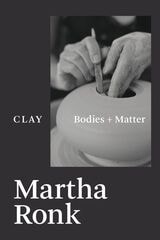
Clay
Martha Ronk
Omnidawn, 2025
The poems in Clay look to the process of forming clay on a potter’s wheel to examine our sense of touch and texture, emptiness, fragility, and the nature of time. Martha Ronk moves through the steps of creating a pot that must be formed, dried, bisque-fired, glazed, and fired again. This practice is paralleled in Ronk’s process-oriented language that addresses how we read texture and color, the ways history and landscapes appear in glazes, Mimbres bowls that covered the faces of the dead, and Giorgio Morandi’s still life paintings of ceramic forms.
For Ronk, pottery raises questions about the value of repetition, inevitable failure, and how we may become one with matter. As the potter’s hands ache and age, the bowl seems to age as it slumps or breaks. Clay includes observations from other potters and writers as well as small photographs of pots.

Clayfeld Holds On
Robert Pack
University of Chicago Press, 2015
Beneath this mellow harvest moon,
I can still picture you—a boy content
just fishing with his father from a ledge
above a foaming stream. The flailing trout
you caught is packed in gleaming ice;
the pink stripe all along its side
is smeared across black shiny dots
that seem to shine with their own light.
I’m sure that you can picture me
with equal vividness, and though we’re not
identical, there is a sense
in which I am inventing you
as much as you’re inventing me.
In Clayfeld Holds On, Robert Pack offers his readers a comprehensive portrait of his longtime protagonist Clayfeld, who is also Pack’s doppelgänger, his alternate self, enacting both the life that the poet has lived and the life he might have lived, given his proclivities and appetites. Poet and protagonist, taken together, are self and consciousness of self, the historical self and the embellished story of that literal self.
Written with a masterly ear for rhythm, and interweaving narrative and lyrical passages, the poems recount Clayfeld’s formative memories while exploring concepts such as loyalty, generosity, commitment, as well as cosmic phenomena such as the big bang theory and black holes. Through all of this, Pack attempts to find purpose and meaning in an indifferent universe, and to explore the labyrinth of his own proliferating identity.
Clean Slate
New & Selected PoemsDaisy Zamora
Northwestern University Press, 1995
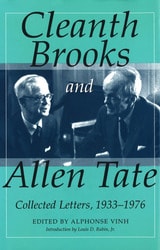
Cleanth Brooks and Allen Tate
Collected Letters, 1933-1976Edited by Alphonse Vinh & Intro by Louis D. Rubin, Jr.
University of Missouri Press, 1998
Offering all of the extant letters exchanged by two of the twentieth century's most distinguished literary figures, Cleanth Brooks and Allen Tate: Collected Letters, 1933-1976 vividly depicts the remarkable relationship, both professional and personal, between Brooks and Tate over the course of their lifelong friendship.
An accomplished poet, critic, biographer, and teacher, Allen Tate had a powerful influence on the literary world of his era. Editor of the Fugitive and the Sewanee Review, Tate greatly affected the lives and careers of his fellow literati, including Cleanth Brooks. Esteemed coeditor of An Approach to Literature and Understanding Poetry, Brooks was one of the principal creators of the New Criticism. His Modern Poetry and the Tradition and The Well Wrought Urn, as well as his two-volume study of Faulkner, remain among the classics read by any serious student of literature. The correspondence between these two gentlemen-scholars, which began in the 1930s, extended over five decades and covered a vast amount of twentieth-century literary history.
In the more than 250 letters collected here, the reader will encounter their shared concerns for and responses to the work of their numerous friends and many prominent writers, including T. S. Eliot, William Faulkner, and Robert Lowell. Their letters offer details about their own developing careers and also provide striking insight into the group dynamics of the Agrarians, the noteworthy community of southern writers who played so influential a role in the literature of modernism.
Brooks once said that Tate treated him like a younger brother, and despite great differences between their personalities and characters, these two figures each felt deep brotherly affection for the other. Whether they contain warm invitations for the one to visit the other, genteel or honest commentaries on their families and friends, or descriptions of the vast array of social, professional, and even political activities each experienced, the letters of Brooks and Tate clearly reveal the personalities of both men and the powerful ties of their strong camaraderie.
Invaluable to both students and teachers of literature, Cleanth Brooks and Allen Tate provides a substantial contribution to the study of twentieth-century American, and particularly southern, literary history.
Closest Pronunciation
PoemsEd Roberson
Northwestern University Press, 2013
Northwestern University Press is honored to inaugurate the Drinking Gourd Chapbook Poetry Prize series with Ed Roberson’s Closest Pronunciation. Here is a teacher of poets studying his own assignments, questioning and seeking the generative capacity in looking at and seeing things that ends in the realization of a poem. In a line from the brief poem "Night Writing," from which the chapbook draws its title, he writes, "The word closest in pronunciation / To an ambulance’s siren is ‘wrong.’" The collection as a whole gives voice, often quiet but always profound, to many things overlooked and neglected in culture, nature, and everyday life.
Cloud of Ink
L. S. Klatt
University of Iowa Press, 2011

Clouds Upside Down Among the Flowers
New & SelectedCal Bedient
Omnidawn, 2026
The poems in Clouds Upside Down Among the Flowers speak to the emotionally and existentially tough challenge presented by Gilles Deleuze and Félix Guattari in What is Philosophy: “It may be that believing in this world, in this life, becomes our most difficult task.”Filled with wit, color, and high-spirited invention, these selected poems offer no room for softness and sentiment. They carry variant voices, whispers like dramatic asides, and mind-expanding assertions as they reveal their layers and nuances. Bedient confronts disasters of politics, love, and faithless time, never turning away from the glinting axe.
This collection also includes new poems that are direct in dealing with the difficulties of keeping faith through life. They recognize that making something—for instance, poetry—is necessary to coach the world into realness and render oneself real in the process, a journey of both intensive investigation and creativity.
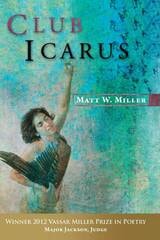
Club Icarus
Matt W. Miller
University of North Texas Press, 2013
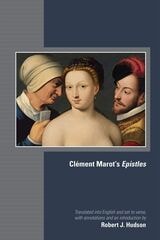
Clément Marot's Epistles
Clément Marot
Arizona Center for Medieval and Renaissance Studies, 2021
Clément Marot (1496–1544), a royal poet in Renaissance France who ushered in new verse forms and renewed existing ones, stands as one of the most important literary voices of the first half of the sixteenth century. Clément Marot’s Epistles represents a first attempt to offer a sustained English-language translation and critical edition of what is widely considered his most personal, historically relevant, and crowning verse form. Aiming for integrality and poetic precision, the volume translates and sets to verse all seventy-four of Marot’s epistles, employing the same meter and rhyme scheme used by the poet in the original compositions. Likewise focused on capturing Marot’s poetic voice, thus maintaining idiomatic and literary integrity, the resulting translation is an attempt to relate the playfulness and pathos of Marot’s verse, rendering it accessible to an anglophone public.
Beyond the more traditional verse epistles included in the primary base text, Marot’s authorized complete works from 1538, the volume also offers translations of the introductory prose epistles penned by Marot for his Adolescence clémentine of 1532 and the 1538 edition (Lyon, Dolet), as well as the coq-à-l’âne and other versified satirical epistles, the “artificial epistle” retelling of a popular medieval romance, and more. A robust critical apparatus includes ample footnotes, an extensive introduction, illustrations, a bibliography, a chronological table, and a concordance with the principal modern French-language editions of Marot’s epistles.
The book should appeal to English-speaking historians and literary scholars alike, as well as to poetry lovers, who will appreciate a new acquaintance with this distinctive voice from poetry’s past.
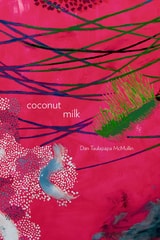
Coconut Milk
Dan Taulapapa McMullin
University of Arizona Press, 2013
McMullin seamlessly flows between exposing the ironies of Tiki kitsch–inspired cultural appropriation and intimate snapshots of Samoan people and place. In doing so, he disrupts popular notions of a beautiful Polynesia available for the taking, and carves out new avenues of meaning for Pacific Islanders of Oceania. Throughout the collection, McMullin illustrates various manifestations of geopolitical, cultural, linguistic, and sexual colonialism. His work illuminates the ongoing resistance to colonialism and the remarkable resilience of Pacific Islanders and queer-identified peoples.
McMullin’s Fa’a Fafine identity—the ability to walk between and embody both the masculine and feminine—creates a grounded and dynamic voice throughout the collection. It also fosters a creative dialogue between Fa’a Fafine people and trans-Indigenous movements. Through a uniquely Samoan practice of storytelling, McMullin contributes to the growing and vibrant body of queer Indigenous literature.