661 books match the query 'South America' and 54 start with c
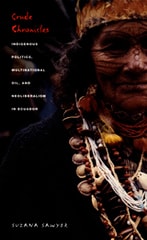
cover of Crude Chronicles: Indigenous Politics, Multinational Oil, and Neoliberalism in Ecuador

Crude Chronicles

Indigenous Politics, Multinational Oil, and Neoliberalism in Ecuador

Suzana Sawyer

Duke University Press, 2004

Ecuador is the third-largest foreign supplier of crude oil to the western United States. As the source of this oil, the Ecuadorian Amazon has borne the far-reaching social and environmental consequences of a growing U.S. demand for petroleum and the dynamics of economic globalization it necessitates. Crude Chronicles traces the emergence during the 1990s of a highly organized indigenous movement and its struggles against a U.S. oil company and Ecuadorian neoliberal policies. Against the backdrop of mounting government attempts to privatize and liberalize the national economy, Suzana Sawyer shows how neoliberal reforms in Ecuador led to a crisis of governance, accountability, and representation that spurred one of twentieth-century Latin America’s strongest indigenous movements.

Through her rich ethnography of indigenous marches, demonstrations, occupations, and negotiations, Sawyer tracks the growing sophistication of indigenous politics as Indians subverted, re-deployed, and, at times, capitulated to the dictates and desires of a transnational neoliberal logic. At the same time, she follows the multiple maneuvers and discourses that the multinational corporation and the Ecuadorian state used to circumscribe and contain indigenous opposition. Ultimately, Sawyer reveals that indigenous struggles over land and oil operations in Ecuador were as much about reconfiguring national and transnational inequality—that is, rupturing the silence around racial injustice, exacting spaces of accountability, and rewriting narratives of national belonging—as they were about the material use and extraction of rain-forest resources.
[more]
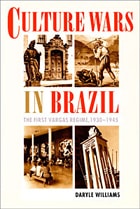
cover of Culture Wars in Brazil: The First Vargas Regime, 1930–1945

Culture Wars in Brazil

The First Vargas Regime, 1930–1945

Daryle Williams

Duke University Press, 2001

In Culture Wars in Brazil Daryle Williams analyzes the contentious politicking over the administration, meaning, and look of Brazilian culture that marked the first regime of president-dictator Getúlio Vargas (1883–1954). Examining a series of interconnected battles waged among bureaucrats, artists, intellectuals, critics, and everyday citizens over the state’s power to regulate and consecrate the field of cultural production, Williams argues that the high-stakes struggles over cultural management fought between the Revolution of 1930 and the fall of the Estado Novo dictatorship centered on the bragging rights to brasilidade—an intangible yet highly coveted sense of Brazilianness.
Williams draws on a rich selection of textual, pictorial, and architectural sources in his exploration of the dynamic nature of educational film and radio, historical preservation, museum management, painting, public architecture, and national delegations organized for international expositions during the unsettled era in which modern Brazil’s cultural canon took definitive form. In his close reading of the tensions surrounding official policies of cultural management, Williams both updates the research of the pioneer generation of North American Brazilianists, who examined the politics of state building during the Vargas era, and engages today’s generation of Brazilianists, who locate the construction of national identity of modern Brazil in the Vargas era.
By integrating Brazil into a growing body of literature on the cultural dimensions of nations and nationalism, Culture Wars in Brazil will be important reading for students and scholars of Latin American history, state formation, modernist art and architecture, and cultural studies.
[more]
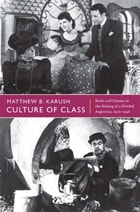
cover of Culture of Class: Radio and Cinema in the Making of a Divided Argentina, 1920-1946

Culture of Class

Radio and Cinema in the Making of a Divided Argentina, 1920-1946

Matthew B. Karush

Duke University Press, 2012
In an innovative cultural history of Argentine movies and radio in the decades before Peronism, Matthew B. Karush demonstrates that competition with jazz and Hollywood cinema shaped Argentina's domestic cultural production in crucial ways, as Argentine producers tried to elevate their offerings to appeal to consumers seduced by North American modernity. At the same time, the transnational marketplace encouraged these producers to compete by marketing "authentic" Argentine culture. Domestic filmmakers, radio and recording entrepreneurs, lyricists, musicians, actors, and screenwriters borrowed heavily from a rich tradition of popular melodrama. Although the resulting mass culture trafficked in conformism and consumerist titillation, it also disseminated versions of national identity that celebrated the virtue and dignity of the poor, while denigrating the wealthy as greedy and mean-spirited. This anti-elitism has been overlooked by historians, who have depicted radio and cinema as instruments of social cohesion and middle-class formation. Analyzing tango and folk songs, film comedies and dramas, radio soap operas, and other genres, Karush argues that the Argentine culture industries generated polarizing images and narratives that provided much of the discursive raw material from which Juan and Eva Perón built their mass movement.
[more]
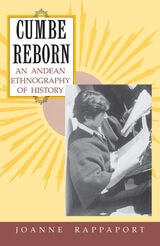
cover of Cumbe Reborn: An Andean Ethnography of History

Cumbe Reborn

An Andean Ethnography of History

Joanne Rappaport

University of Chicago Press, 1993

According to legend, Cumbe ruled the Colombian community of Cumbal during the Spanish invasion. Although there is no documentation of Chief Cumbe's existence, today's Cumbales point to him as their ancestral link to Pasto ancestors. His image reappears often in popular music, theater, community organization, and militant politics as the Cumbales attempt to reinvigorate their indigenous heritage and reclaim the lands this heritage justifies.

Joanne Rappaport examines the Cumbales' reappropriation of history and the resulting reinvention of tradition. She explores the ways in which personal memories are interpreted in nonverbal expression, such as ritual and material culture, as well as in oral and written communication. This novel approach to historical consciousness is grounded on a unique combination of historical and ethnographical analysis.

Cumbe Reborn makes a significant contribution both to our understanding of ethnic militancy in the Americas and to the broader methodological discussion of non-western historical consciousness under colonial domination. It will attract a wide audience of anthropologists, historians, specialists in Andean ethnohistory and Latin American studies and literature, and folklore specialists interested in subaltern discourse.
[more]