663 books match the query 'China' and 110 start with c
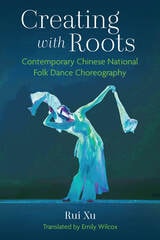
cover of Creating with Roots: Contemporary Chinese National Folk Dance Choreography

Creating with Roots

Contemporary Chinese National Folk Dance Choreography

Rui Xu

University of Michigan Press, 2025

Creating with Roots is a critical introduction to the history, theory, and creative practice of Chinese national folk dance, the Chinese-speaking world’s most popular contemporary dance form. A complex cultural and artistic phenomenon that resists simple categorization, Chinese national folk dance merges folkloric material with contemporary stage aesthetics and blends rural folk dances of the Han majority with dances representing China’s minoritized ethnic communities, bridging cultural differences of geography, economic class, and ethnicity. As such, Chinese national folk dance has become a lightning rod for current debates in the arts worldwide—how to balance local heritage with artistic innovation, how to maintain cultural integrity amid commercialization and Eurocentrism, and the ethics of representation in contemporary multiculturalism. Chinese national folk dance is increasingly a globalized phenomenon: schools, classes, competitions, and performances of professionals and amateurs now exist all across the world. Originally published in Chinese and authored by prominent Chinese dance scholar, Rui Xu, this English translation will be an essential resource for the global conversation about how dancers and choreographers navigate tradition and innovation in contemporary national folk dance choreography. 

Creating with Roots offers a detailed breakdown of key terms and concepts necessary for understanding Chinese national folk dance and analyzes 37 examples of choreography dating from the 1940s to 2000. The author situates these explanations within the longer history of cultural practice and theory in China and in relation to the international dance discourses of the former Soviet Union, Eastern Europe, Western Europe, and North America. 
[more]
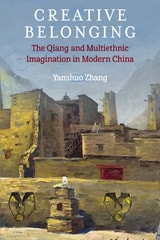
cover of Creative Belonging: The Qiang and Multiethnic Imagination in Modern China

Creative Belonging

The Qiang and Multiethnic Imagination in Modern China

Yanshuo Zhang

University of Michigan Press, 2026

China is a multicultural country home to fifty-five ethnic minority groups, yet due to linguistic and cultural barriers many of these groups remain understudied or unknown in the West. The Qiang, one of modern China’s officially recognized ethnic minorities, is also China’s longest-standing ethnoracial identity marker that has existed since the earliest recorded history of China. Creative Belonging investigates the formation and evolution of the Qiang as a people, a concept, and a cultural history in China. It further examines how the contemporary Qiang ethnic group interacts strategically with mainstream Chinese society, challenging the historically entrenched hierarchies between the sociocultural “centers” of China and its ethnic “peripheries.” 

This book is based on years of ethnographic and textual-archival research in the Himalayan regions of southwest China, where the contemporary Qiang group resides. Drawing on a diverse range of official and local political discourses and previously unstudied literary, historiographical, and cinematic works, Yanshuo Zhang illuminates how the Qiang have carved out spaces of “creative belonging” within the parameters of multiculturalism in contemporary China. Rooted in ethnographic and textual-archival research, the book presents original materials produced by Qiang indigenous writers, scholars, artists, grassroots village cultural activists, and entrepreneurs at both the local and the global levels. Creative Belonging invites readers to rethink ethnicity and national belonging in China by centering minority groups’ efforts to expand the meanings and implications of “Chinese culture.” 
[more]
cover of Creativity and Its Discontents: China's Creative Industries and Intellectual Property Rights Offenses

Creativity and Its Discontents

China's Creative Industries and Intellectual Property Rights Offenses

Laikwan Pang

Duke University Press, 2012
Creativity and Its Discontents is a sharp critique of the intellectual property rights (IPR)–based creative economy, particularly as it is embraced or ignored in China. Laikwan Pang argues that the creative economy—in which creativity is an individual asset to be commodified and protected as property—is an intensification of Western modernity and capitalism at odds with key aspects of Chinese culture. Nevertheless, globalization has compelled China to undertake endeavors involving intellectual property rights. Pang examines China’s IPR-compliant industries, as well as its numerous copyright violations. She describes how China promotes intellectual property rights in projects such as the development of cultural tourism in the World Heritage city of Lijiang, the transformation of Hong Kong cinema, and the cultural branding of Beijing. Meanwhile, copyright infringement proliferates, angering international trade organizations. Pang argues that piracy and counterfeiting embody the intimate connection between creativity and copying. She points to the lack of copyright protections for Japanese anime as the motor of China's dynamic anime culture. Theorizing the relationship between knockoffs and appropriation art, Pang offers an incisive interpretation of China’s flourishing art scene. Creativity and Its Discontents is a refreshing rejoinder to uncritical celebrations of the creative economy.
[more]
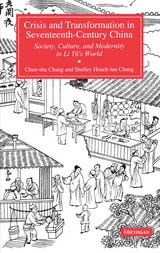
cover of Crisis and Transformation in Seventeenth-Century China: Society, Culture, and Modernity in Li Yu's World

Crisis and Transformation in Seventeenth-Century China

Society, Culture, and Modernity in Li Yu's World

Chun-shu Chang and Shelley Hsueh-lun Chang

University of Michigan Press, 1998

The seventeenth century was a time of great social and political upheaval in China. In Crisis and Transformation in Seventeenth-Century China, Chun-shu Chang and Shelley Hsueh-lun Chang offer a detailed and engaging analysis of society, culture, and the state in China during this critical period.
The main thread of the book follows the life and works of a remarkable figure of the period, Li Yü (1611-80), whose vast array of accomplishments and experiences mirror seventeenth-century China in all its complexity and excitement. Li Yü's China was a world of unprecedented changes in almost all spheres of life. A thriving commercial and industrial economy, stupendous population growth, and the emergence of a new age of science and technology were accompanied by intense urbanization, radical views on money, wealth, and luxury, liberal attitudes toward sexuality, and developments that would change the nature of the literary and intellectual world. The Changs' exhaustive exploration of Chinese historical and literary sources of the sixteenth and seventeenth centuries is combined with a selective application of interpretive insights and analytic techniques from the major theoretical schools.
An important resource for scholars in history, literature, and Asian studies, Crisis and Transformation extends its appeal to those interested in the history of science, issues of gender and social transformation, and popular culture movements.
Chun-shu Chang is Professor of History, University of Michigan, and Honorary Professor of Chinese History, China. Shelley Hsueh-lun Chang is Visiting Associate Professor of History and Research Associate, Center for Chinese Studies, University of Michigan.
[more]
cover of Crisis in Korea: America, China and the Risk of War

Crisis in Korea

America, China and the Risk of War

Tim Beal

Pluto Press, 2011

The South Korean warship Cheonan was sunk in mysterious circumstances on 26 March 2010. The remarkable events that followed are analysed by Tim Beal and woven into a larger study of the increasingly volatile relations between North and South Korea and US concern about the rise of China.

South Korea's stance towards the North has hardened significantly since the new conservative government came to power. Beal argues that the South moved quickly to use the sinking of the Cheonan to put international pressure on the North, even before the cause of the sinking had been established. The US followed suit by attempting to pressurise China into condemning North Korea. The media reports at the time presented an open and shut case of unprovoked North Korean aggression, but the evidence points towards the accidental triggering of a South Korean mine as the cause and South Korean fabrication to incriminate the North.

With the South bent on forcing the fall of the North's regime with US help and China unlikely to stand idly by, this book offers an essential guide to the key factors behind the crisis and possible solutions.
[more]
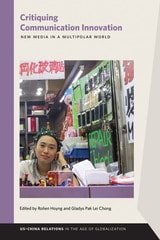
cover of Critiquing Communication Innovation: New Media in a Multipolar World

Critiquing Communication Innovation

New Media in a Multipolar World

Rolien Hoyng

Michigan State University Press, 2022
Challenges to Silicon Valley’s dominant role in conjuring and patenting the world’s technological futures are arising around the world. As digital media technologies emerge from new, globally dispersed locations, a multipolar order of communication innovation seems to be in the making. Yet recovering our ability to imagine futures otherwise requires negotiating conditions—economic, geopolitical, sociocultural, and ecological—rather than reproducing them under the pretext of breaking with the present. The essays in this volume examine research on such conditions critically and comparatively in a variety of geographies. Paying due attention to China’s rise as an innovative platform society and AI powerhouse, this book addresses the broader question of a shifting world order and trends that are shaped by China’s influence but that extend beyond its borders. Looking at multipolar communication innovation through various critical lenses, our technological futures simultaneously appear to be old, new, and uncertain, while the infrastructures and platforms underpinning communication innovation both affiliate communities and set them apart.
[more]
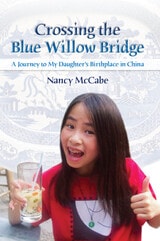
cover of Crossing the Blue Willow Bridge: A Journey to My Daughter's Birthplace in China

Crossing the Blue Willow Bridge

A Journey to My Daughter's Birthplace in China

Nancy McCabe

University of Missouri Press, 2011

 
Even before Nancy McCabe and her daughter, Sophie, left for China, it was clear that, as the mother of an adopted child from China, McCabe would be seeing the country as a tourist while her daughter, who was seeing the place for the first time in her memory, was “going home.” Part travelogue, part memoir, Crossing the Blue Willow Bridge immerses readers in an absorbing and intimate exploration of place and its influence on the meaning of family.
A sequel to Meeting Sophie, which tells McCabe’s story of adopting Sophie as a single woman, Crossing the Blue Willow Bridge picks up a decade later with a much different Sophie—a ten-year-old with braces who wears black nail polish, sneaks eyeliner, wears clothing decorated with skulls, and has mixed feelings about being one of the few non-white children in the little Pennsylvania town where they live. Since she was young, Sophie had felt a closeness to the country of her birth and held it in an idealized light. At ten, she began referring to herself as Asian instead of Asian-American. It was McCabe’s hope that visiting China would “help her become comfortable with both sides of the hyphen, figure out how to be both Chinese and American, together.”
As an adoptive parent of a foreign-born child, McCabe knows that homeland visits are an important rite of passage to help children make sense of the multiple strands of their heritage, create their own hybrid traditions, and find their particular place in the world. Yet McCabe, still reeling from her mother’s recent death, wonders how she can give any part of Sophie back to her homeland. She hopes that Sophie will find affirmation and connection in China, even as she sees firsthand some of the realities of China—overpopulation, pollution, and an oppressive government—but also worries about what that will mean for their relationship.
Throughout their journey on a tour for adopted children, mother and daughter experience China very differently. New tensions and challenges emerge, illuminating how closely intertwined place is with sense of self. As the pair learn to understand each other, they lay the groundwork for visiting Sophie’s orphanage and birth village, life-changing experiences for them both.
[more]
cover of Cultural Industries in Shanghai: Policy and Planning inside a Global City

Cultural Industries in Shanghai

Policy and Planning inside a Global City

Edited by Rong Yueming and Justin O’Connor

Intellect Books, 2018
This volume gathers articles by Chinese scholars dealing with developments in Shanghai’s cultural industries over the past thirty years. Like many cities in China and elsewhere, Shanghai has explicitly stated that fostering the creative economy is its top economic and political priority over the next decade. This book examines, among other aspects of Shanghai’s approach to culture, the effects of this policy focus on the city’s creative growth in economic terms.
[more]
cover of Cultural Revolution and Revolutionary Culture

Cultural Revolution and Revolutionary Culture

Alessandro Russo

Duke University Press, 2020
In Cultural Revolution and Revolutionary Culture, Alessandro Russo presents a dramatic new reading of China's Cultural Revolution as a mass political experiment aimed at thoroughly reexamining the tenets of communism. Russo explores four critical phases of the Cultural Revolution, each with its own reworking of communist political subjectivity: the historical-theatrical “prologue” of 1965; Mao's attempts to shape the Cultural Revolution in 1965 and 1966; the movements and organizing between 1966 and 1968 and the factional divides that ended them; and the mass study campaigns from 1973 to 1976 and the unfinished attempt to evaluate the inadequacies of the political decade that brought the Revolution to a close. Among other topics, Russo shows how the dispute around the play Hai Rui Dismissed from Office was not the result of a Maoist conspiracy, but rather a series of intense and unresolved political and intellectual controversies. He also examines the Shanghai January Storm and the problematic foundation of the short-lived Shanghai Commune. By exploring these and other political-cultural moments of Chinese confrontations with communist principles, Russo overturns conventional wisdom about the Cultural Revolution.
[more]
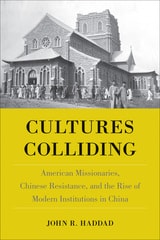
cover of Cultures Colliding: American Missionaries, Chinese Resistance, and the Rise of Modern Institutions in China

Cultures Colliding

American Missionaries, Chinese Resistance, and the Rise of Modern Institutions in China

John R. Haddad

Temple University Press, 2023

As incredible as it may seem, the American missionaries who journeyed to China in 1860 planning solely to spread the Gospel ultimately reinvented their entire enterprise. By 1900, they were modernizing China with schools, colleges, hospitals, museums, and even YMCA chapters. In Cultures Colliding, John R. Haddad nimbly recounts this transformative institution-building—how and why it happened—and its consequences. 

When missionaries first traveled to rural towns atop mules, they confronted populations with entrenched systems of belief that embraced Confucius and rejected Christ. Conflict ensued as these Chinese viewed missionaries as unwanted disruptors. So how did this failing movement eventually change minds and win hearts? Many missionaries chose to innovate. They built hospitals and established educational institutions offering science and math. A second wave of missionaries opened YMCA chapters, coached sports, and taught college. Crucially, missionaries also started listening to Chinese citizens, who exerted surprising influence over the preaching, teaching, and caregiving, eventually running some organizations themselves. They embraced new American ideals while remaining thoroughly Chinese.

In Cultures Colliding, Haddad recounts the unexpected origins and rapid rise of American institutions in China by telling the stories of the Americans who established these institutions and the Chinese who changed them from within. Today, the impact of this untold history continues to resonate in China.

[more]