Results by title
1882 books match the query 'Criticism and interpretation' and 112 start with c
Crafting the Female Subject
Narrative Innovation in the Short Fiction of Emilia Pardo BazánSusan M. McKenna
Catholic University of America Press, 2009

Creating a World on Paper
Harry Fenn's Career in ArtSue Rainey
University of Massachusetts Press, 2013
Arriving in New York from London in 1857 as a young wood engraver, Fenn soon forged a career in illustration. His tiny black-and-white wood engravings for Whittier's Snow-Bound (1868) surprised critics with their power, and his bold, innovative compositions for Picturesque America (1872–74) were enormously popular and expanded the field for illustrators and publishers. In the 1880s and '90s, his illustrations appeared in many of the finest magazines and newspapers, depicting the places and events that interested the public—from post–Civil War national reconciliation to the World's Columbian Exposition in 1893 to the beginnings of imperialism in the Spanish-American War.
This handsomely designed volume documents Fenn's prolific career from the 1860s until his death in 1911. Sue Rainey also recounts his adventurous sketching trips in the western United States, Europe, and the Middle East, which enhanced his reputation for depicting far-flung places at a time when the nation was taking a more prominent role on the world stage.
Crisis and Transformation in Seventeenth-Century China
Society, Culture, and Modernity in Li Yu's WorldChun-shu Chang and Shelley Hsueh-lun Chang
University of Michigan Press, 1998
The main thread of the book follows the life and works of a remarkable figure of the period, Li Yü (1611-80), whose vast array of accomplishments and experiences mirror seventeenth-century China in all its complexity and excitement. Li Yü's China was a world of unprecedented changes in almost all spheres of life. A thriving commercial and industrial economy, stupendous population growth, and the emergence of a new age of science and technology were accompanied by intense urbanization, radical views on money, wealth, and luxury, liberal attitudes toward sexuality, and developments that would change the nature of the literary and intellectual world. The Changs' exhaustive exploration of Chinese historical and literary sources of the sixteenth and seventeenth centuries is combined with a selective application of interpretive insights and analytic techniques from the major theoretical schools.
An important resource for scholars in history, literature, and Asian studies, Crisis and Transformation extends its appeal to those interested in the history of science, issues of gender and social transformation, and popular culture movements.
Chun-shu Chang is Professor of History, University of Michigan, and Honorary Professor of Chinese History, China. Shelley Hsueh-lun Chang is Visiting Associate Professor of History and Research Associate, Center for Chinese Studies, University of Michigan.
Cristi Puiu
Monica Filimon
University of Illinois Press, 2017
Critical Approaches to the Films of Robert Rodriguez
By Frederick Luis Aldama
University of Texas Press, 2015
Frederick Aldama’s The Cinema of Robert Rodriguez (2014) was the first full-scale study of one of the most prolific and significant Latino directors making films today. In this companion volume, Aldama enlists a corps of experts to analyze a majority of Rodriguez’s feature films, from his first break-out success El Mariachi in 1992 to Machete in 2010. The essays explore the formal and thematic features present in his films from the perspectives of industry (context, convention, and distribution), the film blueprint (auditory and visual ingredients), and consumption (ideal and real audiences). The authors illuminate the manifold ways in which Rodriguez’s films operate internally (plot, character, and event) and externally (audience perception, thought, and feeling).
The volume is divided into three parts: “Matters of Mind and Media” includes essays that use psychoanalytic and cognitive psychology to shed light on how Rodriguez’s films complicate Latino identity, as well as how they succeed in remaking audiences’ preconceptions of the world. “Narrative Theory, Cognitive Science, and Sin City: A Case Study” offers tools and models of analysis for the study of Rodriguez’s film re-creation of a comic book (on which Frank Miller was credited as codirector). “Aesthetic and Ontological Border Crossings and Borderlands” considers how Rodriguez’s films innovatively critique fixed notions of Latino identity and experience, as well as open eyes to racial injustices. As a whole, the volume demonstrates how Rodriguez’s career offers critical insights into the filmmaking industry, the creative process, and the consuming and reception of contemporary film.

Critical Paths
Blake and the Argument of MethodDan Miller, Mark Bracher and Donald Ault, eds.
Duke University Press, 1987
The contributors assembled here, leading exponents of contemporary critical methods as well as close students of Blake, argue the grounds, purposes, and validity of each approach and then apply its method in detailed readings of Blake's works. We see deconstruction, psychoanalytic interpretation, feminist critique, semiotic analysis, Marxist criticism, revisionism, and other methods brought to bear on Blake's texts and into confrontation with one another by those best able to do so.
Through the essays themselves and in the reaction they will certainly provoke, Critical Paths will bring increased theoretical awareness to the study of Blake and will further the ongoing redefinition of Blake's art. At the same time, the collection investigates the general problem of methodology in literary studies by means of a casebook examination of modern critical approaches. Blake criticism and current literary theory here come together; the encounter illuminates and enriches both.
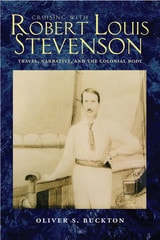
Cruising with Robert Louis Stevenson
Travel, Narrative, and the Colonial BodyOliver S. Buckton
Ohio University Press, 2007
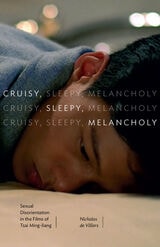
Cruisy, Sleepy, Melancholy
Sexual Disorientation in the Films of Tsai Ming-liangNicholas de Villiers
University of Minnesota Press, 2022
A brilliant approach to the queerness of one of Taiwan’s greatest auteurs
A critical figure in queer Sinophone cinema—and the first director ever commissioned to create a film for the permanent collection of the Louvre—Tsai Ming-liang is a major force in Taiwan cinema and global moving image art. Cruisy, Sleepy, Melancholy offers a fascinating, systematic method for analyzing the queerness of Tsai’s films.
Nicholas de Villiers argues that Tsai expands and revises the notion of queerness by engaging with the sexuality of characters who are migrants, tourists, diasporic, or otherwise displaced. Through their lack of fixed identities, these characters offer a clear challenge to the binary division between heterosexuality and homosexuality, as well as the Orientalist binary division of Asia versus the West. Ultimately, de Villiers explores how Tsai’s films help us understand queerness in terms of spatial, temporal, and sexual disorientation.
Conceiving of Tsai’s cinema as an intertextual network, Cruisy, Sleepy, Melancholy makes an important addition to scholarly work on Tsai in English. It draws on extensive interviews with the director, while also offering a complete reappraisal of Tsai’s body of work. Contributing to queer film theory and the aesthetics of displacement, Cruisy, Sleepy, Melancholy reveals striking connections between sexuality, space, and cinema.
Culture in the Anteroom
The Legacies of Siegfried KracauerEdited by Gerd Gemünden and Johannes von Moltke
University of Michigan Press, 2012
Culture in the Anteroom introduces an English-speaking readership to the full range of Siegfried Kracauer's work as novelist, architect, journalist, sociologist, historian, exile critic, and theorist of visual culture. This interdisciplinary anthology---including pieces from Miriam Bratu Hansen, Andreas Huyssen, Noah Isenberg, Lutz Koepnick, Eric Rentschler, and Heide Schlüpmann---brings together literary and film scholars, historians and art historians, sociologists, and architects to address the scope and current relevance of a body of work dedicated to investigating all aspects of modernism and modernity. The contributors approach Kracauer's writings from a variety of angles, some by placing them in dialogue with his contemporaries in Weimar Germany and the New York Intellectuals of the 1940s and '50s; others by exploring relatively unknown facets of Kracauer's oeuvre by considering his contributions to architectural history, the history of radio as well as other new media, and museum and exhibition culture.
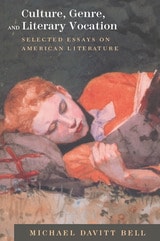
Culture, Genre, and Literary Vocation
Selected Essays on American LiteratureMichael Davitt Bell
University of Chicago Press, 2000
Throughout, Bell revisits issues of genre with an eye toward the unexpected details of authors' lives, and invites us to reconsider the hidden functions that terms such as "romanticism" and "realism" served for authors and their critics. Whether tracing the demands of the market or the expectations of readers, Bell examines the intimate relationship between literary production and culture; each essay closely links the milieu in which American writers worked with the trajectory of their storied careers.
Cultures of Modernism
Marianne Moore, Mina Loy, and Else Lasker-SchulerCristanne Miller
University of Michigan Press, 2005
Cultures of Modernism explores how the structure and location of literary communities significantly influence who writes, what they write about, and their openness to formal experimentation. These influences particularly affect women writers. Author Cristanne Miller notes striking patterns of similarity in the concerns and lives of women living in geographically distant centers of modernist production. She looks at three significant poets---the American Marianne Moore, the British expatriate Mina Loy, and the German Else Lasker-Schüler---in the context of cultural, national, and local elements to argue that location significantly affected their performances of subjectivity, gender, race, and religion. The first book of its kind, Cultures of Modernism breaks new ground while it contributes to the ongoing reconception of the modernist period.
"A fascinating, provocative, and genuinely original study of a 'different' modernism in poetry---namely, the Modernism of women poets."
---Marjorie Perloff, Stanford University
"An important and ambitious work that makes major contributions to the fields of gender studies and modernist studies, and to the study of modernist poetry."
---Robin Schulze, Pennsylvania State University
"Offers a welcome corrective to the unreflective critical tendency . . . to make broad claims about the historical experiences and cultural conundrums of 'women,' and particularly 'women writers.' Miller offers tour-de-force comparative readings . . . threading together the world-historical with the personal, poetics with the political, and wielding the instruments of scansion as deftly as a surgeon."
---Modernism/modernity, The Official Journal of the Modernist Studies Association
Cristanne Miller is Edward H. Butler Professor of English and Chair of the English Department at the University of Buffalo, State University of New York.
Curved Thought and Textual Wandering
Gertrude Stein's PostmodernismEllen E. Berry
University of Michigan Press, 1992