Results by title
3703 books match the query '19th Century' and 228 start with c
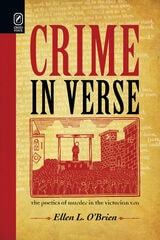
Crime in Verse
The Poetics of Murder in the Victorian EraEllen L. O’Brien
The Ohio State University Press, 2008
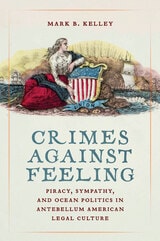
Crimes Against Feeling
Piracy, Sympathy, and Ocean Politics in Antebellum American Legal CultureMark B. Kelley
University of Massachusetts Press, 2026
Demonstrating how emotion became central to the legal and literary meanings of piracy in nineteenth-century America
Pirates have long occupied a central yet unstable place in American law and national identity. In the decades leading up to and including the U.S. Civil War, the charge of piracy was leveled against an unusually wide range of figures: foreign heads of state, imperial filibusters, transoceanic enslavers, enslaved mutineers, radical abolitionists, and others who challenged established forms of authority. Early American literature reflects this instability, portraying pirates who vary dramatically in politics, race, gender, and allegiance. As Mark B. Kelley shows, these characters are united less by ideology than by their challenge to landed social norms and fixed national belonging. The pirate, in both law and literature, emerges as an individual defined by multiplicity rather than political coherence.
Crimes Against Feeling examines how Americans made sense of this ambiguous figure by turning to emotion. Drawing on legal materials including treaties, trial transcripts, congressional debates, and U.S. Supreme Court decisions, as well as popular sentimental fiction (often written by women), Kelley argues that piracy was codified as an offense against moral feeling rather than being a singular political position. Legal thinkers and writers such as John Quincy Adams, Abraham Lincoln, Jefferson Davis, Catharine Maria Sedgwick, Harriet Beecher Stowe, and Maria S. Cummins relied on shared affective frameworks—sympathy, sentiment, and domestic vulnerability—to render piracy legible and punishable. American pirate law, Kelley demonstrates, was shaped by the same emotional logics that structured the era’s popular fiction.
By tracing piracy across debates over domestic sovereignty, global enslavement and abolition, imperial expansion, postbellum reparations, and international copyright, Crimes Against Feeling reveals the pirate as a key figure for understanding gender, home, family, and nation in early America. Reading law and literature together, the book shows how emotional judgment—not political consensus—became a foundational tool for managing oceanic violence and transnational disorder in the nineteenth-century United States.
Crimes of Art and Terror
Frank Lentricchia and Jody McAuliffe
University of Chicago Press, 2003
Crimes of Art and Terror reveals how the desire beneath many romantic literary visions is that of a terrifying awakening that would undo the West's economic and cultural order. This is also the desire, of course, of what is called terrorism. As the authority of writers and artists recedes, it is criminals and terrorists, Lentricchia and McAuliffe suggest, who inherit this romantic, destructive tradition. Moving freely between the realms of high and popular culture, and fictional and actual criminals, the authors describe a web of impulses that catches an unnerving spirit.
Lentricchia and McAuliffe's unorthodox approach pairs Dostoevsky's Crime and Punishment with Martin Scorsese's King of Comedy and connects the real-life Unabomber to the surrealist Joseph Cornell and to the hero of Bret Easton Ellis's bestselling novel American Psycho. They evoke a desperate culture of art through thematic dialogues among authors and filmmakers as varied as Don DeLillo, Joseph Conrad, Francis Ford Coppola, Jean Genet, Frederick Douglass, Hermann Melville, and J. M. Synge, among others. And they conclude provocatively with an imagined conversation between Heinrich von Kleist and Mohamed Atta. The result is a brilliant and unflinching reckoning with the perilous proximity of the impulse to create transgressive art and the impulse to commit violence.
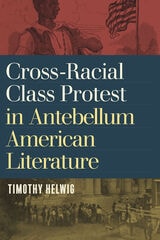
Cross-Racial Class Protest in Antebellum American Literature
Timothy Helwig
University of Massachusetts Press, 2020
Timothy Helwig analyzes the shared strategies of class protest in popular and canonical texts from a range of antebellum white and black American authors, including George Lippard, Ned Buntline, Harry Hazel, Frederick Douglass, William Wells Brown, and Frank J. Webb. This pathbreaking study offers original perspectives on racial representations in antebellum American print culture and provides a new understanding of black and white authors' strivings for socioeconomic justice across racial lines in the years leading up to the Civil War.
Crossing Borders, Claiming a Nation
A History of Argentine Jewish Women, 1880–1955Sandra McGee Deutsch
Duke University Press, 2010
Drawing on extensive archival research and original oral histories, Deutsch tells the stories of individual women, relating their sentiments and experiences as both insiders and outsiders to state formation, transnationalism, and cultural, political, ethnic, and gender borders in Argentine history. As agricultural pioneers and film stars, human rights activists and teachers, mothers and doctors, Argentine Jewish women led wide-ranging and multifaceted lives. Their community involvement—including building libraries and secular schools, and opposing global fascism in the 1930s and 1940s—directly contributed to the cultural and political lifeblood of a changing Argentina. Despite their marginalization as members of an ethnic minority and as women, Argentine Jewish women formed communal bonds, carved out their own place in society, and ultimately shaped Argentina’s changing pluralistic culture through their creativity and work.
Crossing the Border
A Free Black Community in CanadaSharon A. Roger Hepburn
University of Illinois Press, 2007
How formerly enslaved people found freedom and built community in Ontario
In 1849, the Reverend William King and fifteen once-enslaved people he had inherited founded the Canadian settlement of Buxton on Ontario land set aside for sale to Blacks. Though initially opposed by some neighboring whites, Buxton grew into a 700-person agricultural community that supported three schools, four churches, a hotel, a lumber mill, and a post office.
Sharon A. Roger Hepburn tells the story of the settlers from Buxton’s founding of through its first decades of existence. Buxton welcomed Black men, woman, and children from all backgrounds to live in a rural setting that offered benefits of urban life like social contact and collective security. Hepburn’s focus on social history takes readers inside the lives of the people who built Buxton and the hundreds of settlers drawn to the community by the chance to shape new lives in a country that had long represented freedom from enslavement.
Crossing the Deadly Ground
United States Army Tactics, 1865–1899Perry D. Jamieson
University of Alabama Press, 2004
Attempts to answer difficult questions about battle tactics employed by the United States Army
Weapons improved rapidly after the Civil War, raising difficult questions about the battle tactics employed by the United States Army. The most fundamental problem was the dominance of the tactical defensive, when defenders protected by fieldworks could deliver deadly fire from rifles and artillery against attackers advancing in close-ordered lines. The vulnerability of these offensive forces as they crossed the so-called "deadly ground" in front of defensive positions was even greater with the improvement of armaments after the Civil War.
Crossroads of Freedom
Slaves and Freed People in Bahia, Brazil, 1870-1910Walter Fraga
Duke University Press, 2016
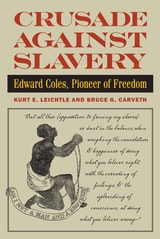
Crusade Against Slavery
Edward Coles, Pioneer of FreedomKurt E. Leichtle and Bruce G. Carveth
Southern Illinois University Press, 2011
Rejecting slavery from a young age, Coles's early wishes to free his family's slaves initially were stymied by legal, practical, and family barriers. Instead he went to Washington, D.C., where his work in the White House was a life-changing blend of social glitter, secretarial drudge, and distasteful political patronage. Returning home, he researched places where he could live out his ideals. After considerable planning and preparation, he left his family's Virginia tobacco plantation in 1819 and started the long trip west to Edwardsville, Illinois, pausing along the Ohio River on an emotional April morning to free his slaves and offer each family 160 acres of Illinois land of their own. Some continued to work for Coles, while others were left to find work for themselves. This book revisits the lives of the slaves Coles freed, including a noted preacher and contributor to the founding of what is now the second-oldest black Baptist organization in America.
Crusade Against Slavery details Coles's struggles with frontier life and his surprise run and election to the office of Illinois governor as well as his continuing antislavery activities. At great personal cost, he led the effort to block a constitutional convention that would have legalized slavery in the state, which resulted in an acrimonious civil suit brought on by his political enemies, who claimed he violated the law by not issuing a bond of emancipation for his slaves. Although initially convicted by a partisan jury, Coles was vindicated when the Illinois Supreme Court overturned the decisions of the lower courts. Through the story of Coles's moral and legal battles against slavery, Leichtle and Carveth unearth new perspectives on an institution that was on unsure footing yet strongly ingrained in the business interests at the economic base of the fledgling state.
In 1831, after less than a decade in Illinois-and after losing a bid for Congress-Coles left for Philadelphia, where he remained in correspondence with Madison about the issue of slavery. Drawing on previous incomplete treatments of Coles's life, including his own short memoir, Crusade Against Slavery includes the first published analysis of Madison's failure to free his slaves despite his plans to do so through his will and a fascinating exploration of Coles's struggle to understand Madison's inability to live up to the ideals both men shared.
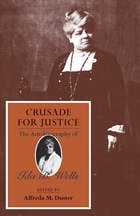
Crusade for Justice
The Autobiography of Ida B. WellsIda B. Wells
University of Chicago Press, 1970
"No student of black history should overlook Crusade for Justice."—William M. Tuttle, Jr., Journal of American History
"Besides being the story of an incredibly courageous and outspoken black woman in the face of innumerable odds, the book is a valuable contribution to the social history of the United States and to the literature of the women's movement as well."—Elizabeth Kolmer, American Quarterly
"[Wells was] a sophisticated fighter whose prose was as thorough as her intellect."—Walter Goodman, New York Times
"An illuminating narrative of a zealous, race-conscious, civic- and church-minded black woman reformer, whose life story is a significant chapter in the history of Negro-White relations."—Thelma D. Perry, Negro History Bulletin
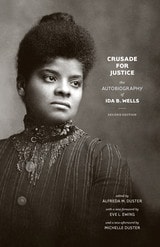
Crusade for Justice
The Autobiography of Ida B. Wells, Second EditionIda B. Wells
University of Chicago Press, 2020
Ida B. Wells is an American icon of truth telling. Born to slaves, she was a pioneer of investigative journalism, a crusader against lynching, and a tireless advocate for suffrage, both for women and for African Americans. She co-founded the NAACP, started the Alpha Suffrage Club in Chicago, and was a leader in the early civil rights movement, working alongside W. E. B. Du Bois, Madam C. J. Walker, Mary Church Terrell, Frederick Douglass, and Susan B. Anthony.
This engaging memoir, originally published 1970, relates Wells’s private life as a mother as well as her public activities as a teacher, lecturer, and journalist in her fight for equality and justice. This updated edition includes a new foreword by Eve L. Ewing, new images, and a new afterword by Ida B. Wells’s great-granddaughter, Michelle Duster.
Crusoes and Other Castaways in Modern French Literature
Solitary AdventuresJoseph Acquisto
University of Delaware Press, 2012
Published by University of Delaware Press. Distributed worldwide by Rutgers University Press.
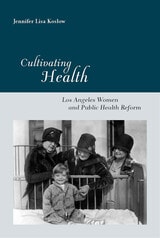
Cultivating Health
Los Angeles Women and Public Health ReformKoslow, Jennifer
Rutgers University Press, 2009
Cultivating Health, an interdisciplinary chronicle, details women's impact on remaking health policy, despite the absence of government support. Combining primary source and municipal archival research with comfortable prose, Jennifer Lisa Koslow explores community nursing, housing reform, milk sanitation, childbirth, and the campaign against venereal disease in late nineteenth and early twentieth century Los Angeles. She demonstrates how women implemented health care reform and civic programs while laying the groundwork for a successful transition of responsibility back to government.
Koslow highlights women's home health care and urban policy-changing accomplishments and pays tribute to what would become the model for similar service-based systems in other American centers.
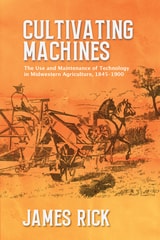
Cultivating Machines
The Use and Maintenance of Technology in Midwestern Agriculture, 1845–1900James Rick
Ohio University Press, 0
How farmers shaped the development of agricultural machinery
Throughout the second half of the nineteenth century, farmers in the midwestern United States and in Ontario began adopting new agricultural machines: threshers, reapers, and drills for more efficient production of grains, as well as sewing and washing machines for more efficient production within the farm household. By using, maintaining, and altering these machines within the natural and social contexts of their farms, rural people produced new technological systems of industrial agriculture. They also struggled with machine manufacturers and their agents for control of those systems—both individually and through farmers’ organizations. Cultivating Machines contributes to historiographies of capitalism, technology, and agriculture as it demonstrates the importance of everyday know-how and informed tinkering to the mechanization of grain agriculture.
In this study, James Rick moves from the middle decades of the nineteenth century, and the introduction of horse-powered machines, to the end of the century, when mechanized technologies became indispensable and central parts of farms themselves. Ultimately, large-scale wheat production, the increased complexity of machines, the need for replacement parts, and the efforts of manufacturers and their agents to assert themselves as authorities over industrial agriculture diminished the technological independence of farming people.
Cultural Genocide
Davidson, Lawrence
Rutgers University Press, 2012
Most scholars of genocide focus on mass murder. Lawrence Davidson, by contrast, explores the murder of culture. He suggests that when people have limited knowledge of the culture outside of their own group, they are unable to accurately assess the alleged threat of others around them. Throughout history, dominant populations have often dealt with these fears through mass murder. However, the shock of the Holocaust now deters today’s great powers from the practice of physical genocide. Majority populations, cognizant of outside pressure and knowing that they should not resort to mass murder, have turned instead to cultural genocide as a “second best” politically determined substitute for physical genocide.
In Cultural Genocide, this theory is applied to events in four settings, two events that preceded the Holocaust and two events that followed it: the destruction of American Indians by uninformed settlers who viewed these natives as inferior and were more intent on removing them from the frontier than annihilating them; the attack on the culture of Eastern European Jews living within Russian-controlled areas before the Holocaust; the Israeli attack on Palestinian culture; and the absorption of Tibet by the People’s Republic of China.
In conclusion, Davidson examines the mechanisms that may be used to combat today’s cultural genocide as well as the contemporary social and political forces at work that must be overcome in the process.
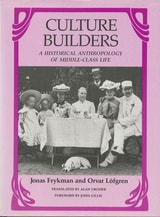
Culture Builders
A Historical Anthropology of Middle Class LifeFrykman, Jonas
Rutgers University Press, 1987
Culture Builders deals primarily with the ways in which ideas about the good and proper life are anchored in the trivialities and routines of everyday life: in the sharing of a meal, in holiday-making, and in the upbringing of children. The authors describe how the attitudes of the bourgeoisie toward. Time and time-keeping set them apart from the peasantry. Uses and perceptions of naturals increasingly divided the classes. For peasants, nature consisted of natural resources to be used. Fr the bourgeoisie, nature had only non-productive connotations. Another change was the growing importance of home over the community. Life became a romantic ideal, not an economic necessity. For the first time, parents became self-conscious about how to raise their children.
Frykman and Lögnen also show how the middle-class developed new perceptions of dirt, pollution, orderliness, health, sexuality, and bodily functions, and how they disdained the filth of peasant households. By stressing refinement, rationality, morality, and discipline, the middle classes were able to differentiate themselves not only from the peasants, but also from the degenerate aristocracy and the disordered and uncontolled emerging working class. The bourgeoisie viewed their own form of culture as the highest on the evolutionary ladder, and turned it into a national culture against which all other groups would be measured.
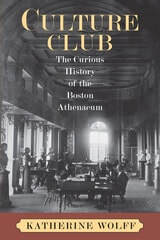
Culture Club
The Curious History of the Boston AthenaeumKatherine Wolff
University of Massachusetts Press, 2009
Yet from the outset, Katherine Wolff shows, the Boston Athenaeum was more than a library; it was also a breeding ground for evolving notions of cultural authority and American identity. Though governed by the Boston elite, who promoted it as a way of strengthening their own clout in the city, the early Athenaeum reflected conflicting and at times contradictory aims and motives on the part of its membership. On the one hand, by drawing on European aesthetic models to reinforce an exalted sense of mission, Athenaeum leaders sought to establish themselves as guardians of a nascent American culture. On the other, they struggled to balance their goals with their concerns about an increasingly democratic urban populace. As the Boston Athenaeum opened its doors to women as well as men outside its inner circle, it eventually began to define itself against a more accessible literary institution, the Boston Public Library.
Told through a series of provocative episodes and generously illustrated, Culture Club offers a more complete picture than previously available of the cultural politics behind the making of a quintessentially American institution.
Culture and Money in the Nineteenth Century
Abstracting EconomicsDaniel Bivona
Ohio University Press, 2016
Since the 1980s, scholars have made the case for examining nineteenth-century culture—particularly literary output—through the lens of economics. In Culture and Money in the Nineteenth Century: Abstracting Economics, two luminaries in the field of Victorian studies, Daniel Bivona and Marlene Tromp, have collected contributions from leading thinkers that push New Economic Criticism in new and exciting directions.
Spanning the Americas, India, England, and Scotland, this volume adopts an inclusive, global view of the cultural effects of economics and exchange. Contributors use the concept of abstraction to show how economic thought and concerns around money permeated all aspects of nineteenth-century culture, from the language of wills to arguments around the social purpose of art.
The characteristics of investment and speculation; the fraught symbolic and practical meanings of paper money to the Victorians; the shifting value of goods, services, and ideas; the evolving legal conceptualizations of artistic ownership—all of these, contributors argue, are essential to understanding nineteenth-century culture in Britain and beyond.
Contributors: Daniel Bivona, Suzanne Daly, Jennifer Hayward, Aeron Hunt, Roy Kreitner, Kathryn Pratt Russell, Cordelia Smith, and Marlene Tromp.
Culture, Genre, and Literary Vocation
Selected Essays on American LiteratureMichael Davitt Bell
University of Chicago Press, 2000
Throughout, Bell revisits issues of genre with an eye toward the unexpected details of authors' lives, and invites us to reconsider the hidden functions that terms such as "romanticism" and "realism" served for authors and their critics. Whether tracing the demands of the market or the expectations of readers, Bell examines the intimate relationship between literary production and culture; each essay closely links the milieu in which American writers worked with the trajectory of their storied careers.
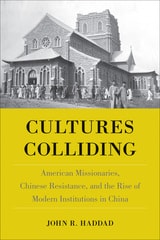
Cultures Colliding
American Missionaries, Chinese Resistance, and the Rise of Modern Institutions in ChinaJohn R. Haddad
Temple University Press, 2023
As incredible as it may seem, the American missionaries who journeyed to China in 1860 planning solely to spread the Gospel ultimately reinvented their entire enterprise. By 1900, they were modernizing China with schools, colleges, hospitals, museums, and even YMCA chapters. In Cultures Colliding, John R. Haddad nimbly recounts this transformative institution-building—how and why it happened—and its consequences.
When missionaries first traveled to rural towns atop mules, they confronted populations with entrenched systems of belief that embraced Confucius and rejected Christ. Conflict ensued as these Chinese viewed missionaries as unwanted disruptors. So how did this failing movement eventually change minds and win hearts? Many missionaries chose to innovate. They built hospitals and established educational institutions offering science and math. A second wave of missionaries opened YMCA chapters, coached sports, and taught college. Crucially, missionaries also started listening to Chinese citizens, who exerted surprising influence over the preaching, teaching, and caregiving, eventually running some organizations themselves. They embraced new American ideals while remaining thoroughly Chinese.
In Cultures Colliding, Haddad recounts the unexpected origins and rapid rise of American institutions in China by telling the stories of the Americans who established these institutions and the Chinese who changed them from within. Today, the impact of this untold history continues to resonate in China.
Cultures In Conflict
A Documentary History of the Mormon War in IllinoisJohn Hallwas and Roger Launius
Utah State University Press, 1999
Cultures of Letters
Scenes of Reading and Writing in Nineteenth-Century AmericaRichard H. Brodhead
University of Chicago Press, 1993
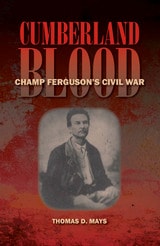
Cumberland Blood
Champ Ferguson's Civil WarThomas D. Mays
Southern Illinois University Press, 2008
By the end of the Civil War, Champ Ferguson had become a notorious criminal whose likeness covered the front pages of Harper’s Weekly, Leslie’s Illustrated, and other newspapers across the country. His crime? Using the war as an excuse to steal, plunder, and murder Union civilians and soldiers.
Cumberland Blood: Champ Ferguson’s Civil War offers insights into Ferguson's lawless brutality and a lesser-known aspect of the Civil War, the bitter guerrilla conflict in the Appalachian highlands, extending from the Carolinas through Tennessee, Kentucky, Virginia, and West Virginia. This compelling volume delves into the violent story of Champ Ferguson, who acted independently of the Confederate army in a personal war that eventually garnered the censure of Confederate officials.
Author Thomas D. Mays traces Ferguson's life in the Cumberland highlands of southern Kentucky, where—even before the Civil War began—he had a reputation as a vicious killer.
Ferguson, a rising slave owner, sided with the Confederacy while many of his neighbors and family members took up arms for the Union. For Ferguson and others in the highlands, the war would not be decided on the distant fields of Shiloh or Gettysburg: it would be local—and personal.
Cumberland Blood describes how Unionists drove Ferguson from his home in Kentucky into Tennessee, where he banded together with other like-minded Southerners to drive the Unionists from the region. Northern sympathizers responded, and a full-scale guerrilla war erupted along the border in 1862. Mays notes that Ferguson's status in the army was never clear, and he skillfully details how raiders picked up Ferguson's gang to work as guides and scouts. In 1864, Ferguson and his gang were incorporated into the Confederate army, but the rogue soldier continued operating as an outlaw, murdering captured Union prisoners after the Battle of Saltville, Virginia.
Cumberland Blood, enhanced by twenty-one illustrations, is an illuminating assessment of one of the Civil War's most ruthless men.
Ferguson's arrest, trial, and execution after the war captured the attention of the nation in
1865, but his story has been largely forgotten. Cumberland Blood: Champ Ferguson's Civil War returns the story of Ferguson's private civil war to its place in history.
Curiosity
A Cultural History of Early Modern InquiryBarbara M. Benedict
University of Chicago Press, 2001
In this striking social history, Barbara M. Benedict draws on the texts of the early modern period to discover the era's attitudes toward curiosity, a trait we learn was often depicted as an unsavory form of transgression or cultural ambition.
Custer's Last Stand
The Unfinished ManuscriptNorman Maclean
University of Chicago Press, 2008
Custerology
The Enduring Legacy of the Indian Wars and George Armstrong CusterMichael A. Elliott
University of Chicago Press, 2007
It’s easy to understand why this tremendous defeat shocked the American public at the time. But with Custerology, Michael A. Elliott tackles the far more complicated question of why the battle still haunts the American imagination today. Weaving vivid historical accounts of Custer at Little Bighorn with contemporary commemorations that range from battle reenactments to the unfinished Crazy Horse memorial, Elliott reveals a Custer and a West whose legacies are still vigorously contested. He takes readers to each of the important places of Custer’s life, from his Civil War home in Michigan to the site of his famous demise, and introduces us to Native American activists, Park Service rangers, and devoted history buffs along the way. Elliott shows how Custer and the Indian Wars continue to be both a powerful symbol of America’s bloody past and a crucial key to understanding the nation’s multicultural present.
“[Elliott] is an approachable guide as he takes readers to battlefields where Custer fought American Indians . . . to the Michigan town of Monroe that Custer called home after he moved there at age 10 . . . to the Black Hills of South Dakota where Custer led an expedition that gave birth to a gold rush."—Steve Weinberg, Atlanta Journal-Constitution
“By ‘Custerology,’ Elliott means the historical interpretation and commemoration of Custer and the Indian Wars in which he fought not only by those who honor Custer but by those who celebrate the Native American resistance that defeated him. The purpose of this book is to show how Custer and the Little Bighorn can be and have been commemorated for such contradictory purposes.”—Library Journal
Cy Young
A Baseball LifeReed Browning
University of Massachusetts Press, 2000
He was the winner of 511 major league baseball games, nearly a hundred more than any other pitcher. He threw three no-hitters, including the first perfect game in the new American League. He was among the original twelve players inducted into baseball's Hall of Fame, and his name is now attached to the game's most prestigious pitching award. Yet for all his accomplishments, Cy Young remains to most baseball fans a legendary but little known figure.
In this book, Reed Browning re-creates the life of Denton True “Cyclone” Young and places his story in the context of a rapidly changing turn-of-the-century America. Born in rural Ohio, the son of a Civil War veteran, Young learned his trade at a time when only underhand pitching was permitted. When he began his professional career in 1890, pitchers wore no gloves and stood five feet closer to the batter than they do today. By the time he retired in 1911, the game of baseball had evolved into its modern form and claimed unquestioned status as America's “national pastime.”
As Browning shows, Young's extraordinary mastery of his craft owed much to his ability to adapt to the changing nature of the game. Endowed with an exceptional fastball, he gradually developed a wide array of deliveries and pitches—all of which he could throw with astonishing control. Yet his success can also be attributed, at least in part, to the rustic values of loyalty, hard work, and fair play that he embraced and embodied, and for which he became renowned among baseball fans of his day.
Cycles of Conflict, Centuries of Change
Crisis, Reform, and Revolution in MexicoElisa Servín, Leticia Reina, and John Tutino, eds.
Duke University Press, 2007
Leading Mexicanists—historians and social scientists from Mexico, the United States, and Europe—examine the three fin-de-siècle eras of crisis. They focus on the role of the country’s communities in advocating change from the eighteenth century to the present. They compare Mexico’s revolutions of 1810 and 1910 and consider whether there might be a twenty-first-century recurrence or whether a globalizing, urbanizing, and democratizing world has so changed Mexico that revolution is improbable. Reflecting on the political changes and social challenges of the late twentieth century, the contributors ask if a democratic transition is possible and, if so, whether it is sufficient to address twenty-first-century demands for participation and justice.
Contributors. Antonio Annino, Guillermo de la Peña, François-Xavier Guerra, Friedrich Katz, Alan Knight, Lorenzo Meyer, Leticia Reina, Enrique Semo, Elisa Servín, John Tutino, Eric Van Young