Results by title
8642 books match the query '20th century' and 580 start with c

Citizen Critics
Literary Public SpheresRosa A. Eberly
University of Illinois Press, 2000
The condition of our public discussions about literary and cultural works has much to say about the state of our democracy. Classrooms, newspapers, magazines, Internet forums, and many other places grant citizens a place to hold public discourses—and claim a voice on national artistic matters.
Rosa A. Eberly looks at four censorship controversies where professionals asserted their authority to deny citizen critics a voice—and effectively removed discussion of literature from the public sphere. Eberly compares the outrage sparked by the publication of James Joyce's Ulysses and Henry Miller's Tropic of Cancer with the relative quiescence that greeted the much more violent and sexually explicit content of Bret Easton Ellis's American Psycho and Andrea Dworkin's Mercy. Through a close reading of letters to the editor, reviews, media coverage, and court cases, Eberly shows how literary critics and legal experts defused censorship debates—and undercut the authority of citizen critics—by shifting the focus from content to aesthetics and from social values to publicity.
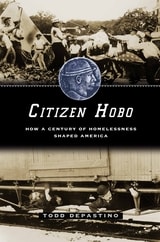
Citizen Hobo
How a Century of Homelessness Shaped AmericaTodd DePastino
University of Chicago Press, 2003
In this eye-opening work of American history, Todd DePastino tells the epic story of hobohemia's rise and fall, and crafts a stunning new interpretation of the "American century" in the process. Drawing on sources ranging from diaries, letters, and police reports to movies and memoirs, Citizen Hobo breathes life into the largely forgotten world of the road, but it also, crucially, shows how the hobo army so haunted the American body politic that it prompted the creation of an entirely new social order and political economy. DePastino shows how hoboes—with their reputation as dangers to civilization, sexual savages, and professional idlers—became a cultural and political force, influencing the creation of welfare state measures, the promotion of mass consumption, and the suburbanization of America. Citizen Hobo's sweeping retelling of American nationhood in light of enduring struggles over "home" does more than chart the change from "homelessness" to "houselessness." In its breadth and scope, the book offers nothing less than an essential new context for thinking about Americans' struggles against inequality and alienation.
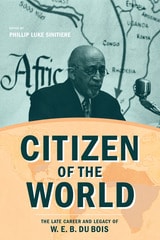
Citizen of the World
The Late Career and Legacy of W. E. B. Du BoisEdited by Phillip Luke Sinitiere
Northwestern University Press, 2019
From his birth in 1868 until his death in 1963, Du Bois sought the liberation of black people in the United States and across the world through intellectual and political labor. His tireless efforts documented and demonstrated connections between freedom for African-descended people abroad and black freedom at home.
In concert with growing scholarship on his twilight years, the essays in this volume assert the fundamental importance of considering Du Bois’s later decades not as a life in decline that descended into blind ideological allegiance to socialism and communism but as the life of a productive, generative intellectual who responded rationally, imaginatively, and radically to massive mid-century changes around the world, and who remained committed to freedom’s realization until his final hour.

Citizen, Invert, Queer
Lesbianism and War in Early Twentieth-Century BritainDeborah Cohler
University of Minnesota Press, 2010
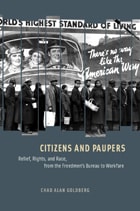
Citizens and Paupers
Relief, Rights, and Race, from the Freedmen's Bureau to WorkfareChad Alan Goldberg
University of Chicago Press, 2008
Citizens and Paupers explores this contentious history by analyzing and comparing three major programs: the Freedmen’s Bureau, the Works Progress Administration, and the present-day system of workfare that arose in the 1990s. Each of these overhauls of the welfare state created new groups of clients, new policies for aiding them, and new disputes over citizenship—conflicts that were entangled in racial politics and of urgent concern for social activists.
This combustible mix of racial tension and social reform continues to influence how we think about welfare, and Citizens and Paupers is an invaluable analysis of the roots of the debate.
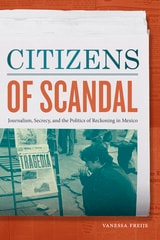
Citizens of Scandal
Journalism, Secrecy, and the Politics of Reckoning in MexicoVanessa Freije
Duke University Press, 2020
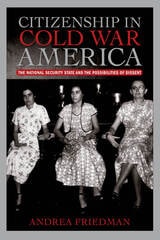
Citizenship in Cold War America
The National Security State and the Possibilities of DissentAndrea Friedman
University of Massachusetts Press, 2014
The stories told here capture a wide-ranging debate about the workings of the national security state and the meaning of American citizenship. Some of the participants in this debate—women like war bride Ellen Knauff and Pentagon employee Annie Lee Moss—were able to make their own experiences compelling examples of the threats posed by the national security regime. Others, such as Ruth Reynolds and Lolita Lebrón, who advocated an end to American empire in Puerto Rico, or the psychiatrist Fredric Wertham, who sought to change the very definition of national security, were less successful. Together, however, they exposed the gap between democratic ideals and government policies.
Friedman traverses immigration law and loyalty boards, popular culture and theoretical treatises, U.S. court-rooms and Puerto Rican jails, to demonstrate how Cold War repression made visible in new ways the unevenness and limitations of American citizenship. Highlighting the ways that race and gender shaped critiques and defenses of the national security regime, she offers new insight into the contradictions of Cold War political culture.
City Dog
EssaysW.S. Di Piero
Northwestern University Press, 2009
City Games
The Evolution of American Urban Society and the Rise of SportsSteven A. Riess
University of Illinois Press, 1989
City Of Sisterly And Brotherly Loves
Lesbian And Gay Philadelphia, 1945-1972Marc Stein
Temple University Press, 2004
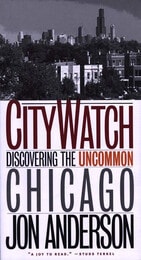
City Watch
Discovering The Uncommon ChicagoJon Anderson
University of Iowa Press, 2000
In forty-five years as one of Chicago's liveliest journalists for Time, Life, and the Chicago Tribune, Jon Anderson has established a reputation for picking up on what someone once called "the beauty of the specific fact." Part "Talk of the Town," part On the Road with Charles Kuralt, Anderson's twice-a-week "City Watch" columns in the Chicago Tribune seek out interesting and unexpected people and places from the everyday life of what the author calls the "most typical American big city." In the process he discovers the joys and triumphs of ordinary people.
Anderson writes with wit and insight about those who find themselves inspired or obsessed with alternative ways of viewing life or getting through the day. Like the man who started with one light pole, then painted all the poles in his southside neighborhood. Or the founder of Cats-Are-Purrsons-Too, a nun who lives with sixty-seven cats. Or the philosopher who, with no financial success, still publishes a newsletter called "The Meaning of Life." After years of hunting down moments of everyday life that have drama and meaning, Anderson offers a book that has curious power, because all of its stories are true.
Drawn from the best of Anderson's columns, City Watch introduces readers to an eclectic mix of social clubs, subcultures, and minor celebrities. From Foraging Friends, a group of penniless ecologists who forage for wild foods in a county forest preserve, to the annual Dumpster Diver fashion show, from the Oakton Elementary School chess team to a group that calls itself Some Chicago Anarchists, readers will discover the characters and events that define Chicago's local color.
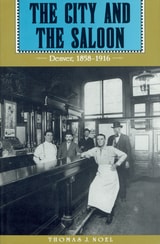
City and the Saloon
Denver, 1858-1916Thomas J. Noel
University Press of Colorado, 1996
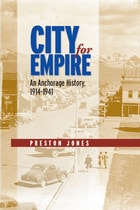
City for Empire
An Anchorage History, 1914-1941Preston Jones
University of Alaska Press, 2010
First settled in 1915, Anchorage, Alaska, was founded with the American empire in mind. During World War I, it served as a conduit through which coal could be shipped to the Pacific, where the US Navy was engaged with Japan. Decades later, during World War II, Anchorage became an equally important site for the defense of the mainland and the projection of American power. City for Empire tells the story of Anchorage's development in that period, focusing in particular on the international context of the city's early decades and its surprisingly diverse inhabitants. A thorough yet accessible read, City for Empire captures the history of this remarkable city.
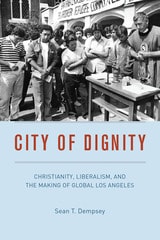
City of Dignity
Christianity, Liberalism, and the Making of Global Los AngelesSean T. Dempsey
University of Chicago Press, 2023
Contemporary Los Angeles is commonly seen as an American bulwark of progressive secular politics, a place that values immigration, equity, diversity, and human rights. But what accounts for the city’s embrace of such staunchly liberal values, which are more hotly contested in other parts of the country? The answer, Sean Dempsey reveals, lies not with those frequent targets of credit and blame—Democrats in Hollywood—but instead with liberal Protestants and other steadfast religious organizations of the postwar era.
As the Religious Right movement emerged in the 1970s, progressive religious activists quietly began promoting an ethical vision that made waves worldwide but saw the largest impact in its place of origin: metropolitan Los Angeles. At the center of this vision lay the concept of human dignity—entwining the integral importance of political and expressive freedom with the moral sanctity of the human condition—which suffused all of the political values that arose from it, whether tolerance, diversity, or equality of opportunity. The work of these religious organizations birthed such phenomena as the Sanctuary Movement—which provided safe haven for refugees fleeing conflict-torn Central America—and advocacy for the homeless, both of which became increasingly fraught issues amid the rising tides of neoliberalism and conservatism. City of Dignity explores how these interwoven spiritual and theological strands found common ground—and made common impacts—in the humanitarian ecosystem of one of America’s largest and most dynamic metro areas.
City of Dignity
Christianity, Liberalism, and the Making of Global Los AngelesSean T. Dempsey
University of Chicago Press, 2023
City of Dignity illuminates how liberal Protestants quietly, yet indelibly, shaped the progressive ethics of postwar Los Angeles.
Contemporary Los Angeles is commonly seen as an American bulwark of progressive secular politics, a place that values immigration, equity, diversity, and human rights. But what accounts for the city’s embrace of such staunchly liberal values, which are more hotly contested in other parts of the country? The answer, Sean Dempsey reveals, lies not with those frequent targets of credit and blame—Democrats in Hollywood—but instead with liberal Protestants and other steadfast religious organizations of the postwar era.
As the Religious Right movement emerged in the 1970s, progressive religious activists quietly began promoting an ethical vision that made waves worldwide but saw the largest impact in its place of origin: metropolitan Los Angeles. At the center of this vision lay the concept of human dignity—entwining the integral importance of political and expressive freedom with the moral sanctity of the human condition—which suffused all of the political values that arose from it, whether tolerance, diversity, or equality of opportunity. The work of these religious organizations birthed such phenomena as the Sanctuary Movement—which provided safe haven for refugees fleeing conflict-torn Central America—and advocacy for the homeless, both of which became increasingly fraught issues amid the rising tides of neoliberalism and conservatism. City of Dignity explores how these interwoven spiritual and theological strands found common ground—and made common impacts—in the humanitarian ecosystem of one of America’s largest and most dynamic metro areas.
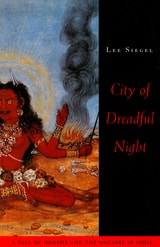
City of Dreadful Night
A Tale of Horror and the Macabre in IndiaLee Siegel
University of Chicago Press, 1995
But what started out as a study of other people's stories became a compelling story itself. City of Dreadful Night is an astonishing work of fiction, a tangle of tales that transports the reader from the Medieval India of magicians, witches, and vampires, through the British India of Brahm Kathuwala's childhood, into the chaos and political terror of contemporary India. Vividly recreating Indian literary and oral traditions, Siegel weaves a web of possession, reincarnation, and magical transformation unlike any found in the Western tradition. Flesh-eating demons, Rajiv Gandhi's assassin, even Bram Stoker and Dracula populate the serpentine narrative, which intermingles stories about the characters with the terrifying tales they tell.
Siegel pursues Brahm Kathuwala from the ghastly lights of the cremation ground at Banaras through villages all over north India. Brahm's life story is revealed through countless tales along the way. We learn that he was raised, and abandoned, by two mothers—one the destitute floor sweeper who bore him; the other her employer, a wealthy Irish woman who read and reread to him the story of Dracula. We hear of his marriage to the daughter of a cremation ground attendant, his battles against her demonic possession, and their painful parting. We come to understand the daily life and motivations of this "horror professional," who uses terrifying tales to ward off the evil he himself fears.
This unorthodox book is more than a story; it blends scholarship, fantasy, travelogue, and autobiography—fusing and overlapping historical accounts and newscasts, literary texts and films, dreams and nocturnal tales. Siegel uses imagination to explore the relation of real terror to horror fiction and to contemplate the ways fear and disgust become thrilling elements in stories of the macabre.
This book is the product of Siegel's deep knowledge of both Indian and Western literary and philosophical traditions. It is also an attempt to come to grips with the omnipresence of political and religious terror in contemporary India. Shocking, original, beautifully written, City of Dreadful Night offers readers a captivating immersion in the wonder and terror of India, past and present.
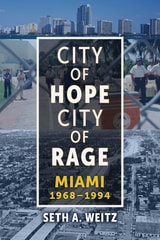
City of Hope, City of Rage
Miami, 1968–1994Weitz, Seth A.
University of Alabama Press, 2024
Examines Miami’s turbulent transformation from a segregated vacation destination to a global, multicultural metropolis
City of Hope, City of Rage gives a fascinating account of three turbulent and transformative decades in the history of Miami. Marked by mass immigration, racially motivated uprisings, economic inequity, rising crime, and social change, Miami’s history from 1968 to 1994 saw the city evolve rapidly from a predominantly white southern city and vacation spot into a global, Hispanic-majority metropolis with an international tourist base. And yet Miami remains highly segregated today.
Exploring beyond the clichés of the Magic City as a bastion of hope for immigrants, a fantasy of beaches and art deco architecture, or a hotbed of drugs and crime, historian Seth A. Weitz reveals the social, political, and cultural shifts that transformed the city. Utilizing archival research and personal stories to reveal the diverse experiences of Miami’s Black, Latinx, Jewish, and LGBTQ+ communities, Weitz explores the struggles for social justice, the rise of the drug trade, and the ongoing fight to mold Miami’s image.
A Miami native, Weitz challenges simplistic narratives about the city, revealing a place defined by hope, rage, and struggle for identity. Illuminating the way Miami is defined and who gets to define it, City of Hope, City of Rage offers a fresh perspective on this vibrant and complex city, making it a valuable resource for anyone interested in Miami’s unique history.
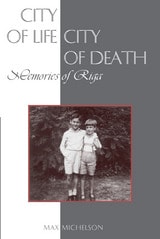
City of Life, City of Death
Memories of RigaMax Michelson
University Press of Colorado, 2001
Michelson had a serene boyhood in an upper middle-class Jewish family in Riga, Latvia--at least until 1940, when the fifteen-year old Michelson witnessed the annexation of Latvia by the Soviet Union. Private properties were nationalized, and Stalin's terror spread to Soviet Latvia. Soon after, Michelson's family was torn apart by the 1941 Nazi invasion of the Soviet Union. He quickly lost his entire family, while witnessing the unspeakable brutalities of war and genocide.
Michelson's memoir is an ode to his lost family; it is the speech of their muted voices and a thank you for their love. Although badly scarred by his experiences, like many other survivors he was able to rebuild his life and gain a new sense of what it means to be alive.
His experiences will be of interest to scholars of both the Holocaust and Eastern European history, as well as the general reader.
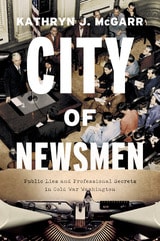
City of Newsmen
Public Lies and Professional Secrets in Cold War WashingtonKathryn J. McGarr
University of Chicago Press, 2022
Americans’ current trust in journalists is at a dismayingly low ebb, particularly on the subject of national and international politics. For some, it might be tempting to look back to the mid-twentieth century, when the nation’s press corps was a seemingly venerable and monolithic institution that conveyed the official line from Washington with nary a glint of anti-patriotic cynicism. As Kathryn McGarr’s City of Newsmen shows, however, the real story of what Cold War–era journalists did and how they did it wasn’t exactly the one you’d find in the morning papers.
City of Newsmen explores foreign policy journalism in Washington during and after World War II—a time supposedly defined by the press’s blind patriotism and groupthink. McGarr reveals, though, that DC reporters then were deeply cynical about government sources and their motives, but kept their doubts to themselves for professional, social, and ideological reasons. The alliance and rivalries among these reporters constituted a world of debts and loyalties: shared memories of harrowing wartime experiences, shared frustrations with government censorship and information programs, shared antagonisms, and shared mentors. McGarr ventures into the back hallways and private clubs of the 1940s and 1950s to show how white male reporters suppressed their skepticism to build one of the most powerful and enduring constructed realities in recent US history—the Washington Cold War consensus. Though by the 1960s, this set of reporters was seen as unduly complicit with the government—failing to openly critique the decisions and worldviews that led to disasters like the Vietnam War—McGarr shows how self-aware these reporters were as they negotiated for access, prominence, and, yes, the truth—even as they denied those things to their readers.

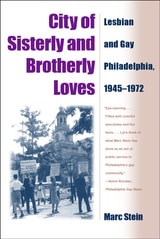
City of Sisterly and Brotherly Loves
Lesbian and Gay Philadelphia, 1945-1972Marc Stein
University of Chicago Press, 2000
Stein takes us on a tour through Philadelphia's bars, restaurants, bookstores, bathhouses, movie theaters, parks, and parades where lesbian and gay cultures thrived.
We learn about the scientific experts, religious leaders, public officials, and journalists who attacked and ignored same-sex sexualities. And we read about the courageous people who fought back with strategies of everyday resistance and organized political activism.
Stein argues against the idea that a conspiracy of silence surrounded gays and lesbians in the 1940s and 1950s. He shows that same-sex sexualities were regularly discussed in controversies concerning the tennis player Big Bill Tilden, the Walt Whitman Bridge, sex murders and crimes, and police raids. Philadelphians became national leaders in the gay and lesbian movement. They conducted sit-ins at Dewey's restaurant, organized pickets at Independence Hall, edited the movement's most widely circulated publications the Ladder and Drum, and pursued court cases all the way to the U.S. Supreme Court.
Beautifully crafted and exceptionally well-written, Stein's book not only provides a new starting place for thinking about lesbian and gay history but also challenges readers to rethink twentieth-century urban history.
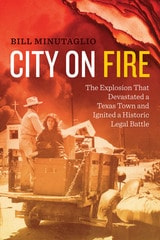
City on Fire
The Explosion that Devastated a Texas Town and Ignited a Historic Legal BattleBy Bill Minutaglio
University of Texas Press, 2014
First published in 2003, City on Fire is a gripping, intimate account of the explosions of two ships loaded with ammonium nitrate fertilizer that demolished Texas City, Texas, in April 1947, in one of the most catastrophic disasters in American history.
Civic War and the Corruption of the Citizen
Peter Alexander Meyers
University of Chicago Press, 2008
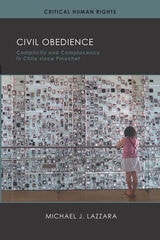
Civil Obedience
Complicity and Complacency in Chile since PinochetMichael J. Lazzara
University of Wisconsin Press, 2020
Michael J. Lazzara boldly argues that today's Chile is a product of both complicity and complacency. Combining historical analysis with deft literary, political, and cultural critique, he scrutinizes the post-Pinochet rationalizations made by politicians, artists, intellectuals, bystanders, former revolutionaries-turned-neoliberals, and common citizens. He looks beyond victims and perpetrators to unveil the ambiguous, ethically vexed realms of memory and experience that authoritarian regimes inevitably generate.
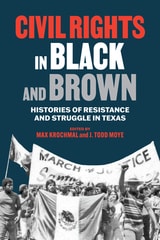
Civil Rights in Black and Brown
Histories of Resistance and Struggle in TexasEdited by Max Krochmal and J. Todd Moye
University of Texas Press, 2021
2022 Best Book Award, Oral History Association
Hundreds of stories of activists at the front lines of the intersecting African American and Mexican American liberation struggle
Not one but two civil rights movements flourished in mid-twentieth-century Texas, and they did so in intimate conversation with one another. Far from the gaze of the national media, African American and Mexican American activists combated the twin caste systems of Jim Crow and Juan Crow. These insurgents worked chiefly within their own racial groups, yet they also looked to each other for guidance and, at times, came together in solidarity. The movements sought more than integration and access: they demanded power and justice.
Civil Rights in Black and Brown draws on more than 500 oral history interviews newly collected across Texas, from the Panhandle to the Piney Woods and everywhere in between. The testimonies speak in detail to the structure of racism in small towns and huge metropolises—both the everyday grind of segregation and the haunting acts of racial violence that upheld Texas’s state-sanctioned systems of white supremacy. Through their memories of resistance and revolution, the activists reveal previously undocumented struggles for equity, as well as the links Black and Chicanx organizers forged in their efforts to achieve self-determination.
Civil Society and Dictatorship in Modern German History
Jürgen Kocka
Brandeis University Press, 2012
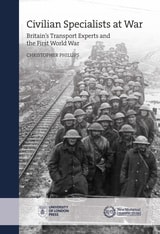
Civilian Specialists at War
Britain's transport experts and the First World WarChristopher Phillips
University of London Press, 2020
In Civilian Specialists at War, Christopher Phillips examines the relationship between industrial society and industrial warfare through the lens of Britain’s transport experts. Phillips analyzes the multiple connections between the army, the government, and the senior executives of some of prewar Britain’s largest industrial enterprises, revealing that civilian transport experts were a key component of Britain’s strategies in World War I. This book also details the application of recognizably civilian technologies and methods to the prosecution of war, and documents how transport experts were constrained by the political and military requirements of coalition warfare.
Civilization without Sexes
Reconstructing Gender in Postwar France, 1917-1927Mary Louise Roberts
University of Chicago Press, 1994
In sources as diverse as parliamentary records, newspaper articles, novels, medical texts, writings on sexology, and vocational literature, Roberts discovers a central question: how to come to terms with rapid economic, social, and cultural change and articulate a new order of social relationships. She examines the role of French trauma concerning the War in legislative efforts to ban propaganda for abortion and contraception, and explains anxieties about the decline of maternity by a crisis in gender relations that linked soldiery, virility, and paternity.
Through these debates, Roberts locates the seeds of actual change. She shows how the willingness to entertain, or simply the need to condemn, nontraditional gender roles created an indecisiveness over female identity that ultimately subverted even the most conservative efforts to return to traditional gender roles and irrevocably altered the social organization of gender in postwar France.
Civilizing War
Imperial Politics and the Poetics of National RuptureNasser Mufti
Northwestern University Press, 2018
Honorable Mention for the 2019 Sonya Rudikoff Prize, awarded by the Northeast Victorian Studies Association
Civilizing War traces the historical transformation of civil war from a civil affair into an uncivil crisis. Civil war is today synonymous with the global refugee crisis, often serving as grounds for liberal-humanitarian intervention and nationalist protectionism.
In Civilizing War, Nasser Mufti situates this contemporary conjuncture in the long history of British imperialism, demonstrating how civil war has been and continues to be integral to the politics of empire. Through comparative readings of literature, criticism, historiography, and social analysis, Civilizing War shows how writers and intellectuals of Britain’s Anglophone empire articulated a “poetics of national rupture” that defined the metropolitan nation and its colonial others.
Mufti’s tour de force marshals a wealth of examples as diverse as Thomas Carlyle, Benjamin Disraeli, Friedrich Engels, Arthur Conan Doyle, Rudyard Kipling, Joseph Conrad, V. S. Naipaul, Nadine Gordimer, and Michael Ondaatje to examine the variety of forms this poetics takes—metaphors, figures, tropes, puns, and plot—all of which have played a central role in Britain’s civilizing mission and its afterlife. In doing so, Civilizing War shifts the terms of Edward Said’s influential Orientalism to suggest that imperialism was not only organized around the norms of civility but also around narratives of civil war.
Claiming Others
Transracial Adoption and National BelongingMark C. Jerng
University of Minnesota Press, 2010
Jerng considers how adoption makes us rethink the parent-child bond as central to issues of race and nationality, showing the ways adoption also speaks to broader questions about our history and identity. He analyzes adoption through a diverse set of texts, including the 1851 Massachusetts statute that established adoption as we understand it today, early adoption manuals, the New York Times blog Relative Choices, and the work of John Tanner, Lydia Maria Child, William Faulkner, Charles Chesnutt, Chang-rae Lee, and David Henry Hwang.
Imaginative and social practices of transracial adoption have shaped major controversies, Jerng argues, from Native American removal to slavery to cold war expansionism in the twentieth century and the contemporary global market in children. As Claiming Others makes clear, understanding adoption is crucial not just to understanding the history between races in the United States, but also the meaning of emancipation and the role of family in nationhood.
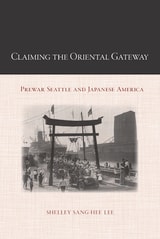
Claiming the Oriental Gateway
Prewar Seattle and Japanese AmericaAuthored by Shelley S. Lee
Temple University Press, 2012
In Claiming the Oriental Gateway, Shelley Sang-Hee Lee explores the various intersections of urbanization, ethnic identity, and internationalism in the experience of Japanese Americans in early twentieth-century Seattle. She examines the development and self-image of the city by documenting how U.S. expansion, Asian trans-Pacific migration, and internationalism were manifested locally—and how these forces affected residents’ relationships with one another and their surroundings.
Lee details the significant role Japanese Americans—both immigrants and U.S. born citizens—played in the social and civic life of the city as a means of becoming American. Seattle embraced the idea of cosmopolitanism and boosted its role as a cultural and commercial "Gateway to the Orient" at the same time as it limited the ways in which Asian Americans could participate in the public schools, local art production, civic celebrations, and sports. She also looks at how Japan encouraged the notion of the "gateway" in its participation in the Alaska-Yukon-Pacific Exposition and International Potlach.
Claiming the Oriental Gateway thus offers an illuminating study of the "Pacific Era" and trans-Pacific relations in the first four decades of the twentieth century.
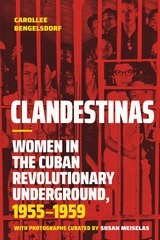
Clandestinas
Women in the Cuban Revolutionary Underground, 1955–1959Carollee Bengelsdorf. With Photographs Curated by Susan Meiselas.
Duke University Press, 2025
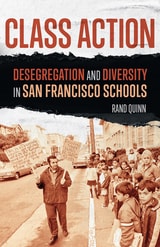
Class Action
Desegregation and Diversity in San Francisco SchoolsRand Quinn
University of Minnesota Press, 2020
A compelling history of school desegregation and activism in San Francisco
The picture of school desegregation in the United States is often painted with broad strokes of generalization and insulated anecdotes. Its true history, however, is remarkably wide ranging. Class Action tells the story of San Francisco’s long struggle over school desegregation in the wake of the 1954 U.S. Supreme Court decision Brown v. Board of Education.
San Francisco’s story provides a critical chapter in the history of American school discrimination and the complicated racial politics that emerged. It was among the first large cities outside the South to face court-ordered desegregation following the Brown rulings, and it experienced the same demographic shifts that transformed other cities throughout the urban West. Rand Quinn argues that the district’s student assignment policies—including busing and other desegregative mechanisms—began as a remedy for state discrimination but transformed into a tool intended to create diversity. Drawing on extensive archival research—from court docket files to school district records—Quinn describes how this transformation was facilitated by the rise of school choice, persistent demand for neighborhood schools, evolving social and legal landscapes, and local community advocacy and activism.
Class Action is the first book to present a comprehensive political history of post-Brown school desegregation in San Francisco. Quinn illuminates the evolving relationship between jurisprudence and community-based activism and brings a deeper understanding to the multiracial politics of urban education reform. He responds to recent calls by scholars to address the connections between ideas and policy change and ultimately provides a fascinating look at race and educational opportunity, school choice, and neighborhood schools in the aftermath of Brown v. Board of Education.
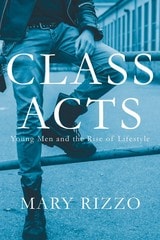
Class Acts
Young Men and the Rise of LifestyleMary Rizzo
University of Nevada Press, 2015
Mary Rizzo traces the development of the concept of lifestyle marketing, showing how marketers disconnected class identity from material reality, focusing instead on a person’s attitudes, opinions, and behaviors. The book includes discussions of the rebel of the 1950s, the hippie of the 1960s, the white suburban hip-hop fan of the 1980s, and the poverty chic of the 1990s. Class Acts illuminates how the concept of “lifestyle,” particularly as expressed through fashion, has disconnected social class from its material reality and diffused social critique into the opportunity to simply buy another identity. The book will appeal to scholars and other readers who are interested in American cultural history, youth culture, fashion, and style.
Class Fictions
Shame and Resistance in the British Working Class Novel, 1890–1945Pamela Fox
Duke University Press, 1994
With a focus on certain classics in the working-class literary "canon," such as The Ragged Trousered Philanthropists and Love on the Dole, as well as lesser-known texts by working-class women, Fox uncovers the anxieties that underlie representations of class and consciousness. Shame repeatedly emerges as a powerful counterforce in these works, continually unsettling the surface narrative of protest to reveal an ambivalent relation toward the working-class identities the novels apparently champion.
Class Fictions offers an equally rigorous analysis of cultural studies itself, which has historically sought to defend and value the radical difference of working-class culture. Fox also brings to her analysis a strong feminist perspective that devotes considerable attention to the often overlooked role of gender in working-class fiction. She demonstrates that working-class novels not only expose master narratives of middle-class culture that must be resisted, but that they also reveal to us a need to create counter narratives or formulas of working-class life. In doing so, this book provides a more subtle sense of the role of resistance in working class culture. While of interest to scholars of Victorian and working-class fiction, Pamela Fox’s argument has far-reaching implications for the way literary and cultural studies will be defined and practiced.
Classic Hollywood
Lifestyles and Film Styles of American Cinema, 1930-1960Veronica Pravadelli
University of Illinois Press, 2015
Pravadelli sets her analysis apart by paying particular attention to the gendered desires and identities exemplified in the films. Availing herself of the significant advances in film theory and modernity studies that have taken place since similar surveys first saw publication, she views Hollywood through strategies as varied as close textural analysis, feminism, psychoanalysis, film style and study of cinematic imagery, revealing the inconsistencies and antithetical traits lurking beneath Classic Hollywood's supposed transparency.
Classic Keys
Keyboard Sounds That Launched Rock MusicAlan S. Lenhoff
University of North Texas Press, 2019
Classical American Pragmatism
ITS CONTEMPORARY VITALITYEdited by Sandra B. Rosenthal, Carl R. Hausman, and Douglas R. Anderson
University of Illinois Press, 1999
Pragmatism emerged as a characteristically American response to an inheritance of British empiricism.
Presenting a radical reconception of the nature of experience, pragmatism represents a belief that ideas are not merely to be contemplated but must be put into action, tested and refined through experience. At the same time, the American pragmatists argued for an emphasis on human community that would offset the deep-seated American bias in favor of individualism. Far from being a relic of the past, pragmatism offers a dynamic and substantive approach to questions of human conduct, social values, scientific inquiry, religious belief, and aesthetic experience that lie at the center of contemporary life. This volume is an invaluable introduction to a school of thought that remains vital, instructive, and provocative.
Classical Spies
American Archaeologists with the OSS in World War II GreeceSusan Heuck Allen
University of Michigan Press, 2013
“Classical Spies will be a lasting contribution to the discipline and will stimulate further research. Susan Heuck Allen presents to a wide readership a topic of interest that is important and has been neglected.”
—William M. Calder III, University of Illinois, Urbana-Champaign
Classical Spies is the first insiders’ account of the operations of the American intelligence service in World War II Greece. Initiated by archaeologists in Greece and the eastern Mediterranean, the network drew on scholars’ personal contacts and knowledge of languages and terrain. While modern readers might think Indiana Jones is just a fantasy character, Classical Spies disclosesevents where even Indy would feel at home: burying Athenian dig records in an Egyptian tomb, activating prep-school connections to establish spies code-named Vulture and Chickadee, and organizing parachute drops.
Susan Heuck Allen reveals remarkable details about a remarkable group of individuals. Often mistaken for mild-mannered professors and scholars, such archaeologists as University of Pennsylvania’s Rodney Young, Cincinnati’s Jack Caskey and Carl Blegen, Yale’s Jerry Sperling and Dorothy Cox, and Bryn Mawr’s Virginia Grace proved their mettle as effective spies in an intriguing game of cat and mouse with their Nazi counterparts. Relying on interviews with individuals sharing their stories for the first time, previously unpublished secret documents, private diaries and letters, and personal photographs, Classical Spies offers an exciting and personal perspective on the history of World War II.
Classicism of the Twenties
Art, Music, and LiteratureTheodore Ziolkowski
University of Chicago Press, 2014
In Classicism of the Twenties, Theodore Ziolkowski offers a compelling account of that movement. Giving equal attention to music, art, and literature, and focusing in particular on the works of Stravinsky, Picasso, and T. S. Eliot, he shows how the turn to classicism manifested itself. In reaction both to the excesses of neoromanticism and early modernism and to the horrors of World War I—and with respectful detachment—artists, writers, and composers adapted themes and forms from the past and tried to imbue their own works with the values of simplicity and order that epitomized earlier classicisms.
By identifying elements common to all three arts, and carefully situating classicism within the broader sweep of modernist movements, Ziolkowski presents a refreshingly original view of the cultural life of the 1920s.
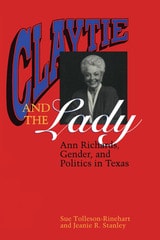
Claytie and the Lady
Ann Richards, Gender, and Politics in TexasBy Sue Tolleson-Rinehart and Jeanie R. Stanley
University of Texas Press, 1994
It was like a remake of The Cowboy and the Lady, except that this time they weren't friends. The 1990 Texas governor's race pitted Republican Clayton Williams, a politically conservative rancher and oil millionaire, against Democrat Ann Richards, an experienced progressive politician noted for her toughness and quick wit. Their differences offered voters a choice not only of policies and programs but also of stereotypes and myths of men's and women's proper roles.
Claytie and the Lady is the first in-depth look at how gender affected the 1990 governor's race. The authors' analysis reveals that Ann Richards' victory was a result of a unique combination of characteristics. She was simultaneously tough enough to convince voters that she could lead and feminine enough to put them at ease. At the same time, she remained committed to the progressive and women's issues that had won her the early support of feminists and progressives. The authors also show how Clayton Williams' appeal to the Texas cowboy myth backfired when he broke the cowboy code of chivalry to women.
The authors set their discussion within the historical context of twentieth-century Texas politics and the theoretical context of gender politics in order to pose a number of thought-provoking questions about the effects of women's participation in political life. Interviews with key players in the 1990 election, including Governor Ann Richards, add a lively and insightful counterpoint to the text.
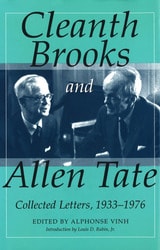
Cleanth Brooks and Allen Tate
Collected Letters, 1933-1976Edited by Alphonse Vinh & Intro by Louis D. Rubin, Jr.
University of Missouri Press, 1998
Offering all of the extant letters exchanged by two of the twentieth century's most distinguished literary figures, Cleanth Brooks and Allen Tate: Collected Letters, 1933-1976 vividly depicts the remarkable relationship, both professional and personal, between Brooks and Tate over the course of their lifelong friendship.
An accomplished poet, critic, biographer, and teacher, Allen Tate had a powerful influence on the literary world of his era. Editor of the Fugitive and the Sewanee Review, Tate greatly affected the lives and careers of his fellow literati, including Cleanth Brooks. Esteemed coeditor of An Approach to Literature and Understanding Poetry, Brooks was one of the principal creators of the New Criticism. His Modern Poetry and the Tradition and The Well Wrought Urn, as well as his two-volume study of Faulkner, remain among the classics read by any serious student of literature. The correspondence between these two gentlemen-scholars, which began in the 1930s, extended over five decades and covered a vast amount of twentieth-century literary history.
In the more than 250 letters collected here, the reader will encounter their shared concerns for and responses to the work of their numerous friends and many prominent writers, including T. S. Eliot, William Faulkner, and Robert Lowell. Their letters offer details about their own developing careers and also provide striking insight into the group dynamics of the Agrarians, the noteworthy community of southern writers who played so influential a role in the literature of modernism.
Brooks once said that Tate treated him like a younger brother, and despite great differences between their personalities and characters, these two figures each felt deep brotherly affection for the other. Whether they contain warm invitations for the one to visit the other, genteel or honest commentaries on their families and friends, or descriptions of the vast array of social, professional, and even political activities each experienced, the letters of Brooks and Tate clearly reveal the personalities of both men and the powerful ties of their strong camaraderie.
Invaluable to both students and teachers of literature, Cleanth Brooks and Allen Tate provides a substantial contribution to the study of twentieth-century American, and particularly southern, literary history.
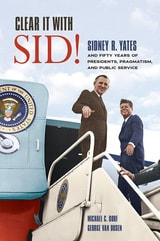
Clear It with Sid!
Sidney R. Yates and Fifty Years of Presidents, Pragmatism, and Public ServiceMichael C. Dorf and George Van Dusen
University of Illinois Press, 2022
Michael C. Dorf and George Van Dusen draw on scores of interviews and unprecedented access to private papers to illuminate the life of an Illinois political icon. Wise, energetic, charismatic, petty, stubborn--Sid Yates presented a complicated character to constituents and colleagues alike. Yet his get-it-done approach to legislation allowed him to bridge partisan divides in the often-polarized House of Representatives. Following Yates from the campaign trail to the negotiating table to the House floor, Dorf and Van Dusen offer a rich portrait of a dealmaker extraordinaire and tireless patriot on a fifty-year journey through postwar American politics.
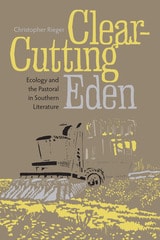
Clear-Cutting Eden
Ecology and the Pastoral in Southern LiteratureChristopher Rieger
University of Alabama Press, 2009
Examines how Southern literary depictions of the natural world were influenced by the historical, social, and ecological changes of the 1930s and 1940s
Rieger studies the ways that nature is conceived of and portrayed by four prominent Southern writers of the era: Erskine Caldwell, Marjorie Kinnan Rawlings, Zora Neale Hurston, and William Faulkner. Specifically, he argues that these writers created new versions of an old literary mode—the pastoral—in response to the destabilizing effects of the Great Depression, the rise of Southern modernism, and the mechanization of agricultural jobs.
Mass deforestation, soil erosion, urban development, and depleted soil fertility are issues that come to the fore in the works of these writers. In response, each author depicts a network model of nature, where humans are part of the natural world, rather than separate, over, or above it, as in the garden pastorals of the Old South, thus significantly revising the pastoral mode proffered by antebellum and Reconstruction-era writers.
Each writer, Rieger finds, infuses the pastoral mode with continuing relevance, creating new versions that fit his or her ideological positions on issues of race, class, and gender. Despite the ways these authors represent nature and humankind’s place in it, they all illustrate the idea that the natural environment is more than just a passive background against which the substance of life, or fiction, is played out.
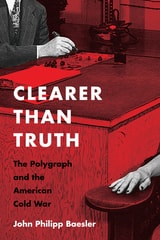
Clearer Than Truth
The Polygraph and the American Cold WarJohn Philipp Baesler
University of Massachusetts Press, 2018
In this first comprehensive history of the polygraph as a tool and symbol of American Cold War policies, John Philipp Baesler tells the story of a technology with weak scientific credentials that was nevertheless celebrated as a device that could expose both internal and external enemies. Considered the go-to technology to test agents' and employees' loyalty, the polygraph's true power was to expose deep ideological and political fault lines. While advocates praised it as America's hard-nosed yet fair answer to communist brainwashing, critics claimed that its use undermined the very values of justice, equality, and the presumption of innocence for which the nation stood.
Clearer Than Truth demonstrates that what began as quick-fix technology promising a precise test of honesty and allegiance eventually came to embody tensions in American Cold War culture between security and freedom, concerns that reach deep into the present day.
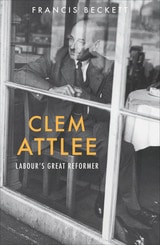
Clem Attlee
Labour's Great ReformerFrancis Beckett
Haus Publishing, 2015
Building on his earlier work on Attlee and including new research and stories, many of which are published here for the first time, Francis Beckett highlights Attlee’s relevance for a new generation. A poet and dreamer, Attlee led a remarkable political life that saw, among other challenges, the beginning of the Cold War. Ultimately, this perceptive biography demonstrates that Attlee’s ideas have never been more relevant.
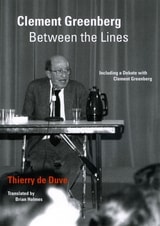
Clement Greenberg Between the Lines
Including a Debate with Clement GreenbergThierry de Duve
University of Chicago Press, 2010
Clement Greenberg (1909–1994), champion of abstract expressionism and modernism—of Pollock, Miró, and Matisse—has been esteemed by many as the greatest art critic of the second half of the twentieth century, and possibly the greatest art critic of all time. This volume, a lively reassessment of Greenberg’s writings, features three approaches to the man and his work: Greenberg as critic, doctrinaire, and theorist. The book also features a transcription of a public debate with Greenberg that de Duve organized at the University of Ottawa in 1988. Clement Greenberg Between the Lines will be an indispensable resource for students, scholars, and enthusiasts of modern art.
“In this compelling study, Thierry de Duve reads Greenberg against the grain of the famous critic’s critics—and sometimes against the grain of the critic himself. By reinterpreting Greenberg’s interpretations of Pollock, Duchamp, and other canonical figures, de Duve establishes new theoretical coordinates by which to understand the uneasy complexities and importance of Greenberg’s practice.” John O’Brian, editor of Clement Greenberg: The Collected Essays and Criticisms
“De Duve is an expert on theoretical aesthetics and thus well suited to reassess the formalist tenets of the late American art critic's theory on art and culture. . . . De Duve's close readings of Greenberg . . . contain much of interest, and the author clearly enjoys matching wits with ‘the world's best known art critic.’” Library Journal
Cleveland Architecture 1890–1930
Building the City BeautifulJeannine deNobel Love
Michigan State University Press, 2020
Climate Dependence and Food Problems in Russia, 1900-1990
The Interaction of Climate and Agricultural Policy and Their Effect on Food ProblemsNikolai M. Dronin
Central European University Press, 2006
Climate Lyricism
Min Hyoung Song
Duke University Press, 2022
Climbing the Ladder, Chasing the Dream
The History of Homer G. Phillips HospitalCandace O’Connor
University of Missouri Press, 2022
When the beautiful, up-to-date hospital opened, it attracted more black residents than any other such program in the United States. Patients also flocked to the hospital, as did nursing students who found there excellent training, ready employment, and a boost into the middle class. For decades, the hospital thrived; by the 1950s, three-quarters of African-American babies in St. Louis were born at Homer G.
But the 1960s and 1970s brought less need for all-black hospitals, as faculty, residents, and patients were increasingly welcome in the many newly integrated institutions. Ever-tightening city budgets meant less money for the hospital, and in 1979, despite protests from the African-American community, HGPH closed. Years later, the venerated, long-vacant building came to life again as the Homer G. Phillips Senior Living Community.
Candace O’Connor draws upon contemporary newspaper articles, institutional records, and dozens of interviews with former staff members to create the first, full history of the Homer G. Phillips Hospital. She also brings new facts and insights into the life and mysterious murder (still an unsolved case) of the hospital’s namesake, a pioneering Black attorney and civil rights activist who led the effort to build the sorely needed medical facility in the Ville neighborhood.