4917 books match the query 'Philosophy' and 256 start with c
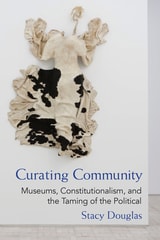
cover of Curating Community: Museums, Constitutionalism, and the Taming of the Political

Curating Community

Museums, Constitutionalism, and the Taming of the Political

Stacy Douglas

University of Michigan Press, 2017

In Curating Community: Museums, Constitutionalism, and the Taming of the Political, Stacy Douglas challenges the centrality of sovereignty in our political and juridical imaginations. Creatively bringing together constitutional, political, and aesthetic theory, Douglas argues that museums and constitutions invite visitors to identify with a prescribed set of political constituencies based on national, ethnic, or anthropocentric premises. In both cases, these stable categories gloss over the radical messiness of the world and ask us to conflate representation with democracy. Yet the museum, when paired with the constitution, can also serve as a resource in the production of alternative imaginations of community. Consequently, Douglas’s key contribution is the articulation of a theory of counter-monumental constitutionalism, using the museum, that seeks to move beyond individual and collective forms of sovereignty that have dominated postcolonial and postapartheid theories of law and commemoration. She insists on the need to reconsider deep questions about how we conceptualize the limits of ourselves, as well as our political communities, in order to attend to everyday questions of justice in the courtroom, the museum, and beyond.
Curating Community is a book for academics, artists, curators, and constitutional designers interested in legacies of violence, transitional justice, and democracy.
 
[more]
cover of Curators of the Buddha: The Study of Buddhism under Colonialism

Curators of the Buddha

The Study of Buddhism under Colonialism

Edited by Donald S. Lopez Jr.

University of Chicago Press, 1995

Curators of the Buddha is the first critical history of the study of Buddhism in the West and the first work to bring the insights of colonial and postcolonial cultural studies to bear on this field.

After an overview of the origins of Buddhist studies in the early nineteenth century, the essays focus on important "curators of the Buddha," such as Aurel Stein, D. T. Suzuki, and Carl Jung, who, as they created and maintained the discipline, played a significant role in disseminating knowledge about Buddhism in the West. The essays bring to life many of the important but unexamined social, political, and cultural conditions that have shaped the course of Buddhist studies for more than a century—and have frequently distorted the understanding of a complex set of traditions. Contributors Charles Hallisey, Gustavo Benavides, Stanley Abe, Luis Gómez, Robert Sharf, and Donald Lopez challenge some of the most enduring ideas in Buddhist studies: that Zen Buddhism is, above all, an experience; that Tibetan Buddhism is polluted, or pristine; that the Buddha image is of Greek or Roman origin; that the classical text supersedes the vernacular, as the manuscript supersedes the informant; and many others.
[more]
cover of Curiosity and Power: The Politics of Inquiry

Curiosity and Power

The Politics of Inquiry

Perry Zurn

University of Minnesota Press, 2021

A trailblazing exploration of the political stakes of curiosity

Curiosity is political. Who is curious, when, and how reflects the social values and power structures of a given society. In Curiosity and Power, Perry Zurn explores the political philosophy of curiosity, staking the groundbreaking claim that it is a social force—the heartbeat of political resistance and a critical factor in social justice. He argues that the very scaffolding of curiosity is the product of political architectures, and exploring these values and architectures is crucial if we are to better understand, and more ethically navigate, the struggle over inquiry in an unequal world. 

Curiosity and Power explores curiosity through the lens of political philosophy—weaving in Nietzsche, Foucault, and Derrida in doing so—and the experience of political marginalization, demonstrating that curiosity is implicated equally in the maintenance of societies and in their transformation. Curiosity plays as central a role in establishing social institutions and fields of inquiry as it does in their deconstruction and in building new forms of political community. Understanding curiosity is critical to understanding politics, and understanding politics is critical to understanding curiosity. 

Drawing not only on philosophy and political theory but also on feminist theory, race theory, disability studies, and trans studies, Curiosity and Power tracks curiosity in the structures of political marginalization and resistance—from the Civil Rights Movement to building better social relationships. Curiosity and Power insists that the power of curiosity be recognized and engaged responsibly.
[more]
cover of Current Continental Theory and Modern Philosophy

Current Continental Theory and Modern Philosophy

Stephen Daniel

Northwestern University Press, 2006

For decades Continental theorists from Derrida to Deleuze have engaged in provocative, penetrating, and often extensive examinations of modern philosophers-studies that have opened up new ways to think about figures such as Descartes, Spinoza, Leibniz, Locke, Hume, Rousseau, and Kant. This volume, for the first time, gives this work its due. A systematic rereading of early modern philosophers in the light of recent Continental philosophy, it exposes overlooked but critical aspects of sixteenth- through eighteenth-century philosophy even as it brings to light certain historical assumptions that have colored-and distorted-our understanding of modernist thought. This volume thus retrieves modern thinkers from the modernistic ways in which they have been portrayed since the nineteenth century; at the same time, it enhances our view of the roots and concerns of current Continental thought.

What claims does the early modern period have on contemporary philosophy? How have recent theorists engaged this material, and why? In answer, some of these essays explore how major Continental theorists such as Derrida, Deleuze, Le Doeuff, Irigaray, Kristeva, and Althusser explicate the ideas of classical modern thinkers; others draw on recent Continental insights to examine the doctrines of modern philosophers beginning with Machiavelli and ending with Kant. Together they show how current Continental theory reinvigorates the study of the history of modern philosophers by transforming not only how we interpret their answers to certain questions, but also how we understand the very nature of these questions.
[more]
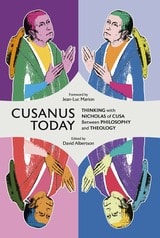
cover of Cusanus Today: Thinking with Nicholas of Cusa Between Philosophy and Theology

Cusanus Today

Thinking with Nicholas of Cusa Between Philosophy and Theology

David C. Albertson

Catholic University of America Press, 2024
At the end of the nineteenth century, German theologians and philosophers rediscovered the Renaissance cardinal Nicholas of Cusa (1401-1464). Immediately they hailed Cusanus as the first modern thinker, a brilliant German rival to the French Descartes. But since the founding of the Cusanus critical edition in 1927 up to its conclusion in 2005, historians have gradually learned that Nicholas was more of a medieval preacher and contemplative than a modern philosopher. Yet over the same century, modern German and French readers were already digging into Nicholas’s many works. There they encountered an exciting voice with fresh perspectives about God’s immanence in the cosmos and the awesome capacities of the human mind. Leading philosophers and theologians from Erich Przywara to Karl Jaspers to Hans-Georg Gadamer, and from Gilles Deleuze to Jacques Lacan to Michel de Certeau, found their own thinking stimulated by the cardinal’s innovative concepts and interdisciplinary style. Even as Nicholas shifted from modern to medieval among historians, he was emerging as a contemporary interlocutor for moderns and postmoderns. Who could have guessed that the first debate between Jean-Luc Marion and Emmanuel Falque would take place over the fifteenth-century mystical dialogue, De visione dei? If Meister Eckhart found his moment amidst Deconstruction in prior decades, Nicholas of Cusa is our thinker for today. His interests anticipate themes in continental philosophy of religion, whether alterity, invisibility, the fold, or the icon. His habit of interweaving philosophy and theology anticipates current debates on the thresholds of phenomenology. Our volume first maps the contours of modern receptions of Nicholas of Cusa in French and German spheres, and then beyond Europe to the Americas and Japan. It also hosts the next round of engagement by some of today’s most original Christian thinkers: Emmanuel Falque, John Milbank, and David Bentley Hart.
[more]
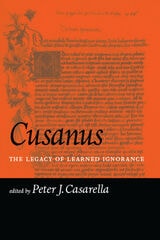
cover of Cusanus: A Legacy of Learned Ignorance

Cusanus

A Legacy of Learned Ignorance

Peter J. Casarella

Catholic University of America Press, 2006

This volume offers a detailed historical background to Cusanus's thinking while also assaying his significance for the present. It brings together major contributions from the English-speaking world as well as voices from Europe.
[more]