Results by title
4743 books match the query 'Religion' and 302 start with c
Cosmas of Prague
The Chronicle of the CzechsPetra Mutlová
Central European University Press, 2020
The Latin-English bilingual volume presents the text of The Chronicle of the Czechs by Cosmas of Prague. Cosmas was born around 1045, educated in Liège, upon his return to Bohemia, he got married as well as became a priest. In 1086 he was appointed prebendary, a senior member of clergy in Prague. He completed the first book of the Chronicle in 1119, starting with the creation of the world and the earliest deeds of the Czechs up to Saint Adalbert. In the second and third books Cosmas presents the preceding century in the history of Bohemia, and succeeds in reporting about events up to 1125, the year when he died.
The English translation was done by Petra Mutlova and Martyn Rady with the cooperation of Libor Švanda. The introduction and the explanatory notes were written by Jan Hasil with the cooperation of Irene van Rensvoude.T
Cosmic Blueprint
New Discoveries In Natures Ability To Order UniversePaul Davies
Templeton Press, 2004
In this critically acclaimed book, first published in 1988 and now reprinted in paperback, scientist and author Paul Davies explains how recent scientific advances are transforming our understanding of the emergence of complexity and organization in the universe.
Melding a variety of ideas and disciplines from biology, fundamental physics, computer science, mathematics, genetics, and neurology, Davies presents his provocative theory on the source of the universe's creative potency. He explores the new paradigm (replacing the centuries-old Newtonian view of the universe) that recognizes the collective and holistic properties of physical systems and the power of self-organization. He casts the laws in physics in the role of a "blueprint," embodying a grand cosmic scheme that progressively unfolds as the universe develops.
Challenging the viewpoint that the physical universe is a meaningless collection of particles, he finds overwhelming evidence for an underlying purpose: "Science may explain all the processes whereby the universe evolves its own destiny, but that still leaves room for there to be a meaning behind existence."
Cosmic Dance
Guiseppe Dr. Del Re
Templeton Press, 1999
This book focuses on a new worldview emerging from the science of the last decades of the second millennium. Its metaphor is the cosmic dance, or the harmony between systems so strongly interdependent that they behave as a single entity. This dance image hints at a general, evolving pattern in which all objects in the universe participate—like the ordered chaos of an African open-air market.
Cosmic Impressions
Traces of God in the Laws of NatureWalter Thirring
Templeton Press, 2007
Cosmopolitanism and Solidarity
Studies in Ethnoracial, Religious, and Professional Affiliation in the United StatesDavid A. Hollinger
University of Wisconsin Press, 2006
Building on many of the topics in his highly acclaimed earlier work, these essays treat a number of contentious issues, many of them deeply embedded in America's past and present political polarization. Essays include "Amalgamation and Hypodescent," "Enough Already: Universities Do Not Need More Christianity," "Cultural Relativism," "Why Are Jews Preeminent in Science and Scholarship: The Veblen Thesis Reconsidered," and "The One Drop Rule and the One Hate Rule." Hollinger is at his best in his judicious approach to America's controversial history of race, ethnicity, and religion, and he offers his own thoughtful prescriptions as Americans and others throughout the world struggle with the pressing questions of identity and solidarity.
Cosmopolitanisms and the Jews
Cathy S. Gelbin and Sander L. Gilman
University of Michigan Press, 2017

Cosmopolitans and Parochials
Modern Orthodox Jews in AmericaSamuel C. Heilman and Steven M. Cohen
University of Chicago Press, 1989
Heilman and Cohen reveal that American Jewish Orthodoxy is not a monolith by distinguishing its three broad varieties: the "traditionalists," the "centrists," and the "nominally" orthodox. To illuminate this full spectrum of orthodoxy the authors focus on the "centrists," taking us through the dimensions of their ritual observances, religious beliefs, community life, and their social, political, and sexual attitudes. Both parochial and cosmopolitan, orthodox and liberal, these Jews are characterized by their dualism, by their successful involvement in both the modern Western world and in traditional Jewish culture. In painting this provocative and fascinating portrait of what Jewish Orthodoxy has become in America today, Heilman and Cohen's study also sheds light on the larger picture of the persistence of religion in the modern world.
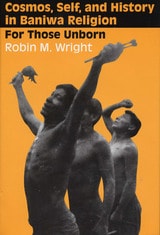
Cosmos, Self, and History in Baniwa Religion
For Those UnbornBy Robin M. Wright
University of Texas Press, 1998
The Baniwa Indians of the Northwest Amazon have engaged in millenarian movements since at least the middle of the nineteenth century. The defining characteristic of these movements is usually a prophecy of the end of this present world and the restoration of the primordial, utopian world of creation. This prophetic message, delivered by powerful shamans, has its roots in Baniwa myths of origin and creation.
In this ethnography of Baniwa religion, Robin M. Wright explores the myths of creation and how they have been embodied in religious movements and social action—particularly in a widespread conversion to evangelical Christianity. He opens with a discussion of cosmogony, cosmology, and shamanism, and then goes on to explain how Baniwa origin myths have played an active role in shaping both personal and community identity and history. He also explores the concepts of death and eschatology and shows how the mythology of destruction and renewal in Baniwa religion has made the Baniwa people receptive to both Catholic and Protestant missionaries.
Counsels of Imperfection
Thinking Through Catholic Social TeachingEdward Hadas
Catholic University of America Press, 2021
Count Me In
Young, Darlene
Signature Books, 2024
Countercultural Conservatives
American Evangelicalism from the Postwar Revival to the New Christian RightAxel R. Schäfer
University of Wisconsin Press, 2012
In the mid-twentieth century, far more evangelicals supported such “liberal” causes as peace, social justice, and environmental protection. Only gradually did the conservative evangelical faction win dominance, allying with the Republican Party of Ronald Reagan and, eventually, George W. Bush.
In Countercultural Conservatives Axel Schäfer traces the evolution of a diffuse and pluralistic movement into the political force of the New Christian Right. In forging its complex theological and political identity, evangelicalism did not simply reject the ideas of 1960s counterculture, Schäfer argues. For all their strict Biblicism and uncompromising morality, evangelicals absorbed and extended key aspects of the countercultural worldview.
Carefully examining evangelicalism’s internal dynamics, fissures, and coalitions, this book offers an intriguing reinterpretation of the most important development in American religion and politics since World War II.
Covenant of Blood
Circumcision and Gender in Rabbinic JudaismLawrence A. Hoffman
University of Chicago Press, 1995
In the rabbinic system, Hoffman argues, circumcision was neither a birth ritual nor the beginning of the human life cycle, but a rite of covenantal initiation into a male "life line." Although the evolution of the rite was shaped by rabbinic debates with early Christianity, the Rabbis shared with the church a view of blood as providing salvation. Hoffman examines the particular significance of circumcision blood, which, in addition to its salvific role, contrasted with menstrual blood to symbolize the gender dichotomy within the rabbinic system. His analysis of the Rabbis' views of circumcision and menstrual blood sheds light on the marginalization of women in rabbinic law. Differentiating official mores about gender from actual practice, Hoffman surveys women's spirituality within rabbinic society and examines the roles mothers played in their sons' circumcisions until the medieval period, when they were finally excluded.
Covenant of Justice
Prayers, Poems, and Meditations from Women of Reform JudaismWomen of Reform Judaism
Central Conference of American Rabbis, 2025
Copublished with Women of Reform Judaism
Covert Gestures
Crypto-Islamic Literature as Cultural Practice in Early Modern SpainVincent Barletta
University of Minnesota Press, 2005
Crabgrass Catholicism
How Suburbanization Transformed Faith and Politics in Postwar AmericaStephen M. Koeth
University of Chicago Press, 2025
The 1960s in America were a time of revolt against the stifling conformism embodied in the sprawling, uniform suburbs of the 1950s. Typically, the reforms of the Catholic Church’s Second Vatican Council, which aimed to make the Church more modern and accessible, are seen as one result of that broader cultural liberalization. Yet in Crabgrass Catholicism, Stephen M. Koeth demonstrates that the liberalization of the Church was instead the product of the mass suburbanization that began some fifteen years earlier. Koeth argues that postwar suburbanization revolutionized the Catholic parish, the relationship between clergy and laity, conceptions of parochial education, and Catholic participation in US politics, and thereby was a significant factor in the religious disaffiliation that only accelerated in subsequent decades.
A novel exploration of the role of Catholics in postwar suburbanization, Crabgrass Catholicism will be of particular interest to urban historians, scholars of American Catholicism and religious studies, and Catholic clergy and laity.
Crainte de Dieu, Sagesse et Loi
Aspects théologiques à partir de Si 10,19-11,6Katharina Lentz
SBL Press, 2020
Peu d'études spécifiques ont été consacrées à Ben Sira 10,19-11,6. Lentz examine le texte en hébreu, grec, syriaque et latin, en essayant d'identifier les différences majeures entre ces versions et leurs orientations fondamentales respectives. Dans cette péricope, elle révèle trois thèmes importants: la crainte de Dieu, la sagesse et la loi. En prenant comme point de départ le thème de la crainte de Dieu dans le Deutéronome, les Psaumes et les Proverbes, Job et Qoheleth en plus de Ben Sira, Lentz examine la relation de ce thème avec la sagesse et la loi. La relation étroite entre la crainte de Dieu, la sagesse et la loi devrait inciter les spécialistes à se demander si celles-ci ne représentent pas trois aspects de la même réalité.
Few specific studies have been devoted to Ben Sira 10:19-11:6. Lentz examines the text in Hebrew, Greek, Syriac, and Latin, trying to identify the major differences between these versions and their respective fundamental orientations. In this pericope she reveals three important themes: the fear of God, wisdom, and the law. Taking as a point of departure the theme of the fear of God in Deuteronomy, Psalms, and Proverbs, Job, and Qoheleth, in addition to Ben Sira, Lentz examines the relationship of this theme with wisdom and the law. The close relationship between the fear of God, wisdom, and the law should lead scholars to ask if these do not represent three aspects of the same reality.
Creating Ourselves
African Americans and Hispanic Americans on Popular Culture and Religious ExpressionAnthony B. Pinn and Benjamín Valentín, eds.
Duke University Press, 2009
Corresponding to a particular form of popular culture, each section features two essays, one by an African American scholar and one by a Latino/a scholar, as well as a short response by each scholar to the other’s essay. The essays and responses are lively, varied, and often personal. One contributor puts forth a “brown” theology of hip hop that celebrates hybridity, contradiction, and cultural miscegenation. Another analyzes the content of the message transmitted by African American evangelical preachers who have become popular sensations through television broadcasts, video distribution, and Internet promotions. The other essays include a theological reading of the Latina body, a consideration of the “authenticity” of representations of Jesus as white, a theological account of the popularity of telenovelas, and a reading of African American ideas of paradise in one of Toni Morrison’s novels. Creating Ourselves helps to make popular culture available as a resource for theology and religious studies and for facilitating meaningful discussions across racial and ethnic boundaries.
Contributors. Teresa Delgado, James H. Evans Jr., Joseph De León, Cheryl Kirk-Duggan, Angel F. Méndez Montoya, Alexander Nava, Anthony B. Pinn, Mayra Rivera, Suzanne E. Hoeferkamp Segovia, Benjamín Valentín, Jonathan L. Walton, Traci C. West, Nancy Lynne Westfield, Sheila F. Winborne
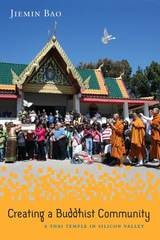
Creating a Buddhist Community
A Thai Temple in Silicon ValleyJiemin Bao
Temple University Press, 2015
In Creating a Buddhist Community, Jiemin Bao shows how the Wat Thai participants practice Buddhism and rework gender relationships in the course of organizing temple space, teaching meditation, schooling children in Thai language and culture, merit making, fundraising, and celebrating festivals.
Bao’s detailed account of the process of creating an inclusive temple community with Thai immigrants as the majority helps to deconstruct the exoticized view of Buddhism in American culture. Creating a Buddhist Community also explores Wat Thai’s identification with both the United States and Thailand and how this transnational perspective reimagines and reterritorializes what is called American Buddhism.
Creating a Human World
A New Psychological and Religious Anthropology In Dialogue with Freud, Heidegger, and KierkegaardErnest Daniel Carrere
University of Scranton Press, 2006
Carrere elucidates the paradoxical spiritual truth that salvation lies not in an escape from humanity, but in embracing it. An interdisciplinary tour de force, this book will appeal to anyone interested in philosophy, psychology, religion, or cultural anthropology.
Creating a Perfect World
Religious and Secular Utopias in Nineteenth-Century OhioCatherine M. Rokicky
Ohio University Press, 2002
Powerful currents of religious revival and political and social reform swept nineteenth-century America. Many people expressed their radical religious and social ideals by creating or joining self-contained utopian communities. These utopianists challenged the existing social and economic order with alternative notions about religion, marriage, family, sexuality, property ownership, and wage labor.
Between 1787 and 1919, approximately 270 utopian communities existed in the United States. Due to its unique location on the young nation’s frontier, the state of Ohio was the site of much of this activity.
Creating a Perfect World examines Ohio’s utopian movements, both religious and secular. These include the United Society of Believers in Christ’s Second Coming, or Shakers; the Society of Separatists at Zoar; the Mormons, who stopped in the state for several years on their way west; and several societies based on the philosophies of European social reformers Robert Owen and Charles Fourier.
In this detailed account of a unique and fascinating chapter in Ohio’s history, Catherine M. Rokicky profiles these communities and explores their ideals, how and why they were established, their leaders, and their members’ reasons for joining and sometimes leaving. She also examines the roles men and women played, their approaches to communal living and community property, their economic activities, their relations with surrounding communities and the state, and the various reasons for their success or failure.
Creation through Evolution
New Perspectives from Thomistic Theology and PhilosophyNicanor Pier Giorgio Austriaco
Catholic University of America Press, 2025
Creative Tension
Essays On Science & ReligionMichael Heller
Templeton Press, 2003
The voice of a renowned professor of philosophy in Poland, who is also a Roman Catholic priest, is introduced to the United States in this collection of his provocative essays on the interplay of science and religion. Michael Heller progressively outlines systematic steps that might lead to a peaceful coexistence of these traditionally separate fields of study. Some essays have their roots in the author's work in physics and cosmology, while others present his theories on the language of God, creation, and transcendence, inspired by his work in the applications of so-called noncommutative geometry, an emerging field of study.
- Part one deals with methodology, evaluate the theological interpretation of scientific theories, and proposes a program for a "theology of science."
- Part two looks at the interaction of science and religion from a historical perspective. Topics include the evolution of ideas connected with the place of man in the Universe and the evolution of matter, among others.
- Part three concentrates on the "creation and science" quandary, including the big bang theory, the role of probability and chance in science, and their impact on theological questions.
- Part four looks for vestiges of transcendence in contemporary science.
Credulity
A Cultural History of US MesmerismEmily Ogden
University of Chicago Press, 2018
Credulity tells the fascinating story of mesmerism’s spread from the plantations of the French Antilles to the textile factory cities of 1830s New England. As it proliferated along the Eastern seaboard, this occult movement attracted attention from Ralph Waldo Emerson’s circle and ignited the nineteenth-century equivalent of flame wars in the major newspapers. But mesmerism was not simply the last gasp of magic in modern times. Far from being magicians themselves, mesmerists claimed to provide the first rational means of manipulating the credulous human tendencies that had underwritten past superstitions. Now, rather than propping up the powers of oracles and false gods, these tendencies served modern ends such as labor supervision, education, and mediated communication. Neither an atavistic throwback nor a radical alternative, mesmerism was part and parcel of the modern. Credulity offers us a new way of understanding the place of enchantment in secularizing America.
Crescent over Another Horizon
Islam in Latin America, the Caribbean, and Latino USAEdited by Maria del Mar Logroño Narbona, Paulo G. Pinto, and John Tofik Karam
University of Texas Press, 2015
Muslims have been shaping the Americas and the Caribbean for more than five hundred years, yet this interplay is frequently overlooked or misconstrued. Brimming with revelations that synthesize area and ethnic studies, Crescent over Another Horizon presents a portrait of Islam’s unity as it evolved through plural formulations of identity, power, and belonging. Offering a Latino American perspective on a wider Islamic world, the editors overturn the conventional perception of Muslim communities in the New World, arguing that their characterization as “minorities” obscures the interplay of ethnicity and religion that continues to foster transnational ties.
Bringing together studies of Iberian colonists, enslaved Africans, indentured South Asians, migrant Arabs, and Latino and Latin American converts, the volume captures the power-laden processes at work in religious conversion or resistance. Throughout each analysis—spanning times of inquisition, conquest, repressive nationalism, and anti-terror security protocols—the authors offer innovative frameworks to probe the ways in which racialized Islam has facilitated the building of new national identities while fostering a double-edged marginalization. The subjects of the essays transition from imperialism (with studies of morisco converts to Christianity, West African slave uprisings, and Muslim and Hindu South Asian indentured laborers in Dutch Suriname) to the contemporary Muslim presence in Argentina, Brazil, Mexico, and Trinidad, completed by a timely examination of the United States, including Muslim communities in “Hispanicized” South Florida and the agency of Latina conversion. The result is a fresh perspective that opens new horizons for a vibrant range of fields.
Criminal-Inquisitorial Trials in English Church Trials
From the Middle Ages to the ReformationHenry Ansgar Kelly
Catholic University of America Press, 2023
Crisis in Watertown
The Polarization of an American CommunityLynn Eden
University of Michigan Press, 1972
Crisis of Conscience
Arkansas Methodists and the Civil Rights StruggleJames T. Clemons
Butler Center for Arkansas Studies, 2007
Critical Terms for Religious Studies
Edited by Mark C. Taylor
University of Chicago Press, 1998
Following in the very successful tradition of Critical Terms for Literary Studies and Critical Terms for Art History, this book attempts to provide a revitalized, self-aware vocabulary with which this bewildering religious diversity can be accurately described and responsibly discussed. Leading scholars working in a variety of traditions demonstrate through their incisive discussions that even our most basic terms for understanding religion are not neutral but carry specific historical and conceptual freight.
These essays adopt the approach that has won this book's predecessors such widespread acclaim: each provides a concise history of a critical term, explores the issues raised by the term, and puts the term to use in an analysis of a religious work, practice, or event. Moving across Judaism, Christianity, Hinduism, Buddhism, Islam, and Native American and Mayan religions, contributors explore terms ranging from experience, territory, and image, to God, sacrifice, and transgression.
The result is an essential reference that will reshape the field of religious studies and transform the way in which religion is understood by scholars from all disciplines, including anthropology, sociology, psychology, cultural studies, gender studies, and literary studies.
Critical Terms for Religious Studies, Second Edition
Edited by Sarah Hammerschlag
University of Chicago Press, 2025
First published nearly thirty years ago, Critical Terms for Religious Studies proved a vital resource for an emerging interdisciplinary conversation. We still use much of the same language in the study of religion, but fresh concerns have both changed the meaning of terms and given rise to new terms altogether. This edition consists of twenty-three entirely new essays that offer students and scholars alike the tools to historicize and evaluate the shifting role of familiar and emerging critical terms in religious studies.
These are “critical terms” both because they are important in our cultural moment and because thinking through them reveals how religions are embedded in and shaped by material, social, economic, and political forces. A shared conviction unites contributors from a range of traditions and methodologies: a recognition that our world is saturated by the persistence of religious traditions as shape-shifting (not static or transcendent) forces of authority, as powerful today as ever before.
Critical Terms for the Study of Buddhism
Edited by Donald S. Lopez Jr.
University of Chicago Press, 2005
This volume provides a unique introduction to Buddhism by examining categories essential for a nuanced understanding of its traditions. Each of the fifteen essays here shows students how a fundamental term—from art to word—illuminates the practice of Buddhism, both in traditional Buddhist societies and in the realms of modernity. Apart from Buddha, the list of terms in this collection deliberately includes none that are intrinsic to the religion. Instead, the contributors explore terms that are important for many fields and that invite interdisciplinary reflection. Through incisive discussions of topics ranging from practice, power, and pedagogy to ritual, history, sex, and death, the authors offer new directions for the understanding of Buddhism, taking constructive and sometimes polemical positions in an effort both to demonstrate the shortcomings of assumptions about the religion and the potential power of revisionary approaches.
Following the tradition of Critical Terms for Religious Studies, this volume is not only an invaluable resource for the classroom but one that belongs on the short list of essential books for anyone seriously interested in Buddhism and Asian religions.
Cross Purposes
Pierce v. Society of Sisters and the Struggle over Compulsory Public EducationPaula Abrams
University of Michigan Press, 2009
"A definitive study of an extremely important, though curiously neglected, Supreme Court decision, Pierce v. Society of Sisters."
---Robert O'Neil, Professor of Law Emeritus, University of Virginia School of Law
---Richard W. Garnett, Professor of Law and Associate Dean, Notre Dame Law School
"A well-written, well-researched blend of law, politics, and history."
---Joan DelFattore, Professor of English and Legal Studies, University of Delaware
In 1922, the people of Oregon passed legislation requiring all children to attend public schools. For the nativists and progressives who had campaigned for the Oregon School Bill, it marked the first victory in a national campaign to homogenize education---and ultimately the populace. Private schools, both secular and religious, vowed to challenge the law. The Catholic Church, the largest provider of private education in the country and the primary target of the Ku Klux Klan campaign, stepped forward to lead the fight all the way to the U.S. Supreme Court.
In Pierce v. Society of Sisters (1925), the court declared the Oregon School Bill unconstitutional and ruled that parents have the right to determine how their children should be educated. Since then, Pierce has provided a precedent in many cases pitting parents against the state.
Paula Abrams is Professor of Constitutional Law at Lewis & Clark Law School.
Cross and Creation
A Theological Introduction to Origen of AlexandriaMark E. Therrien
Catholic University of America Press, 2022
Cross and Cruciform in the Anglo-Saxon World
Studies to Honor the Memory of Timothy ReuterSARAH LARRATT KEEFER
West Virginia University Press, 2010
Cross and Cruciform in the Anglo-Saxon World: Studies to Honor the Memory of Timothy Reuter is edited by Sarah Larratt Keefer, Karen Louise Jolly, and Catherine E. Karkov and is the third and final volume of an ambitious research initiative begun in 1999 concerned with the image of the cross, showing how its very material form cuts across both the culture of a society and the boundaries of academic disciplines—history, archaeology, art history, literature, philosophy, and religion—providing vital insights into how symbols function within society. The flexibility, portability, and adaptability of the Anglo-Saxon understanding of the cross suggest that, in pre-Conquest England, at least, the linking of word, image, and performance joined the physical and spiritual, the temporal and eternal, and the earthly and heavenly in the Anglo-Saxon imaginative landscape.
This volume is divided into three sections. The first section of the collection focuses on representations of “The Cross: Image and Emblem,” with contributions by Michelle P. Brown, David A. E. Pelteret, and Catherine E. Karkov. The second section, “The Cross: Meaning and Word,” deals in semantics and semeology with essays by Éamonn Ó Carragáin, Helen Damico, Rolf Bremmer, and Ursula Lenker. The third section of the book, “The Cross: Gesture and Structure,” employs methodologies drawn from archaeology, new media, and theories of rulership to develop new insights into subjects as varied as cereal production, the little-known Nunburnholme Cross, and early medieval concepts of political power.
Cross and Cruciform in the Anglo-Saxon World: Studies to Honor the Memory of Timothy Reuter is a major collection of new research, completing the publication series of the Sancta Crux/Halig Rod project. Cross and Culture in Anglo-Saxon England: Studies in Honor of George Hardin Brown, Volume 2 in this series, remains available from West Virginia University Press.
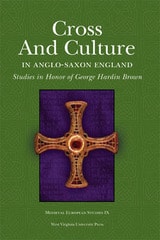
Cross and Culture in Anglo-Saxon England
Studies in Honor of George Hardin BrownKAREN L. JOLLY
West Virginia University Press, 2008
As Volume One in the Sancta Crux/Halig Rod series, this collection of new research offers fascinating glimpses into how the way the cross, the central image of Christianity in the Anglo-Saxon period, was textualized, reified, visualized, and performed. The cross in early medieval England was so ubiquitous it became invisible to the modern eye, and yet it played an innovative role in Anglo-Saxon culture, medicine, and popular practice. It represented one of the most powerful relics, emblems, and images in medieval culture because it could be duplicated in many forms and was accessible to every layer of society. The volume speaks to critical issues of cultural interpretation for Anglo-Saxonists, medievalists of all disciplines, and those interested in cultural studies in general.
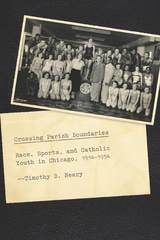
Crossing Parish Boundaries
Race, Sports, and Catholic Youth in Chicago, 1914-1954Timothy B. Neary
University of Chicago Press, 2016
In this book, Timothy B. Neary reveals the history of Bishop Bernard Sheil’s Catholic Youth Organization (CYO), which brought together thousands of young people of all races and religions from Chicago’s racially segregated neighborhoods to take part in sports and educational programming. Tens of thousands of boys and girls participated in basketball, track and field, and the most popular sport of all, boxing, which regularly filled Chicago Stadium with roaring crowds. The history of Bishop Sheil and the CYO shows a cosmopolitan version of American Catholicism, one that is usually overshadowed by accounts of white ethnic Catholics aggressively resisting the racial integration of their working-class neighborhoods. By telling the story of Catholic-sponsored interracial cooperation within Chicago, Crossing Parish Boundaries complicates our understanding of northern urban race relations in the mid-twentieth century.
Crossing the Gods
World Religions and Worldly PoliticsDemerath, Jay
Rutgers University Press, 2003
Eminent sociologist of religion Jay Demerath traveled to Brazil, China, Egypt, Guatemala, India, Indonesia, Israel, Japan, Northern Ireland, Pakistan, Poland, Sweden, Turkey, and Thailand to explore the history and current relationship of religion, politics, and the state in each country. In the first part of this wide-ranging book, he asks, What are the basic fault lines along which current tensions and conflicts have formed? What are the trajectories of change from past to present, and how do they help predict the future?
In the book’s second part the author returns home to focus on the United States the only nation founded specifically on the principle of a separation between religion and state and examines the extent to which this principle actually holds and the consequences when it does not. Highlighting such issues as culture wars, violence, globalization, and the fluidity of individual religious identity, Demerath exposes the provincialism and fallacies underlying many of our views of religion and politics worldwide.
Finally, Demerath examines America’s status as the world’s most religious nation. He places that claim within a comparative context and argues that our country is not “more religious” but “differently religious.” He argues that it represents a unique combination of congregational religion, religious pluralism, and civil religion. But the United States also illustrates the universal tendency for the sacred to give way to the secular and for the secular to generate new forms of the sacred.
Crossing the River
Shalom Eilati
University of Alabama Press, 2009
A child’s journey through war, memory, and survival—told with haunting clarity and poetic grace.
Crossing the River is a personal memoir—and more. Against the backdrop of Lithuania’s occupation—first by the Red Army, next by the Germans, and then again by the Russians—it is a story reflected through the prism of a sharp-eyed young child, Shalom Eilati. His story starts in the occupied Kovno Ghetto and ends with his flight across the Soviet border, through Poland and Germany and finally, his arrival in Palestine.
The adult survivor, while recalling the terrorized child that he was and how he then perceived the adult world, also takes stock of his present life. Throughout the memoir, Eilati attempts to reconcile his present life as a husband, father, scientist, and writer, with the images, feelings, and thoughts from the past that have left an indelible mark on his life and that continue to haunt him.
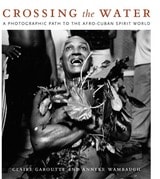
Crossing the Water
A Photographic Path to the Afro-Cuban Spirit WorldClaire Garoutte and Anneke Wambaugh
Duke University Press, 2007
A book of more than 150 striking photographs in both black and white and color, Crossing the Water includes images of elaborate Santería altars and Palo spirit cauldrons, as well as of Santiago and his religious “family” engaged in ritual practices: the feeding of the spirits, spirit possession, and private and collective healing ceremonies. As the charismatic head of a large religious community, Santiago helps his godchildren and others who consult him to cope with physical illness, emotional crises, contentious relationships, legal problems, and the hardships born of day-to-day survival in contemporary Cuba. He draws on the distinct yet intertwined traditions of Santería, Palo Monte, and Espiritismo to foster healing of both mind and body—the three religions form a coherent theological whole for him.
Santiago eventually became Garoutte’s and Wambaugh’s spiritual godfather, and Crossing the Water is informed by their experiences as initiates of Santería and Palo Monte. Their text provides nuanced, clear explanations of the objects and practices depicted in the images. Describing the powerful intensity of human-spirit interactions, and evoking the sights, smells, sounds, and choreography of ritual practice, Crossing the Water takes readers deep inside the intimate world of Afro-Cuban spirituality.
Crowned with Hope
Essays in Honor of Paul O'CallaghanKenny Ang
St. Augustine's Press, 2026
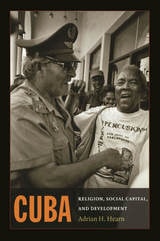
Cuba
Religion, Social Capital, and DevelopmentAdrian H. Hearn
Duke University Press, 2008
While conducting research, Hearn lived for one year each in two Santería temple-houses: one located in Old Havana and the other in Santiago de Cuba. During those stays he conducted numerous interviews: with the historian of Havana and the conservationist of Santiago de Cuba (officials roughly equivalent to mayors in the United States), acclaimed writers, influential leaders of Afro-Cuban religions, and many citizens involved in community development initiatives. Hearn draws on those interviews, his participant observation in the temple-houses, case studies, and archival research to convey the daily life experiences and motivations of religious practitioners, development workers, and politicians. Using the concept of social capital, he explains the state’s desire to incorporate tightly knit religious groups into its community development projects, and he illuminates a fundamental challenge facing Cuba’s religious communities: how to maintain their spiritual integrity and internal solidarity while participating in state-directed projects.

Cuchama and Sacred Mountains
Walter Y. Evans-Wentz
Ohio University Press, 1981
W. Y. Evans–Wentz, great Buddhist scholar and translator of such now familiar works as the Tibetan Book of the Dead and the Tibetan Book of the Great Liberation, spent his final years in California. There, in the shadow of Cuchama, one of the Earth’s holiest mountains, he began to explore the astonishing parallels between the spiritual teaching of America’s native peoples and that of the deeply mystical Hindus and Tibetans. Cuchama and Sacred Mountains, a book completed shortly before his death in 1965, is the fruit of those explorations.
To Cuchama, “Exalted High Place,” came the young Cochimi and Yuma boys for initiation into the mystic rites for their people. In solitude they sought and received guidance and wisdom. In this same way, the peoples of ancient Greece, the Hebrews, the early Christians, and the Hindus had found access to inner truth on their own holy mountains: and in this same way must the modern person find the path to inner knowing.
Surveying many of the most Sacred Mountains in North America, South America, Europe, and Asia, Evans–Wentz expresses the belief that the secret power of these high places has not passed away but only awaits the coming of a New Age. This new age, in accord with the oldest prophecies of our continent, will be a time of renaissance, the long–waited era of harmony and peace among all peoples.
This renaissance shall be uniquely American, a renewal based on the values so long honored by the Americans before Columbus, and so ruthlessly trampled by the “civilized” Europeans who overran them. No other race of people has been as spiritual in their way of life than the original Americans, notes Evans–Wentz. Perhaps none other has known such martyrdom. Yet the secret greatness of the Indian religion still lives, ancient as the Earth itself, yet ageless in its power to renew.
Cultivating the Good Student
Fostering the Moral Virtues of the Intellectual LifeDouglas LeBlanc
Catholic University of America Press, 2026
Cults, Martyrs and Good Samaritans
Religion in Contemporary English Political DiscourseJames Crossley
Pluto Press, 2018
From the paternalistic Christianity used to justify ever-intensifying neoliberalism, to the ethnonationalist and protectionist Christianity of Theresa May and Brexit, to the socialist constructions of Christianity by Jeremy Corbyn and Momentum, Crossley guides us through the love affair between politics and Christianity.. Drawing on interviews with politicians, activists, revolutionaries, and voters on either side of Brexit, Crossley reveals how religion is linked to positions on issues of class, capitalism, and foreign policy, and how it can can often challenge dominant class interests, obfuscate potential causes of unrest, and even justify military intervention.
Cultural Disjunctions
Post-Traditional Jewish IdentitiesPaul Mendes-Flohr
University of Chicago Press, 2021
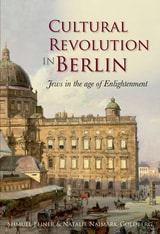
Cultural Revolution in Berlin
Jews in the Age of EnlightenmentShmuel Feiner and Natalie Naimark-Goldberg
Bodleian Library Publishing, 2011
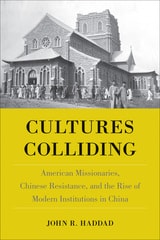
Cultures Colliding
American Missionaries, Chinese Resistance, and the Rise of Modern Institutions in ChinaJohn R. Haddad
Temple University Press, 2023
As incredible as it may seem, the American missionaries who journeyed to China in 1860 planning solely to spread the Gospel ultimately reinvented their entire enterprise. By 1900, they were modernizing China with schools, colleges, hospitals, museums, and even YMCA chapters. In Cultures Colliding, John R. Haddad nimbly recounts this transformative institution-building—how and why it happened—and its consequences.
When missionaries first traveled to rural towns atop mules, they confronted populations with entrenched systems of belief that embraced Confucius and rejected Christ. Conflict ensued as these Chinese viewed missionaries as unwanted disruptors. So how did this failing movement eventually change minds and win hearts? Many missionaries chose to innovate. They built hospitals and established educational institutions offering science and math. A second wave of missionaries opened YMCA chapters, coached sports, and taught college. Crucially, missionaries also started listening to Chinese citizens, who exerted surprising influence over the preaching, teaching, and caregiving, eventually running some organizations themselves. They embraced new American ideals while remaining thoroughly Chinese.
In Cultures Colliding, Haddad recounts the unexpected origins and rapid rise of American institutions in China by telling the stories of the Americans who established these institutions and the Chinese who changed them from within. Today, the impact of this untold history continues to resonate in China.
Cultures In Conflict
A Documentary History of the Mormon War in IllinoisJohn Hallwas and Roger Launius
Utah State University Press, 1999
Cur homo?
A History of the Thesis of Man as a Replacement for Fallen AngelsVojtech Novotný
Karolinum Press, 2014
First introduced by St. Augustine and developed by other church fathers, the concept truly flourished in the twelfth century, when it was decided that man is an “original” being, created for its own sake, for whom God created the world. Vojtech Novotný goes on to trace the idea as it gradually faded over the centuries and, more recently, has been revived in the fields of modern philosophical thought.
Curators of the Buddha
The Study of Buddhism under ColonialismEdited by Donald S. Lopez Jr.
University of Chicago Press, 1995
After an overview of the origins of Buddhist studies in the early nineteenth century, the essays focus on important "curators of the Buddha," such as Aurel Stein, D. T. Suzuki, and Carl Jung, who, as they created and maintained the discipline, played a significant role in disseminating knowledge about Buddhism in the West. The essays bring to life many of the important but unexamined social, political, and cultural conditions that have shaped the course of Buddhist studies for more than a century—and have frequently distorted the understanding of a complex set of traditions. Contributors Charles Hallisey, Gustavo Benavides, Stanley Abe, Luis Gómez, Robert Sharf, and Donald Lopez challenge some of the most enduring ideas in Buddhist studies: that Zen Buddhism is, above all, an experience; that Tibetan Buddhism is polluted, or pristine; that the Buddha image is of Greek or Roman origin; that the classical text supersedes the vernacular, as the manuscript supersedes the informant; and many others.
Current Issues in Priestly and Related Literature
The Legacy of Jacob Milgrom and BeyondRoy E. Gane
SBL Press, 2015
New directions and fresh insight for scholars and students
The single greatest catalyst and contributor to our developing understanding of priestly literature has been Jacob Milgrom (1923-2010), whose seminal articles, provocative hypotheses, and comprehensively probing books vastly expanded and significantly altered scholarship regarding priestly and related literature. Nineteen articles build on Milgrom's work and look to future directions of research. Essays cover a range of topics including the interpretation, composition and literary structure of priestly and holiness texts as well as their relationships to deuteronomic and extra-biblical texts. The book includes a bibliography of Milgrom's work published between 1994 and 2014.
Features: