Results by title
5448 books match the query 'History and criticism' and 372 start with c

Cultural Difference and the Literary Text
Pluralism and the Limits of Authenticity in North American LiteratureWinfried Siemerling
University of Iowa Press, 1997
This dynamic, open-minded collection of essays responds to the issues raised by Werner Sollors when he argues against the rigidity of cultural pluralism, against the ethnic group-by-group segregation of American literature. Instead he calls for an openly transethinic recognition of cross-cultural interplays and connections among all so-called groups and their canons. In enthusiastic response to such issues, the contributors explore a variety of approaches to pluralism, multiculturalism, group identity, and the problematics of authenticity in literary texts and criticism both historically and currently.
The scholars in this civil, persuasive volume are at home in an international world that crosses linguistic, cultural, and national boundaries. They thus transcend the customary restrictions of earlier, relatively isolationist scholarship to form new, nonpolemical links among cultural identities. This relationship between oral modes of communal identity and writing in tribal cultures joins an examination of Houston Baker's discursive strategies. A consideration of ethnic humor in the writings of Zora Neale Hurston and Jerre Mangione and a discussion of Jean Toomer's racial persona offer striking contextualizations. Two contributors study discursive constructions of mestizaje in Chicano/a texts, followed by essays on cultural difference in Faulkner's Light in August and Roth's Call It Sleep.Finally, Werner Sollers's essay extends the interactions among all these energetic, nonjudgmental dialogues.

Cultural Erotics in Cuban America
Ricardo L. Ortíz
University of Minnesota Press, 2006
In this wide-ranging work Ortíz argues for the authentically diasporic quality of postrevolutionary, off-island Cuban experience. Highlighting various forms of cultural expression, Cultural Erotics in Cuban America traces underrepresented communities’ responses to the threat of cultural disappearance in an overwhelming and hegemonic U.S. culture. Ortíz shows how the work of Cuban-American writers and artists challenges the heteronormativity of both home and host culture. Focusing on artists who have had an ambivalent, indirect, or nonexistent connection to Miami, he presents close readings of such novelists as Reinaldo Arenas, Roberto G. Fernández, Achy Obejas, and Cristina García, the playwright Eduardo Machado, the poet Rafael Campo, and musical performers Albita Rodríguez and Celia Cruz.
Ortíz charts the legacies of sexism and homophobia in patriarchal Cuban culture, as well as their influence on Cuban-revolutionary and Cuban-exile ideologies. Moving beyond the outdated cultural terms of the Cold War, he looks forward to envision queer futures for Cuban-American culture free from the ties to restrictive—indeed, oppressive—constructions of nation, place, language, and desire.
Ricardo L. Ortíz is associate professor of English at Georgetown University.
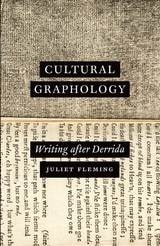
Cultural Graphology
Writing after DerridaJuliet Fleming
University of Chicago Press, 2016
Fleming shows that the single most important lesson to survive from Derrida’s early work is that we do not know what writing is. Channeling Derrida’s thought into places it has not been seen before, she examines printed errors, spaces, and ornaments (topics that have hitherto been marginal to our accounts of print culture) and excavates the long-forgotten reading practice of cutting printed books. Proposing radical deformations to the meanings of fundamental and apparently simple terms such as “error,” “letter,” “surface,” and “cut,” Fleming opens up exciting new pathways into our understanding of writing all told.
Cultural Institutions of the Novel
Deidre Lynch and William B. Warner, eds.
Duke University Press, 1996
The essays in Cultural Institutions of the Novel find new ways to analyze how a genre notorious for its aesthetic unruliness has become institutionalized—defined, legitimated, and equipped with a canon. With a particular focus on the status of novels as commodities, their mediation of national cultures, and their role in transnational exchange, these pieces range from the seventeenth century to the present and examine the forms and histories of the novel in England, Nigeria, Japan, France, New Zealand, Canada, and the United States. Works by Jane Austen, Natsume Sôseki, Gabriel García Márquez, Buchi Emecheta, and Toni Morrison are among those explored as Cultural Institutions of the Novel investigates how theories of “the” novel and disputes about which narratives count as novels shape social struggles and are implicated in contests over cultural identity and authority.
Contributors. Susan Z. Andrade, Lauren Berlant, Homer Brown, Michelle Burnham, James A. Fujii, Nancy Glazener, Dane Johnson, Lisa Lowe, Deidre Lynch, Jann Matlock, Dorothea von Mücke, Bridget Orr, Clifford Siskin, Katie Trumpener, William B. Warner
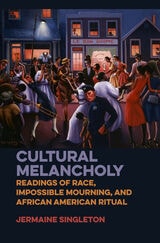
Cultural Melancholy
Readings of Race, Impossible Mourning, and African American RitualJermaine Singleton
University of Illinois Press, 2015
Singleton develops the concept of "cultural melancholy" as a response to scholarship that calls for the separation of critical race studies and psychoanalysis, excludes queer theoretical approaches from readings of African American literatures and cultures, and overlooks the status of racialized performance culture as a site of serious academic theorization. In doing so, he weaves critical race studies, psychoanalysis, queer theory, and performance studies into conversation to uncover a host of hidden dialogues—psychic and social, personal and political, individual and collective—for the purpose of promoting a culture of racial grieving, critical race consciousness, and collective agency.
Wide-ranging and theoretically bold, Cultural Melancholy counteracts the racial legacy effects that plague our twenty-first century multiculture.
Culture Concept
Writing and Difference in the Age of RealismMichael A. Elliott
University of Minnesota Press, 2002
Examines the prehistory of the American struggle to address cultural difference.
"Culture" is a term we commonly use to explain the differences in our ways of living. In this book Michael A. Elliott returns to the moment this usage was first articulated, tracing the concept of culture to the writings-folktales, dialect literature, local color sketches, and ethnographies-that provided its intellectual underpinnings in turn-of-the-century America.
The Culture Concept explains how this now-familiar definition of "culture" emerged during the late nineteenth century through the intersection of two separate endeavors that shared a commitment to recording group-based difference-American literary realism and scientific ethnography. Elliott looks at early works of cultural studies as diverse as the conjure tales of Charles Chesnutt, the Ghost Dance ethnography of James Mooney, and the prose narrative of the Omaha anthropologist-turned-author Francis La Flesche. His reading of these works-which struggle to find appropriate theoretical and textual tools for articulating a less chauvinistic understanding of human difference-is at once a recovery of a lost connection between American literary realism and ethnography and a productive inquiry into the usefulness of the culture concept as a critical tool in our time and times to come.
Culture and Language at Crossed Purposes
The Unsettled Records of American SettlementJerome McGann
University of Chicago Press, 2022
Classic American literature, Jerome McGann argues, is haunted by the betrayal of seventeenth- and eighteenth-century Indian treaties—“a stunned memory preserved in the negative spaces of the treaty records.” A noted scholar of the “textual conditions” of literature, McGann investigates canonical works from the colonial period, including the Arbella sermon and key writings of William Bradford, John Winthrop, Anne Bradstreet, Cotton Mather’s Magnalia, Benjamin Franklin’s celebrated treaty folios and Autobiography, and Thomas Jefferson’s Notes on the State of Virginia. These are highly practical, purpose-driven works—the record of Enlightenment dreams put to the severe test of dangerous conditions. McGann suggests that the treaty-makers never doubted the unsettled character of what they were prosecuting, and a similar conflicted ethos pervades these works. Like the treaty records, they deliberately test themselves against stringent measures of truth and accomplishment and show a distinctive consciousness of their limits and failures. McGann’s book is ultimately a reminder of the public importance of truth and memory—the vocational commitments of humanist scholars and educators.
Culture, Genre, and Literary Vocation
Selected Essays on American LiteratureMichael Davitt Bell
University of Chicago Press, 2000
Throughout, Bell revisits issues of genre with an eye toward the unexpected details of authors' lives, and invites us to reconsider the hidden functions that terms such as "romanticism" and "realism" served for authors and their critics. Whether tracing the demands of the market or the expectations of readers, Bell examines the intimate relationship between literary production and culture; each essay closely links the milieu in which American writers worked with the trajectory of their storied careers.
Cultures of Letters
Scenes of Reading and Writing in Nineteenth-Century AmericaRichard H. Brodhead
University of Chicago Press, 1993
Cultures of Modernism
Marianne Moore, Mina Loy, and Else Lasker-SchulerCristanne Miller
University of Michigan Press, 2005
Cultures of Modernism explores how the structure and location of literary communities significantly influence who writes, what they write about, and their openness to formal experimentation. These influences particularly affect women writers. Author Cristanne Miller notes striking patterns of similarity in the concerns and lives of women living in geographically distant centers of modernist production. She looks at three significant poets---the American Marianne Moore, the British expatriate Mina Loy, and the German Else Lasker-Schüler---in the context of cultural, national, and local elements to argue that location significantly affected their performances of subjectivity, gender, race, and religion. The first book of its kind, Cultures of Modernism breaks new ground while it contributes to the ongoing reconception of the modernist period.
"A fascinating, provocative, and genuinely original study of a 'different' modernism in poetry---namely, the Modernism of women poets."
---Marjorie Perloff, Stanford University
"An important and ambitious work that makes major contributions to the fields of gender studies and modernist studies, and to the study of modernist poetry."
---Robin Schulze, Pennsylvania State University
"Offers a welcome corrective to the unreflective critical tendency . . . to make broad claims about the historical experiences and cultural conundrums of 'women,' and particularly 'women writers.' Miller offers tour-de-force comparative readings . . . threading together the world-historical with the personal, poetics with the political, and wielding the instruments of scansion as deftly as a surgeon."
---Modernism/modernity, The Official Journal of the Modernist Studies Association
Cristanne Miller is Edward H. Butler Professor of English and Chair of the English Department at the University of Buffalo, State University of New York.
Cultures of War in Graphic Novels
Violence, Trauma, and MemoryProrokova, Tatiana
Rutgers University Press, 2018
Cultures of War in Graphic Novels examines the representation of small-scale and often less acknowledged conflicts from around the world and throughout history. The contributors look at an array of graphic novels about conflicts such as the Boxer Rebellion (1899-1901), the Irish struggle for national independence (1916-1998), the Falkland War (1982), the Bosnian War (1992-1995), the Rwandan genocide (1994), the Israel-Lebanon War (2006), and the War on Terror (2001-). The book explores the multi-layered relation between the graphic novel as a popular medium and war as a pivotal recurring experience in human history. The focus on largely overlooked small-scale conflicts contributes not only to advance our understanding of graphic novels about war and the cultural aspects of war as reflected in graphic novels, but also our sense of the early twenty-first century, in which popular media and limited conflicts have become closely interrelated.

Cumbia!
Scenes of a Migrant Latin American Music GenreHéctor Fernández L Hoeste and Pablo Vila, eds.
Duke University Press, 2013
Contributors. Cristian Alarcón, Jorge Arévalo Mateus, Leonardo D'Amico, Héctor Fernández L'Hoeste, Alejandro L. Madrid, Kathryn Metz, José Juan Olvera Gudiño, Cathy Ragland, Pablo Semán, Joshua Tucker, Matthew J. Van Hoose, Pablo Vila
Curiosity
A Cultural History of Early Modern InquiryBarbara M. Benedict
University of Chicago Press, 2001
In this striking social history, Barbara M. Benedict draws on the texts of the early modern period to discover the era's attitudes toward curiosity, a trait we learn was often depicted as an unsavory form of transgression or cultural ambition.
Curious and Modern Inventions
Instrumental Music as Discovery in Galileo's ItalyRebecca Cypess
University of Chicago Press, 2016
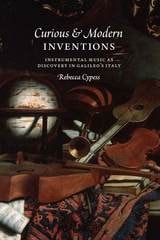
Rebecca Cypess shows that early modern thinkers were fascinated with instrumental technologies. The telescope, the clock, the pen, the lute—these were vital instruments for leading thinkers of the age, from Galileo Galilei to Giambattista Marino. No longer used merely to remake an object or repeat a process already known, instruments were increasingly seen as tools for open-ended inquiry that would lead to new knowledge. Engaging with themes from the history of science, literature, and the visual arts, this study reveals the intimate connections between instrumental music and the scientific and artisanal tools that served to mediate between individuals and the world around them.
Current Thought in Musicology
Edited by John W. Grubbs
University of Texas Press, 1976
Current Thought in Musicology covers a variety of topics, ranging from the Middle Ages to the present and touching on all the major disciplines of musicology: music history, theory and composition, music education, and performance. Taken together, the nine papers constitute a broad overview of the direction of music scholarship in the 1970s.
In “Tractatus Esthetico-Semioticus: Model of the Systems of Human Communication,” Charles Seeger presents a model of the situations in which the study of humanistic art may best be conducted. Charles Hamm writes in “The Ecstatic and the Didactic: A Pattern in American Music” of the pattern of conflicting points of view in music history and theory. American composer Elliott Carter, in his chapter titled “Music and the Time Screen,” presents a lucid explanation of his compositional process, including his concept of musical time. In “Instruments and Voices in the Fifteenth-Century Chanson,” Howard Mayer Brown suggests the nature of fifteenth-century performance, drawn from iconography and various musical sources. “Nottebohm Revisited,” by Lewis Lockwood, reexamines Beethoven’s sketchbooks, showing the extent to which performing editions of his work must be updated. Daniel Heartz’s article, “The Chanson in the Humanist Era,” is multidisciplinary and will interest a variety of scholars, including French historians and French literary historians. Gilbert Chase applies structuralism to musicological studies in his chapter, “Musicology, History, and Anthropology: Current Thoughts.” The concluding essays, “The Prospects for Research in Medieval Music in the 1970’s,” by Gilbert Reaney, and “The Library of the Mind: Observations on the Relationship between Musical Scholarship and Bibliography,” by Vincent Duckles, provide a unique view of the opportunities for further work in these areas.
The volume also includes an introduction by the editor, notes on the contributors, and an index. Current Thought in Musicology is the result of a symposium held at the University of Texas at Austin in 1971.
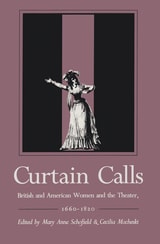
Curtain Calls
British and American Women and the Theater, 1660–1820Mary A. Schofield
Ohio University Press, 1991
“I here and there o’heard a Coxcomb cry,
Ah, rot—’tis a Woman’s Comedy.”
Thus Aphra Behn ushers in a new era for women in the British Theatre (Sir Patient Fancy, 1678). In the hundred years that were to follow—and exactly those years that Curtain Calls examines—women truly took the theater world by storm.
For each woman who chose a career in the theater world of the eighteenth century, there is a unique tale of struggle, insult, success, good or bad fortune, disaster, seduction, or fame. Whether acting, writing, reviewing, or stage managing, women played a major, if frequently unacknowledged, role in the history of the theater from the late seventeenth through the early nineteenth centuries. From Alpha Behn’s earliest plays through the glorious celebrity of Sara Siddons, women molded the taste of the age and carved out in the theater one of the few available opportunities for independence and renown.
Not all the women who tried succeeded, of course, and even the best faced opposition as they challenged the male stronghold of playwriting and theater managing. Curtain Calls maps the new territory as these pioneering women staked it for their own; it chronicles their lives, their triumphs, and their losses.
We begin with Aphra Behn, whose first play was staged in 1670, and conclude in the early decades of the nineteenth century with Inchbald and Siddons. The one hundred and fifty years encompassed by their lives contain the careers of dozens of lesser–known women, a network, as Dr. Johnson would have it, encompassing both talent and tribulation.
Contributors include: Edward Langhans, Linda R. Payne, Pat Rogers, Maureen e. Mulvihill, Deborah Payne, Betty Rizzo, Ellen Donkin, Frances M. Kavenik, Jessica Munns, nancy Cotton, Edna L. Steevs, Doreen Saar, Jean B. Kern, Katherine M. Rogers, Constance Clark, William J. Burling, Judith Phillips Stanton, Douglas Butler, Rose Zimbardo, and the editors.
Curved Thought and Textual Wandering
Gertrude Stein's PostmodernismEllen E. Berry
University of Michigan Press, 1992
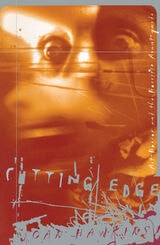
Cutting Edge
Art-Horror and the Horrific Avant-gardeJoan Hawkins
University of Minnesota Press, 2000
Explores what horror movies tell us about issues of taste.
Even before Jean-Luc Godard and other members of the French New Wave championed Hollywood B movies, aesthetes and cineasts relished the raw emotions of genre films. This contradiction has been particularly true of horror cinema, in which the same images and themes found in exploitation and splatter movies are also found in avant-garde and experimental films, blurring boundaries of taste and calling into question traditional distinctions between high and low culture.
In Cutting Edge, Joan Hawkins offers an original and provocative discussion of taste, trash aesthetics, and avant-garde culture of the 1960s and 1970s to reveal horror’s subversiveness as a genre. In her treatment of what she terms "art-horror" films, Hawkins examines home viewing, video collection catalogs, and fanzines for insights into what draws audiences to transgressive films. Cutting Edge provides the first extended political critique of Yoko Ono’s rarely seen Rape and shows how a film such as Franju’s Eyes without a Face can work simultaneously as an art, political, and splatter film. The rediscovery of Tod Browning’s Freaks as an art film, the "eurotrash" cinema of Jess Franco, camp cults like the one around Maria Montez, and the "cross-over" reception of Andy Warhol’s Frankenstein are all studied for what they reveal about cultural hierarchies. Looking at the low aspects of high culture and the high aspects of low culture, Hawkins scrutinizes the privilege habitually accorded "high" art-a tendency, she argues, that lets highbrow culture off the hook and removes it from the kinds of ethical and critical social discussions that have plagued horror and porn. Full of unexpected insights, Cutting Edge calls for a rethinking of high/low distinctions-and a reassigning of labels at the video store.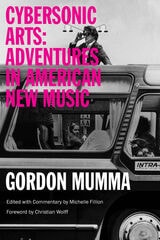
Cybersonic Arts
Adventures in American New MusicGodon Mumma, Edited by Michelle Fillion
University of Illinois Press, 2015
Musicologist Michelle Fillion curates a collection of Mumma's writings, presenting revised versions of his classic pieces as well as many unpublished works from every stage of his storied career. Here, through words and astonishing photos, is Mumma's chronicle of seminal events in the musical world of the twentieth century: his cofounding the Cooperative Studio for Electronic Music; his role in organizing the historic ONCE Festivals of Contemporary Music; performances with the Sonic Arts Union; and working alongside John Cage and David Tudor as a composer-musician with the Merce Cunningham Dance Company. In addition, Mumma describes his collaborations with composers, performers, dancers, and visual artists ranging from Robert Ashley and Pauline Oliveros to Marcel Duchamp and Robert Rauschenberg.
Candid and insightful, Cybersonic Arts is the eye-opening account of a broad artistic community by an active participant and observer.
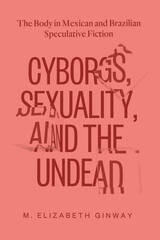
Cyborgs, Sexuality, and the Undead
The Body in Mexican and Brazilian Speculative FictionM. Elizabeth Ginway
Vanderbilt University Press, 2020
In Cyborgs, Sexuality, and the Undead, M. Elizabeth Ginway examines all these issues from a number of theoretical perspectives, most importantly through the lens of Bolívar Echeverría’s “baroque ethos,” which emphasizes the strategies that subaltern populations may adopt in order to survive and prosper in the face of massive historical and structural disadvantages. Foucault’s concept of biopolitics is developed in discussion with Roberto Esposito’s concept of immunity and Giorgio Agamben’s distinction between “political life” and “bare life.”
This book will be of interest to scholars of speculative fiction, as well as Mexicanists and Brazilianists in history, literary studies, and critical theory.
Cycles, Sequels, Spin-offs, Remakes, and Reboots
Multiplicities in Film and TelevisionEdited by Amanda Ann Klein and R. Barton Palmer
University of Texas Press, 2016
With sequels, prequels, remakes, spin-offs, or copies of successful films or franchises dominating film and television production, it sometimes seems as if Hollywood is incapable of making an original film or TV show. These textual pluralities or multiplicities—while loved by fans who flock to them in droves—tend to be dismissed by critics and scholars as markers of the death of high culture. Cycles, Sequels, Spin-offs, Remakes, and Reboots takes the opposite view, surveying a wide range of international media multiplicities for the first time to elucidate their importance for audiences, industrial practices, and popular culture.
The essays in this volume offer a broad picture of the ways in which cinema and television have used multiplicities to streamline the production process, and to capitalize on and exploit viewer interest in previously successful and/or sensational story properties. An impressive lineup of established and emerging scholars talk seriously about forms of multiplicity that are rarely discussed as such, including direct-to-DVD films made in Nigeria, cross-cultural Japanese horror remakes, YouTube fan-generated trailer mash-ups, and 1970s animal revenge films. They show how considering the particular bonds that tie texts to one another allows us to understand more about the audiences for these texts and why they crave a version of the same story (or character or subject) over and over again. These findings demonstrate that, far from being lowbrow art, multiplicities are actually doing important cultural work that is very worthy of serious study.
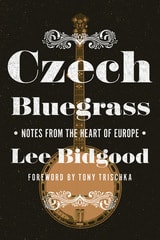
Czech Bluegrass
Notes from the Heart of EuropeLee Bidgood
University of Illinois Press, 2017
Lee Bidgood offers a fascinating study of the Czech bluegrass phenomenon that merges intimate immersion in the music with on-the-ground fieldwork informed by his life as a working musician. Drawing on his own close personal and professional interactions, Bidgood charts how Czech bluegrass put down roots and looks at its performance as a uniquely Czech musical practice. He also reflects on “Americanist” musical projects and the ways Czech musicians use them to construct personal and social identities. Bidgood sees these acts of construction as a response to the Czech Republic’s postsocialist environment but also to US cultural prominence within our global mediascape.