Results by title
482 books match the query '17th Century' and 13 start with d

Defects
Engendering the Modern BodyHelen Deutsch and Felicity Nussbaum, Editors
University of Michigan Press, 2000

Descartes and His Contemporaries
Meditations, Objections, and RepliesEdited by Roger Ariew and Marjorie Grene
University of Chicago Press, 1995
Descartes and his Contemporaries recreates the tumultuous intellectual community of seventeenth-century Europe and provides a detailed, modern analysis of the Meditations in its historical context. The book's chapters examine the arguments and positions of each of the objectors—Hobbes, Gassendi, Arnauld, Morin, Caterus, Bourdin, and others whose views were compiled by Mersenne. They illuminate Descartes' relationships to the scholastics and particularly the Jesuits, to Mersenne's circle with its debates about the natural sciences, to the Epicurean movements of his day, and to the Augustinian tradition. Providing a glimpse of the interactions among leading 17th-century intellectuals as they grappled with major philosophical issues, this book sheds light on how Descartes' thought developed and was articulated in opposition to the ideas of his contemporaries.
Descartes and the Resilience of Rhetoric
Varieties of Cartesian Rhetorical TheoryThomas M. Carr, Jr.
Southern Illinois University Press, 2009
A careful analysis of the rhetorical thought of René Descartes and of a distinguished group of post-Cartesians. Covering a unique range of authors, including Bernard Lamy and Nicolas Malebranche, Carr attacks the idea, which has become commonplace in contemporary criticism, that the Cartesian system is incompatible with rhetoric.
Carr analyzes the writings of Balzac, the Port-Royalists Arnauld and Nicole, Malebranche, and Lamy, exploring the evolution of Descartes’ thought into their different theories of rhetoric. He constructs his arguments, probing each author’s writings on rhetoric, persuasion, and attention, to demonstrate the basis for rhetorical thought present in Descartes’ theory of persuasion when it is combined with his psychophysiology of attention.
Digital Pedagogy in Early Modern Studies
Method and PraxisEdited by Andie Silva and Scott Schofield
Iter Press, 2023
This collection of essays focuses on teaching at the intersection of early modern literature, book history, and digital media. It considers how teaching different fields and methods of study can be enhanced and facilitated by digital technologies. The volume provides a snapshot of current thinking on digital pedagogy as practiced by leading scholars in the field and offers a series of models that may be adapted, personalized, and repurposed by future teachers seeking to bring digital methodologies to their classrooms. Supplementary materials for this title are available on the Iter Press website (iterpress.org): see under Books/Supplementary Materials.
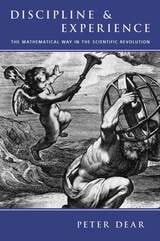
Discipline and Experience
The Mathematical Way in the Scientific RevolutionPeter Dear
University of Chicago Press, 1995
Peter Dear investigates the nature of the change that occurred during this period, focusing particular attention on evolving notions of experience and how these developed into the experimental work that is at the center of modern science. He examines seventeenth-century mathematical sciences—astronomy, optics, and mechanics—not as abstract ideas, but as vital enterprises that involved practices related to both experience and experiment. Dear illuminates how mathematicians and natural philosophers of the period—Mersenne, Descartes, Pascal, Barrow, Newton, Boyle, and the Jesuits—used experience in their argumentation, and how and why these approaches changed over the course of a century. Drawing on mathematical texts and works of natural philosophy from all over Europe, he describes a process of change that was gradual, halting, sometimes contradictory—far from the sharp break with intellectual tradition implied by the term "revolution."

Discovering the Secrets of Soft-Paste Porcelain at the Saint-Cloud Manufactory, ca. 1690-1766
Bertrand Rondot
Bard Graduate Center, 1999
Divas in the Convent
Nuns, Music, and Defiance in Seventeenth-Century ItalyCraig A. Monson
University of Chicago Press, 2012
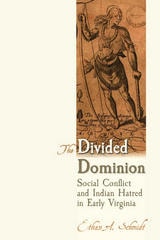
Divided Dominion
Social Conflict and Indian Hatred in Early VirginiaEthan A. Schmidt
University Press of Colorado, 2014
Myriad internal and external factors drove Virginians to interpret their disputes with one another increasingly along class lines. The decades-long tripartite struggle among elite whites, non-elite whites, and Native Americans resulted in the development of mutually beneficial economic and political relationships between elites and Native Americans. When these relationships culminated in the granting of rights—equal to those of non-elite white colonists—to Native Americans, the elites crossed a line and non-elite anger boiled over. A call for the annihilation of all Indians in Virginia united different non-elite white factions and molded them in widespread social rebellion.
The Divided Dominion places Indian policy at the heart of Bacon's Rebellion, revealing the complex mix of social, cultural, and racial forces that collided in Virginia in 1676. This new analysis will interest students and scholars of colonial and Native American history.
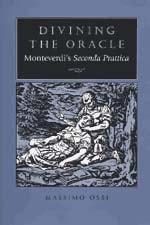
Divining the Oracle
Monteverdi's Seconda pratticaMassimo Ossi
University of Chicago Press, 2003
Challenged in print for the unconventional aspects of his music, Monteverdi found himself at the center of a debate between defenders of Renaissance principles and the newest musical currents of the time. The principles of the seconda prattica, Ossi argues in this sophisticated analysis of Monteverdi's writings, music, and approaches to text-setting, were in fact much more significant to the course of Monteverdi's career than previously thought by modern scholars-not only did Monteverdi continue to pursue their aesthetic and theoretical implications for the rest of his life, but they also affected his dramatic compositions as well as his chamber vocal music and sacred works.
Ossi "divines the oracle" of Monteverdi's ambiguous theoretical concepts in a clear way and in terms of pure music; his book will enhance our understanding of Monteverdi as one of the most significant figures in western music history.
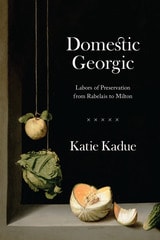
Domestic Georgic
Labors of Preservation from Rabelais to MiltonKatie Kadue
University of Chicago Press, 2021
When is literary production more menial than inspired, more like housework than heroics of the mind? In this revisionist study, Katie Kadue shows that some of the authors we credit with groundbreaking literary feats—including Michel de Montaigne and John Milton—conceived of their writing in surprisingly modest and domestic terms. In contrast to the monumental ambitions associated with the literature of the age, and picking up an undercurrent of Virgil’s Georgics, poetic labor of the Renaissance emerges here as often aligned with so-called women’s work. Kadue reveals how male authors’ engagements with a feminized georgic mode became central to their conceptions of what literature is and could be. This other georgic strain in literature shared the same primary concern as housekeeping: the necessity of constant, almost invisible labor to keep the things of the world intact. Domestic Georgic brings into focus a conception of literary—as well as scholarly and critical—labor not as a striving for originality and fame but as a form of maintenance work that aims at preserving individual and collective life.
Dramatic Extracts in Seventeenth-Century English Manuscripts
Watching, Reading, Changing PlaysLaura Estill
University of Delaware Press, 2015
Throughout the seventeenth century, early modern play readers and playgoers copied dramatic extracts (selections from plays and masques) into their commonplace books, verse miscellanies, diaries, and songbooks. Dramatic Extracts in Seventeenth-Century English Manuscripts: Watching, Reading, Changing Plays is the first to examine these often overlooked texts, which reveal what early modern audiences and readers took, literally and figuratively, from plays. As this under-examined archival evidence shows, play readers and playgoers viewed plays as malleable and modular texts to be altered, appropriated, and, most importantly, used. These records provide information that is not available in other forms about the popularity and importance of early modern plays, the reasons plays appealed to their audiences, and the ideas in plays that most interested audiences.
Tracing the course of dramatic extracting from the earliest stages in the 1590s, through the prolific manuscript circulation at the universities, to the closure and reopening of the theatres, Estill gathers these microhistories to create a comprehensive overview of seventeenth-century dramatic extracts and the culture of extracting from plays. Dramatic Extracts in Seventeenth-Century English Manuscripts: Watching, Reading, Changing Plays explores new archival evidence (from John Milton’s signature to unpublished university plays) while also analyzing the popularity of perennial favorites such as Shakespeare’s The Tempest. The study of dramatic extracts is the study of particulars: particular readers, particular manuscripts, particular plays or masques, particular historic moments. As D. F. McKenzie puts it, “different readers [bring] the text to life in different ways.” By providing careful analyses of these rich source texts, this book shows how active play-viewing and play-reading (that is, extracting) ultimately led to changing the plays themselves, both through selecting and manipulating the extracts and positioning the plays in new contexts.
Published by University of Delaware Press. Distributed worldwide by Rutgers University Press.
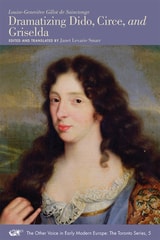
Dramatizing Dido, Circe, and Griselda
Louise-Geneviève Gillot de Sainctonge
Iter Press, 2010
—Perry Gethner
Norris Professor of French, Oklahoma State University

Dystopias of Infamy
Insult and Collective Identity in Early Modern SpainJavier Irigoyen-García
Bucknell University Press, 2022