193 books match the query '1945-' and 3 start with d

cover of Documenting Desegregation: Racial and Gender Segregation in Private Sector Employment Since the Civil Rights Act

Documenting Desegregation

Racial and Gender Segregation in Private Sector Employment Since the Civil Rights Act

Kevin Stainback

Russell Sage Foundation, 2013
Enacted nearly fifty years ago, the Civil Rights Act codified a new vision for American society by formally ending segregation and banning race and gender discrimination in the workplace. But how much change did the legislation actually produce? As employers responded to the law, did new and more subtle forms of inequality emerge in the workplace? In an insightful analysis that combines history with a rigorous empirical analysis of newly available data, Documenting Desegregation offers the most comprehensive account to date of what has happened to equal opportunity in America—and what needs to be done in order to achieve a truly integrated workforce. Weaving strands of history, cognitive psychology, and demography, Documenting Desgregation provides a compelling exploration of the ways legislation can affect employer behavior and produce change. Authors Kevin Stainback and Donald Tomaskovic-Devey use a remarkable historical record—data from more than six million workplaces collected by the U.S. Equal Employment Opportunity Commission (EEOC) since 1966—to present a sobering portrait of race and gender in the American workplace. Progress has been decidedly uneven: black men, black women, and white women have prospered in firms that rely on educational credentials when hiring, though white women have advanced more quickly. And white men have hardly fallen behind—they now hold more managerial positions than they did in 1964. The authors argue that the Civil Rights Act's equal opportunity clauses have been most effective when accompanied by social movements demanding changes. EEOC data show that African American men made rapid gains in the 1960s at the height of the Civil Rights movement. Similarly, white women gained access to more professional and managerial jobs in the 1970s as regulators and policymakers began to enact and enforce gender discrimination laws. By the 1980s, however, racial desegregation had stalled, reflecting the dimmed status of the Civil Rights agenda. Racial and gender employment segregation remain high today, and, alarmingly, many firms, particularly in high-wage industries, seem to be moving in the wrong direction and have shown signs of resegregating since the 1980s. To counter this worrying trend, the authors propose new methods to increase diversity by changing industry norms, holding human resources managers to account, and exerting renewed government pressure on large corporations to make equal employment opportunity a national priority. At a time of high unemployment and rising inequality, Documenting Desegregation provides an incisive re-examination of America's tortured pursuit of equal employment opportunity. This important new book will be an indispensable guide for those seeking to understand where America stands in fulfilling its promise of a workplace free from discrimination.
[more]
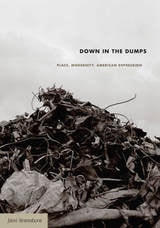
cover of Down in the Dumps: Place, Modernity, American Depression

Down in the Dumps

Place, Modernity, American Depression

Jani Scandura

Duke University Press, 2007

Mucking around in the messy terrain of American trash, Jani Scandura tells the story of the United States during the Great Depression through evocative and photo-rich portraits of four locales: Reno, Key West, Harlem, and Hollywood. In investigating these Depression-era “dumps,” places that she claims contained and reclaimed the cultural, ideological, and material refuse of modern America, Scandura introduces the concept of “depressive modernity,” an enduring affective component of American culture that exposes itself at those moments when the foundational myths of America and progressive modernity—capitalism, democracy, individualism, secularism, utopian aspiration—are thrown into question. Depressive modernity is modernity at a standstill. Such a modernity is not stagnant or fixed, nor immobile, but is constituted by an instantaneous unstaging of desire, territory, language, and memory that reveals itself in the shimmering of place.

An interpretive bricolage that draws on an unlikely archive of 1930s detritus—office memos, scribbled manuscripts, scrapbooks, ruined photographs, newspaper clippings, glass eyes, incinerated stage sets, pulp novels, and junk washed ashore—Down in the Dumps escorts its readers through Reno’s divorce factory of the 1930s, where couples from across the United States came to quickly dissolve matrimonial bonds; Key West’s multilingual salvage economy and its status as the island that became the center of an ideological tug-of-war between the American New Deal government and a politically fraught Caribbean; post-Renaissance Harlem, in the process of memorializing, remembering, grieving, and rewriting a modernity that had already passed; and Studio-era Hollywood, Nathanael West’s “dump of dreams,” in which the introduction of sound in film and shifts in art direction began to transform how Americans understood place-making and even being itself. A coda on Alcatraz and the Pentagon brings the book into the present, exploring how American Depression comes to bear on post-9/11 America.
[more]
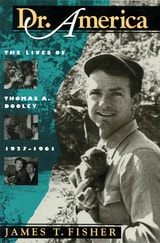
cover of Dr. America: The Lives of Thomas A. Dooley, 1927-1961

Dr. America

The Lives of Thomas A. Dooley, 1927-1961

James T. Fisher

University of Massachusetts Press, 1997

This book chronicles the life of Tom Dooley, the American doctor whose much-publicized exploits in Vietnam and Laos during the 1950s helped lay the ideological groundwork for the U.S. military intervention a decade later. The scion of an upper-middle-class St. Louis family, Dooley was an enormously complex and fascinating individual. He was a devoutly religious Roman Catholic as well as a self-styled playboy socialite, a devoted physician to the poor and a tireless propagandist for the “Vietnam Lobby,” a shameless self-promoter and a closeted homosexual, a victim of Navy persecution and a beneficiary of CIA support. Dooley first gained notoriety as a young Navy doctor charged with overseeing the evacuation of Catholic refugees from North Vietnam in the wake of the 1954 Geneva Accords. His celebrity grew after his book Deliver Us from Evil, a fervently anticommunist account of his experiences, was serialized in Reader's Digest. By the end of the decade, as his name became associated (albeit mistakenly) with a ballad popularized by the Kingston Trio, he had achieved the status of “America's first pop star saint.” In addition to exposing the roots of the Vietnam War, Dooley's story illuminates a broad range of developments in post-World War II United States culture—from the “Americanization” of Catholicism to the rise of the mass media.

[more]