Results by title
93 books match the query '1946-' and 8 start with d

David Lynch
Justus Nieland
University of Illinois Press, 2012
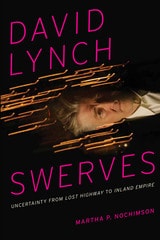
David Lynch Swerves
Uncertainty from Lost Highway to Inland EmpireBy Martha Nochimson
University of Texas Press, 2013
Beginning with Lost Highway, director David Lynch “swerved” in a new direction, one in which very disorienting images of the physical world take center stage in his films. Seeking to understand this unusual emphasis in his work, noted Lynch scholar Martha Nochimson engaged Lynch in a long conversation of unprecedented openness, during which he shared his vision of the physical world as an uncertain place that masks important universal realities. He described how he derives this vision from the Holy Vedas of the Hindu religion, as well as from his layman’s fascination with modern physics.
With this deep insight, Nochimson forges a startlingly original template for analyzing Lynch’s later films—the seemingly unlikely combination of the spiritual landscape envisioned in the Holy Vedas and the material landscape evoked by quantum mechanics and relativity. In David Lynch Swerves, Nochimson navigates the complexities of Lost Highway, The Straight Story, Mulholland Drive, and Inland Empire with uncanny skill, shedding light on the beauty of their organic compositions; their thematic critiques of the immense dangers of modern materialism; and their hopeful conceptions of human potential. She concludes with excerpts from the wide-ranging interview in which Lynch discussed his vision with her, as well as an interview with Columbia University physicist David Albert, who was one of Nochimson’s principal tutors in the discipline of quantum physics.

Decoding the Digital Church
Evangelical Storytelling and the Election of Donald J. TrumpStephanie A. Martin
University of Alabama Press, 2021
"This investigation tries to understand why many Evangelical pastors were blamed for endorsing Trump when, in fact, most did not. This book joins other attempts by scholars and journalists to analyze the relationship between Trump and Evangelicals. Recommended.” —CHOICE
Tracing the digital narratives that shaped evangelical identity in a pivotal political moment.
As a political constituency, white conservative evangelicals are generally portrayed as easy to dupe, disposed to vote against their own interests, and prone to intolerance and knee-jerk reactions. In Decoding the Digital Church: Evangelical Storytelling and the Election of Donald J. Trump, Stephanie A. Martin challenges this assumption and moves beyond these overused stereotypes to develop a refined explanation for this constituency’s voting behavior.
This volume offers a fresh perspective on the study of religion and politics and stems from the author’s personal interest in the ways her experiences with believers differ from how scholars often frame this group’s rationale and behaviors. To address this disparity, Martin examines sermons, drawing on her expertise in rhetoric and communication studies with the benefits of ethnographic research in an innovative hybrid approach she terms a “digital rhetorical ethnography.” Martin’s thorough research surveys more than 150 online sermons from America’s largest evangelical megachurches in 37 different states. Through listening closely to the words of the pastors who lead these conservative congregations, Martin describes a gentler discourse less obsessed with issues like abortion or marriage equality than stereotypes of evangelicals might suggest. Instead, the politicaleconomic sermons and stories from pastors encourage true believers
to remember the exceptional nature of the nation’s founding while also deemphasizing how much American citizenship really means.
Martin grapples with and pays serious, scholarly attention to a seeming contradiction: while the large majority of white conservative evangelicals voted in 2016 for Donald J. Trump, Martin shows that many of their pastors were deeply concerned about the candidate, the divisive nature of the campaign, and the potential effect of the race on their congregants’ devotion to democratic process itself. In-depth chapters provide a fuller analysis of our current political climate, recapping previous scholarship on the history of this growing divide and establishing the groundwork to set up the dissonance between the political commitments of evangelicals and their faith that the rhetorical ethnography addresses.

Digital Demagogue
Authoritarian Capitalism in the Age of Trump and TwitterChristian Fuchs
Pluto Press, 2018
This book delves into new political-economic structures as expressed through political communication to explain the rise of authoritarian capitalism, nationalism and right-wing ideology throughout the world. Christian Fuchs does this through updating Marxist theory and the Frankfurt School's critical theory. He re-invigorates the works on authoritarianism of Franz L. Neumann, Theodor W. Adorno, Erich Fromm, Herbert Marcuse, Max Horkheimer, Wilhelm Reich, Leo Lowenthal and Klaus Theweleit in the age of Trump and Twitter.
In the age of big data and social media, Digital Demagogue studies the expressions of ideology, nationalism and authoritarianism today and discusses prospects for overcoming capitalism and renewing the Left.

Don Gummer
Don Gummer
The Artist Book Foundation, 2021
The trajectory of Don Gummer's career as a sculptor began in New York City in the late 1970s with his wall reliefs of painted wood, carefully layered geometric works exhibiting a strong architectural influence. Moving beyond wood to stone, bronze, stainless steel, aluminum, and glass as his primary materials, his artworks evolved into subtly inventive freestanding sculptures, often of monumental scale, that exhibit his unfailing attention to craftsmanship and detail.
In a 2001 interview with Peter Plagens, American artist and art critic, Gummer described his interest in sculpture as "the recontextualization of natural phenomena, of unaltered things brought into aesthetic balance by choosing and placing." Using balance, proportion, and his unique sense of harmony, the artist is able to make durable materials seem almost buoyant. Negative space becomes an intrinsic element in his work, imparting a sense that his exquisite, seemingly permanent forms are ultimately as fleeting as any of nature's creations would be. The Artist Book Foundation is delighted to present Don Gummer, a new monograph on the artist and his highly acclaimed body of work.

Don't Call Me Inspirational
A Disabled Feminist Talks BackHarilyn Rousso
Temple University Press, 2013
For psychotherapist, painter, feminist, filmmaker, writer, and disability activist Harilyn Rousso, hearing well-intentioned people tell her, "You're so inspirational!" is patronizing, not complimentary.
In her empowering and at times confrontational memoir, Don't Call Me Inspirational, Rousso, who has cerebral palsy, describes overcoming the prejudice against disability--not overcoming disability. She addresses the often absurd and ignorant attitudes of strangers, friends, and family.Rousso also examines her own prejudice toward her disabled body, and portrays the healing effects of intimacy and creativity, as well as her involvement with the disability rights community. She intimately reveals herself with honesty and humor and measures her personal growth as she goes from "passing" to embracing and claiming her disability as a source of pride, positive identity, and rebellion.
A collage of images about her life, rather than a formal portrait, Don't Call Me Inspirational celebrates Rousso's wise, witty, productive, outrageous life, disability and all.

Duty to Serve, Duty to Conscience
The Story of Two Conscientious Objector Combat Medics during the Vietnam WarJames C. Kearney
University of North Texas Press, 2023

Dynamics, Geometry, Number Theory
The Impact of Margulis on Modern MathematicsEdited by David Fisher, Dmitry Kleinbock, and Gregory Soifer
University of Chicago Press, 2022
This edited collection highlights the foundations and evolution of research by widely influential Fields Medalist Gregory Margulis. Margulis is unusual in the degree to which his solutions to particular problems have opened new vistas of mathematics; his ideas were central, for example, to developments that led to the recent Fields Medals of Elon Lindenstrauss and Maryam Mirzhakhani. Dynamics, Geometry, Number Theory introduces these areas, their development, their use in current research, and the connections between them. Divided into four broad sections—“Arithmeticity, Superrigidity, Normal Subgroups”; “Discrete Subgroups”; “Expanders, Representations, Spectral Theory”; and “Homogeneous Dynamics”—the chapters have all been written by the foremost experts on each topic with a view to making them accessible both to graduate students and to experts in other parts of mathematics. This was no simple feat: Margulis’s work stands out in part because of its depth, but also because it brings together ideas from different areas of mathematics. Few can be experts in all of these fields, and this diversity of ideas can make it challenging to enter Margulis’s area of research. Dynamics, Geometry, Number Theory provides one remedy to that challenge.