Results by title
59 books match the query '1993-' and 7 start with d
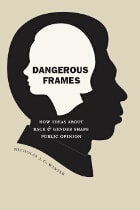
Dangerous Frames
How Ideas about Race and Gender Shape Public OpinionNicholas J. G. Winter
University of Chicago Press, 2008

Dark Hope
Working for Peace in Israel and PalestineDavid Shulman
University of Chicago Press, 2007
For decades, we’ve been shocked by images of violent clashes between Israelis and Palestinians in the West Bank and Gaza. But for all their power, those images leave us at a loss: from our vantage at home, it’s hard for us to imagine the struggles of those living in the midst of the fighting. Now, American-born Israeli David Shulman takes us right into the heart of the conflict with Dark Hope, an eye-opening chronicle of his work as a member of the peace group Ta‘ayush, which takes its name from the Arabic for “living together.”
Though Shulman never denies the complexity of the issues fueling the conflict—nor the culpability of people on both sides—he forcefully clarifies the injustices perpetrated by Israel by showing us the human dimension of the occupation. Here we meet Palestinians whose houses have been blown up by the Israeli army, shepherds whose sheep have been poisoned by settlers, farmers stripped of their land by Israel’s dividing wall. We watch as whip-swinging police on horseback attack crowds of nonviolent demonstrators, as Israeli settlers shoot innocent Palestinians harvesting olives, and as families and communities become utterly destroyed by the unrelenting violence of the occupation.
Opposing such injustices, Shulman and his companions—Israeli and Palestinian both—doggedly work through checkpoints to bring aid, rebuild houses, and physically block the progress of the dividing wall. As they face off against police, soldiers, and hostile Israeli settlers, anger mixes with compassion, moments of kinship alternate with confrontation, and, throughout, Shulman wrestles with his duty to fight the cruelty enabled by “that dependable and devastating human failure to feel.”
With Dark Hope, Shulman has written a book of deep moral searching, an attempt to discover how his beloved Israel went wrong—and how, through acts of compassionate disobedience, it might still be brought back.
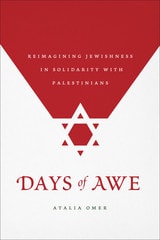
Days of Awe
Reimagining Jewishness in Solidarity with PalestiniansAtalia Omer
University of Chicago Press, 2019
In Days of Awe, Atalia Omer examines this shift through interviews with a new generation of Jewish activists, rigorous data analysis, and fieldwork within a progressive synagogue community. She highlights people politically inspired by social justice campaigns including the Black Lives Matter movement and protests against anti-immigration policies. These activists, she shows, discover that their ethical outrage at US policies extends to Israel’s treatment of Palestinians. For these American Jews, the Jewish history of dispossession and diaspora compels a search for solidarity with liberation movements. This shift produces innovations within Jewish tradition, including multi-racial and intersectional conceptions of Jewishness and movements to reclaim prophetic Judaism. Charting the rise of such religious innovation, Omer points toward the possible futures of post-Zionist Judaism.
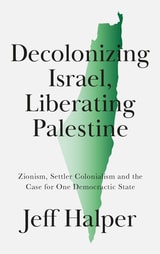
Decolonizing Israel, Liberating Palestine
Zionism, Settler Colonialism, and the Case for One Democratic StateJeff Halper
Pluto Press, 2021
For decades we have spoken of the 'Israel-Palestine conflict', but what if our understanding of the issue has been wrong all along? This book explores how the concept of settler colonialism provides a clearer understanding of the Zionist movement's project to establish a Jewish state in Palestine, displacing the Palestinian Arab population and marginalizing its cultural presence.
Jeff Halper argues that the only way out of a colonial situation is decolonization: the dismantling of Zionist structures of domination and control and their replacement by a single democratic state, in which Palestinians and Israeli Jews forge a new civil society and a shared political community.
To show how this can be done, Halper uses the 10-point program of the One Democratic State Campaign as a guide for thinking through the process of decolonization to its post-colonial conclusion. Halper's unflinching reframing will empower activists fighting for the rights of the Palestinians and democracy for all.

Dispatches From Palestine
The Rise and Fall of the Oslo Peace ProcessGraham Usher
Pluto Press, 1999
‘Usher ... does the best foreign on-the-spot reporting from Palestine.’ Edward Said, London Review of Books
‘The reader vicariously experiences what will become great moments of popular oral history that official historians will forget in the great scheme of things.’ Middle East International

Divide and Pacify
Strategic Social Policies and Political Protests in Post-Communist DemocraciesPieter Vanhuysse
Central European University Press, 2006
Despite dramatic increases in poverty, unemployment, and social inequalities, the Central and Eastern European transitions from communism to market democracy in the 1990s have been remarkably peaceful. This book proposes a new explanation for this unexpected political quiescence. It shows how reforming governments in Poland, Hungary and the Czech Republic have been able to prevent massive waves of strikes and protests by the strategic use of welfare state programs such as pensions and unemployment benefits.
Divide and Pacify explains how social policies were used to prevent massive job losses with softening labor market policies, or to split up highly aggrieved groups of workers in precarious jobs by sending some of them onto unemployment benefits and many others onto early retirement and disability pensions. From a narrow economic viewpoint, these policies often appeared to be immensely costly or irresponsibly populist. Yet a more inclusive social-scientific perspective can shed new light on these seemingly irrational policies by pointing to deeper political motives and wider sociological consequences.
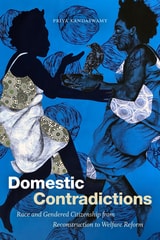
Domestic Contradictions
Race and Gendered Citizenship from Reconstruction to Welfare ReformPriya Kandaswamy
Duke University Press, 2021