Results by title
3703 books match the query '19th century' and 126 start with d
DECIPHERING RACE
WHITE ANXIETY, RACIAL CONFLICT, & THE TURN TO FICTION IN MID-VICTORIAN ENGLISH PROSELaura Callanan
The Ohio State University Press, 2005
In this manner these narratives confront the complexity, indeterminacy, and irrationality of both racial difference and the systems put in place to understand that difference. Deciphering Race unpacks this narrative turn to the aesthetic in writings by white English individuals and thus reveals the instability at the heart of cultural understanding of race and racial tropes at mid-century. This series of readings will help to see how figurative structures, while providing a bridge between different cultures and epistemologies, also reinforce a distance that keeps groups separate. Only by disentangling these structures, by addressing and unpacking our assumptions and narratives about those different from ourselves, and by understanding our deep cultural anxiety and investment in these ways of talking about one another, can we begin to create the conditions for productive, local understanding between different cultures, races, and communities.
DETECTING THE NATION
FICTIONS OF DETECTION AND THE IMPERIAL VENTURECaroline Reitz
The Ohio State University Press, 2004
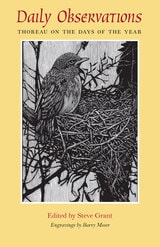
Daily Observations
Thoreau on the Days of the YearSteve Grant
University of Massachusetts Press, 2005
“How many a man has dated a new era in his life from the reading of a book,” wrote Henry David Thoreau in Walden. Today that book continues to provoke, inspire, and change lives all over the world, and each rereading is fresh and challenging. Yet as Thoreau's countless admirers know, there is more to the man than Walden. An engineer, poet, teacher, naturalist, lecturer, and political activist, he truly had multiple lives to lead, and each one speaks forcefully to us today.
Sponsored by the Thoreau Society, the brief, handsomely presented books in this series offer the thoughts of a great writer on a variety of topics, some that we readily associate with him, some that may be surprising. Each volume includes selections from his familiar published works as well as from less well known lectures, letters, and journal entries. The books include original engravings by renowned illustrator and book artist Barry Moser.

Daisy Turner's Kin
An African American Family SagaJane C. Beck
University of Illinois Press, 2015
In 1983, folklorist Jane Beck began a series of interviews with Turner, then one hundred years old and still relating four generations of oral history. Beck uses Turner's storytelling to build the Turner family saga, using at its foundation the oft-repeated touchstone stories at the heart of their experiences: the abduction into slavery of Turner's African ancestors; Daisy's father Alec Turner learning to read; his return as a soldier to his former plantation to kill his former overseer; and Daisy's childhood stand against racism. Other stories re-create enslavement and her father's life in Vermont--in short, the range of life events large and small, transmitted by means so alive as to include voice inflections. Beck, at the same time, weaves in historical research and offers a folklorist's perspective on oral history and the hazards--and uses--of memory.
Publication of this book is supported by grants from the Andrew W. Mellon Foundation and the L. J. and Mary C. Skaggs Folklore Fund.
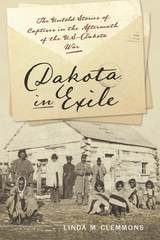
Dakota in Exile
The Untold Stories of Captives in the Aftermath of the U.S.-Dakota WarLinda M. Clemmons
University of Iowa Press, 2019
Historian Linda Clemmons examines the surviving letters from Robert and Sarah; other Dakota language sources; and letters from missionaries, newspaper accounts, and federal documents. She blends both the personal and the historical to complicate our understanding of the development of the Midwest, while also serving as a testament to the resilience of the Dakota and other indigenous peoples who have lived in this region from time immemorial.

Damn the Old Tinderbox!
Milwaukee’s Palace of the West and the Fire that Defined an EraMatthew J. Prigge
Wisconsin Historical Society Press, 2019
Damn the Old Tinderbox! is the gripping tale of one of the Gilded Age’s forgotten calamities, a fire that remains among the deadliest unsolved arsons in American history, and a significant chapter in both the history of Milwaukee and the Midwest.

Dan de Quille
Dwayne Kling
University of Nevada Press, 1990
A biography and anthology of William Wright (1829–1898), better known by the pen name Dan DeQuille or Dan De Quille, an American author, journalist, and humorist. He was best known for his written accounts of the people, events, and silver mining operations on the Comstock Lode at Virginia City, Nevada, including his non-fiction book History of the Big Bonanza (American Publishing Company, 1876).
DeQuille was on the staff of the (Virginia City) Territorial Enterprise for over thirty years, and his writings were also printed in other publications throughout the country and abroad. Highly regarded for his knowledge of silver mining techniques and his ability to explain them in simple terms, he was also appreciated for his humor, similar in style to that of his associate and friend Mark Twain, and of a type very popular in the United States at that time, now referred to as the Sagebrush School literary genre.
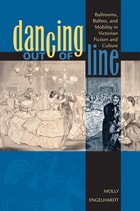
Dancing out of Line
Ballrooms, Ballets, and Mobility in Victorian Fiction and CultureMolly Engelhardt
Ohio University Press, 2009
Dancing out of Line transports readers back to the 1840s, when the craze for social and stage dancing forced Victorians into a complex relationship with the moving body in its most voluble, volatile form.
By partnering cultural discourses with representations of the dance and the dancer in novels such as Jane Eyre, Bleak House, and Daniel Deronda, Molly Engelhardt makes explicit many of the ironies underlying Victorian practices that up to this time have gone unnoticed in critical circles. She analyzes the role of the illustrious dance master, who created and disseminated the manners and moves expected of fashionable society, despite his position as a social outsider of nebulous origins. She describes how the daughters of the social elite were expected to “come out” to society in the ballroom, the most potent space in the cultural imagination for licentious behavior and temptation. These incongruities generated new, progressive ideas about the body, subjectivity, sexuality, and health.
Engelhardt challenges our assumptions about Victorian sensibilities and attitudes toward the sexual/social roles of men and women by bringing together historical voices from various fields to demonstrate the versatility of the dance, not only as a social practice but also as a forum for Victorians to engage in debate about the body and its pleasures and pathologies.
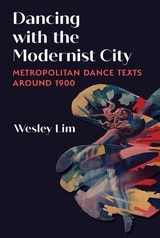
Dancing with the Modernist City
Metropolitan Dance Texts around 1900Wesley Lim
University of Michigan Press, 2024
Drawing on cultural, literary, dance, performance, and queer studies, Dancing with the Modernist City analyzes an array of material from 1896 to 1914—essays, novels, short stories, poetry, newspaper articles, photographs, posters, drawings, and early film. It argues that these writers and artists created a genre called the metropolitan dance text, which depicts dancing figures not on a traditional stage, but with the streets, advertising pillars, theaters, cafes, squares, and even hospitals of an urban setting. Breaking away from the historically male, heteronormative view, this posthumanist mode of writing highlights the visual and episodic unexpectedness of urban encounters. These literary depictions question traditional conceptualizations of space and performance by making the protagonist and the reader feel like they embody the dancer and the movement. In doing so, they upset the conventional depictions of performance and urban spaces in ways paralleling modern dance.

Dangerous Intimacies
Toward a Sapphic History of the British NovelLisa L. Moore
Duke University Press, 1997
Moore demonstrates that intimacy between women was vividly imagined in the British eighteenth century as not only chaste and virtuous, but also insistently and inevitably sexual. She looks at instances of sapphism in such novels as Millenium Hall, Memoirs of a Woman of Pleasure, Belinda, and Emma and analyzes how the new literary form of the novel made the bourgeois heroine’s successful negotiation of female friendship central to the establishment of her virtue. Moore also examines representations of sapphism through the sweeping economic and political changes of the period and claims that middle-class readers’ identifications with the heroine’s virtue helped the novel’s bourgeois audience justify the violent bases of their new prosperity, including slavery, colonialism, and bloody national rivalry.
In revealing the struggle over sapphism at the heart of these novels of female friendship—and at the heart of England’s national identity—Moore shows how feminine sexual agency emerged as an important cultural force in post-Enlightenment England

Dangerous Subjects
James D. Saules and the Rise of Black Exclusion in OregonKenneth R. Coleman
Oregon State University Press, 2017
In Oregon, Saules encountered a multiethnic population already transformed by colonialism—in particular, the fur industry and Protestant missionaries. Once the Oregon Trail emigrants began arriving in large numbers, in 1843, Saules had to adapt to a new reality in which Anglo-American settlers persistently sought to marginalize and exclude black residents from the region. Unlike Saules, who adapted and thrived in Oregon’s multiethnic milieu, the settler colonists sought to remake Oregon as a white man’s country. They used race as shorthand to determine which previous inhabitants would be included and which would be excluded. Saules inspired and later had to contend with a web of black exclusion laws designed to deny black people citizenship, mobility, and land.
In Dangerous Subjects, Kenneth Coleman sheds light on a neglected chapter in Oregon’s history. His book will be welcomed by scholars in the fields of western history and ethnic studies, as well as general readers interested in early Oregon and its history of racial exclusion.

Dangerous Work
Diary of an Arctic AdventureArthur Conan Doyle
University of Chicago Press, 2012
In 1880 a young medical student named Arthur Conan Doyle embarked upon the “first real outstanding adventure” of his life, taking a berth as ship’s surgeon on an Arctic whaler, the Hope. The voyage took him to unknown regions, showered him with dramatic and unexpected experiences, and plunged him into dangerous work on the ice floes of the Arctic seas. He tested himself, overcame the hardships, and, as he wrote later, “came of age at 80 degrees north latitude.”
A special limited, numbered edition of the clothbound book is also available. In addition, a text-only e-book edition is published as Dangerous Work: Diary of an Arctic Adventure, Text-only Edition.
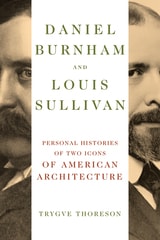
Daniel Burnham and Louis Sullivan
Personal Histories of Two Icons of American ArchitectureTrygve Thoreson
University of Illinois Press, 2026
An engaging piece of nonfiction storytelling, Daniel Burnham and Louis Sullivan reveals new facets of the architects’ personal, intellectual, and artistic lives.

Daniel Webster and the Oratory of Civil Religion
Craig R. Smith
University of Missouri Press, 2005

Daniel Webster, “The Completest Man”
Documents from The Papers of Daniel WebsterEdited by Kenneth E. Shewmaker and Daniel Webster
Brandeis University Press, 1993

Danish, But Not Lutheran
The Impact of Mormonism on Danish Cultural Identity, 1850–1920Julie K. Allen
University of Utah Press, 2017
The Danish-Mormon migration to Utah in the nineteenth century was, relative to population size, one of the largest European religious out-migrations in history. Hundreds of thousands of Americans can trace their ancestry to Danish Mormons, but few know about the social and cultural ramifications of their ancestors’ conversion to Mormonism. This book tells that exciting and complex story for the first time.
In 1849, after nearly a thousand years of state- controlled religion, Denmark’s first democratic constitution granted religious freedom. One year later, the arrival of three Mormon missionaries in Denmark and their rapid success at winning converts to their faith caused a crisis in Danish society over the existential question: "How could someone be Danish but not Lutheran?" Over the next half-century nearly thirty thousand Danes joined the LDS Church, more than eighteen thousand of whom emigrated to join their fellow Mormons in Utah. This volume explores the range of Danish public reactions to Mormonism over a seventy-year period—from theological concerns articulated by Søren and Peter Christian Kierkegaard in the 1850s to fear-mongering about polygamy and white slavery in silent films of the 1910s and 1920s—and looks at the personal histories of converts.
Honorable Mention for Best International Book from the Mormon History Association.

Dante in Deutschland
An Itinerary of Romantic MythDaniel DiMassa
Bucknell University Press, 2022

Dark Stones
Dias de Melo, Introduction by Maria João Dodman, Translated by Gregory McNab
Tagus Press, 2021
This expanded Tagus Press edition features Gregory McNab’s masterful 1988 translation of Dark Stones and a new introduction from Maria João Dodman. As an insider from the island of Pico, Dias de Melo writes in a realistic style that is passionate and forceful, yet tenacious, without ever losing certainty and control.

Dark Victorians
Vanessa D. Dickerson
University of Illinois Press, 2007

Dark Voices
W. E. B. Du Bois and American Thought, 1888-1903Shamoon Zamir
University of Chicago Press, 1995
Bringing to light materials from the Du Bois archives that have not been discussed before, Shamoon Zamir explores Du Bois's deep engagement with American and European philosophy and social science. He examines the impact on Du Bois of his studies at Harvard with William James and George Santayana, and shows how the experience of post-Reconstruction racism moved Du Bois from metaphysical speculation to the more instrumentalist knowledge of history and the new discipline of sociology, as well as toward the very different kind of understanding embodied in the literary imagination. Providing a new and detailed reading of The Souls of Black Folk in comparison with Hegel's Phenomenology of Mind, Zamir challenges accounts that place Du Bois alongside Emerson and James, or characterize him as a Hegelian idealist. This reading also explores Du Bois's relationship to African American folk culture, and shows how Du Bois was able to dramatize the collapse of many of his hopes for racial justice and liberation.
The first book to place The Souls of Black Folk in its intellectual context, Dark Voices is a case study of African American literary development in relation to the broader currents of European and American thought.

Darkly Perfect World
Colonial Adventure, Postmodernism, and American NoirStanley Orr
The Ohio State University Press, 2010

Darwin and the General Reader
The Reception of Darwin's Theory of Evolution in the British Periodical Press, 1859-1872Alvar Ellegård
University of Chicago Press, 1990

Darwin and the Novelists
Patterns of Science in Victorian FictionGeorge Levine
University of Chicago Press, 1991
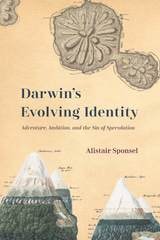
Darwin's Evolving Identity
Adventure, Ambition, and the Sin of SpeculationAlistair Sponsel
University of Chicago Press, 2018
Drawing on his own ambitious research in Darwin’s manuscripts and at the Beagle’s remotest ports of call, Sponsel takes us from the ocean to the Origin and beyond. He provides a vivid new picture of Darwin’s career as a voyaging naturalist and metropolitan author, and in doing so makes a bold argument about how we should understand the history of scientific theories.

Darwin's Footprint
Cultural Perspectives on Evolution in Greece (1880–1930s)Maria Zarimis
Central European University Press, 2015
Darwin’s Footprint examines the impact of Darwinism in Greece, investigating how it has shaped Greece in terms of its cultural and intellectual history, and in particular its literature.
The book demonstrates that in the late 19th to early 20th centuries Darwinism and associated science strongly influenced celebrated Greek literary writers and other influential intellectuals, which fueled debate in various areas such as ‘man’s place in nature’, eugenics, the nature-nurture controversy, religion, as well as class, race and gender.
In addition, the study reveals that many of these individuals were also considering alternative approaches to these issues based on Darwinian and associated biological post-Darwinian ideas. Their concerns included the Greek “race” or nation, its culture, language and identity; also politics and gender equality.
Zarimis’s monograph devotes considerable space to Xenopoulos (1867-1951), notable novelist, journalist and playwright.

Das Arkansas Echo
A Year in the Life of Germans in the Nineteenth-Century SouthKathleen Condray
University of Arkansas Press, 2020
“Das Arkansas Echo”: A Year in the Life of Germans in the Nineteenth-Century South examines topics the newspaper covered during its inaugural year. Kathleen Condray illuminates the newspaper’s crusade against Prohibition, its advocacy for the protection of German schools and the German language, and its promotion of immigration. We also learn about aspects of daily living, including food preparation and preservation, religion, recreation, the role of women in the family and society, health and wellness, and practical housekeeping. And we see how the paper assisted German speakers in navigating civic life outside their immigrant community, including the racial tensions of the post-Reconstruction South.
“Das Arkansas Echo”: A Year in the Life of Germans in the Nineteenth-Century South offers a fresh perspective on the German speakers who settled in a modernizing Arkansas. Mining a valuable newspaper archive, Condray sheds light on how these immigrants navigated their new identity as southern Americans.
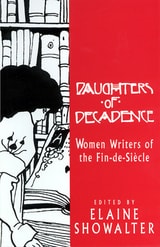
Daughters of Decadence
Women Writers of the Fin de SiecleShowalter, Elaine
Rutgers University Press, 1993
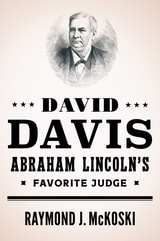
David Davis, Abraham Lincoln's Favorite Judge
Raymond J. McKoski
University of Illinois Press, 2025
One of Abraham Lincoln’s staunchest and most effective allies, Judge David Davis masterminded the floor fight that gave Lincoln the presidential nomination at the 1860 Republican National Convention. This history-changing event emerged from a long friendship between the two men. It also altered the course of Davis’s career, as Lincoln named him to the U.S. Supreme Court in 1862.
Raymond J. McKoski offers a biography of Davis’s public life, his impact on the presidency and judiciary, and his personal, professional, and political relationships with Lincoln. Davis lent his vast network of connections, organizational and leadership abilities, and personal persuasiveness to help Lincoln’s political rise. When Davis became a judge, he honed an ability to hear each case with complete impartiality, a practice that endeared him to Lincoln but one day put him at odds with the president over important Civil War–era rulings. McKoski details these cases while providing an in-depth account of Davis’s role in Lincoln’s two unsuccessful campaigns for U.S. Senate and the fateful run for the presidency.

Dead Balls and Double Curves
An Anthology of Early Baseball FictionEdited and with an Introduction by Trey Strecker. Foreword by Arnold Hano
Southern Illinois University Press, 2004
Dead Balls and Double Curves: An Anthology of Early Baseball Fiction collects twenty-two classic stories from baseball’s youth, presented in chronological order to capture the development of this most American of sports. Many of these tales have never before been reprinted, adding historical value to the rich literary merits of this anthology.
Editor Trey Strecker’s collection begins with an informal village match in an excerpt from James Fenimore Cooper’s Home as Found (1838), published the year prior to Abner Doubleday’s alleged invention of the game outside Cooperstown, New York, and concludes with the arrival of the superstar slugger that signaled the end of the dead-ball era in Heywood Broun’s The Sun Field (1923). The sampling of fiction from the eighty-five-year interim loads the bases with the humor, realism, and athletic gallantry of the sport’s earliest years. Not all grandstanding and heroism, these stories also explore cultural and class conflicts, racial strife, town rivalries, labor disputes, gambling scandals, and the striking personalities that decorated a simple game’s evolution into a national pastime.
Dead Balls and Double Curves presents a lineup of first-division writers, including Mark Twain, Frank Norris, Christy Mathewson, Edna Ferber, and the game’s poet laureate, Ring Lardner, plus legendary characters such as Baseball Joe, South-Paw Skaggs, Tin Can Tommy, and the sole artiste of the mythic double curve, Frank Merriwell. Throughout the volume, each author’s abiding affection for the game and its characters shines through with diamond-like focus.

Dead Man's Rapids
William Durbin
University of Minnesota Press, 2018
When 13-year-old Ben Ward left school to work with his Pa in a logging camp, a winter of peeling potatoes and setting tables wasn’t the adventure he had in mind. Still, come spring, he signs up for the log drive with his friend Nevers, wishing the head cook on the wanigan (the floating cook shack) could be someone other than his crabby Pa. Fate, with a wink, complies, and Pa quits—only to be replaced by someone far worse: Pete Sardman, aka Old Sard, a cantankerous character complete with a greasy apron, an eye patch, one deaf ear, and plenty to say.
Luckily, there’s also the rest of the crew—a colorful, sometimes outrageous company of men. Together Ben and Nevers endure freezing weather, dangerous rapids, logjams, storms and floods, and a number of gripping tall tales, along the way learning about logging on the river and a whole lot more about life.
Taking up where Blackwater Ben left off, Dead Man’s Rapids returns to the north woods of Minnesota in the late nineteenth century, and with warmth, humor, and attention to historical detail engages readers both young and old.

Deaf Identity and Social Images in Nineteenth-Century France
Anne T. Quartararo
Gallaudet University Press, 2008
Since the French Revolution in1789, Deaf French people have struggled to preserve their cultural heritage, to win full civil rights, and to gain access to society through their sign language. Anne T. Quartararo depicts this struggle in her new book Deaf Identity and Social Images in Nineteenth-Century France. In it, she portrays the genesis of the French Deaf community, examines its identity as a minority culture, and analyzes how deaf people developed their cultural heritage, a deaf patrimonie that has been historically connected to the preservation of French sign language.
Quartararo begins by describing how Abbé de l’Epée promoted the education of deaf students with sign language, an approach supported by the French revolutionary government, which formally established the Paris Deaf Institute in 1791. In the early part of the nineteenth century, the school’s hearing director, Roch-Ambroise-Auguste Bébian, advocated the use of sign language even while the institute’s physician Dr. Jean-Marc-Gaspard Itard worked to discredit signing.
In this meticulous study, Quartararo details the many variations in deaf education from 1830 to1930. She describes the banquet movement in the 1830s led by Ferdinand Berthier, Alponse Lenoir, and Claudius Forestier, which celebrated sign language and fostered the deaf association known as the Société Centrale. Quartararo also recounts how hearing educators at the Milan Congress in 1880 universally adopted oralism as the way to defeat deafness, and prohibited sign language in deaf schools. French deaf people refused to submit to this attack upon their cultural heritage, however, and an explosion of social activity among deaf people between 1880 and 1900 created a host of active deaf groups in all corners of the country. Deaf Identity and Social Images paints a unique, rich tapestry of the resilience of French deaf people in defending their culture through the most trying century in their history.

Dear Munificent Friends
Henry James's Letters to Four WomenSusan E. Gunter, Editor
University of Michigan Press, 2000

Dearly Beloved Friends
Henry James's Letters to Younger MenSusan E. Gunter and Steven H. Jobe, Editors
University of Michigan Press, 2004

Death at Cross Plains
An Alabama Reconstruction TragedyGene L. Howard with a foreword by Gary B. Mills
University of Alabama Press, 1984
Reconstruction in the South is a much studied and yet little understood period in the region’s history. In many areas it was marked by such violence as to have been guerrilla warfare in all but name. Death at Cross Plains is the gripping story of one local incident that illuminates the aftermath of the Civil War throughout the region.

Death of a Gunfighter
The Quest for Jack Slade, the West's Most Elusive LegendDan Rottenberg
Westholme Publishing, 2008
The True Story of One of America’s Most Enigmatic and Tragic Heroes
Awarded Best Western History Book of 2008 by the Wild West History Association
"A superb biography"—Foreword Reviews
"An ambitious, well-written effort to restore a Wild West desperado to history.... Readers will surely remember Jack Slade from henceforth. A treat for Western history buffs and fans of true crime."—Kirkus Reviews
"An enjoyable read, and it is also a heroic effort."—Wall Street Journal
"Every bit the page-turner as Roughing It, with one added advantage—Rottenberg's book approaches the truth."—Wild West magazine
"Now and then a book of Western history comes along that captures an era and clears up many a mystery; Death of a Gunfighter is such a book."—Colorado Central magazine
In 1859, as the United States careened toward civil war, Washington's only northern link with America's richest state, California, was a stagecoach line operating between Missouri and the Pacific. Yet the stage line was plagued by graft, outlaws, and hostile Indians. At this critical moment, the company enlisted a former wagon train captain and Mexican War veteran to clean up its most dangerous division. Over the next three years, Joseph Alfred "Jack" Slade exceeded his employers' wildest dreams, capturing bandits and horse thieves and driving away gangs; he even shot to death a disruptive employee. He kept the stagecoaches and the U.S. Mail running, and helped launch the Pony Express, all of which kept California in the Union—and without California's gold, the Union would have failed to finance its cause. Across the Great Plains he became known as "The Law West of Kearny."
Slade's legend grew when he was shot multiple times and left for dead, only to survive and exact revenge on his would-be killer. But once Slade had restored the peace, leaving him without challenges, his life descended into an alcoholic Dr. Jekyll and Mr. Hyde nightmare, transforming him from a courageous leader, charming gentleman, and devoted husband into a vicious, quick-triggered ruffian—a purported outlaw —who finally lost his life at the hands of vigilantes.
Since Slade's death in 1864, persistent myths and stories have defied the efforts of writers and historians, including Mark Twain, to capture the real Jack Slade. Despite his notoriety, the pieces of Slade's fascinating life—including his marriage to the beautiful Maria Virginia—have remained scattered and hidden. He was never photographed and left almost no personal writings, not even a letter. In Death of a Gunfighter: The Quest for Jack Slade, the West's Most Elusive Legend, journalist Dan Rottenberg assembles years of research to reveal the true story of Jack Slade, one of America's greatest tragic heroes.

Death, Dissection and the Destitute
Ruth Richardson
University of Chicago Press, 2001

Debating Women
Gender, Education, and Spaces for Argument, 1835-1945Carly S. Woods
Michigan State University Press, 2018

Deberlinization
Refabulating the World, a Theory of PraxisEdited by Bonaventure Soh Bejeng Ndikung, Ibou Coulibaly Diop, and Franck Hermann Ekra
Diaphanes, 2025
In 1884, the Chancellor of the German Empire, Otto von Bismarck, convened a conference in Berlin to organize the division of the African continent among the industrial and military powers of the time. The result was a profound dismemberment of Africa’s original political structures, which, driven by nationalism and a barbaric ethos of rule, had a lasting impact on the continent’s political, socioeconomic, cultural, and spiritual development. One hundred and forty years after the Berlin Conference, it seems more than urgent to disentangle this complex of colonial appropriation, identify its after-effects, and question its epistemological legacy—all the more so as Europe searches for a new positioning in the changing geopolitical balance of power.
This multidisciplinary anthology takes up the idea of a transnational performative utopia to explore the possibilities of refabulating the world order and its future. Between creative action and resistance, memory and foresight, Deberlinization opens up perspectives on trans-African cohesion and outlines a new poetics of sovereignty.
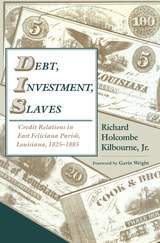
Debt, Investment, Slaves
Credit Relations in East Feliciana Parish, Louisiana, 1825-1885Richard Holcombe Kilbourne
University of Alabama Press, 2013
For his landmark Debt, Investment, Slaves, Louisiana attorney Richard Holcombe Kilbourne Jr. performed a thorough survey of parish mortgage records and other manuscripts to create a rich map of antebellum credit relationships in the region. He demonstrates that most credit relationships, collateralized and uncollateralized, were grounded in slave property and not, as a contemporary reader would assume, land or other forms of wealth. Antebellum slavery was thus not only an arrangement of labor, but also an arrangement of finance and economics that shaped all of Southern life and politics. For this reason, defeat in the Civil War and emancipation not only freed enslaved people to work and earn wages, it occasioned a monumental credit implosion from which the Southern economy did not recover for the remainder of the nineteenth century.
To understand the antebellum South, it is necessary to set aside assumptions shared by modern Americans about the nature of borrowing, lending, banking, and investing. Kilbourne's seminal work reminds readers of the absence of banks outside of major cities like Charleston, New Orleans, and Mobile. He explains the defined and ad hoc roles that regional banks, intermediary lenders, and flexible agents ("factors") played in the absence of a robust banking system. He persuasively shows that this network of borrowers and lenders was based to an extent not well understood today on bondage. He then demonstrates how this fragile and improvised financial system had no ability to respond to the shocks and disruptions of war.
Setting out to write a book of local history, Kilbourne achieved an enduring work that illuminated aspects of Southern life that are indispensable to understanding American history.

Decadent Style
John Robert Reed
Ohio University Press, 1985
In Decadent Style, John Reed defines “decadent art” broadly enough to encompass literature, music, and the visual arts and precisely enough to examine individual works in detail. Reed focuses on the essential characteristics of this style and distinguishes it from non–esthetic categories of “decadent artists” and “decadent themes.”
Like the natural sciences and psychology, the arts in the late nineteenth century reflect an interest in the process of atomization. Literature and the other arts mirror this interest by developing, or rather elaborating, existing forms to the point of what appears to be dissolution. Instead of these forms dissolving, however, they require their audience’s participation and thus involve a new order. Reed argues that this process of reordering characterizes decadent style, which depends upon sensory provocation resolvable only through negation and is therefore bounded by philosophical and emotional assumptions of inevitable frustration.
Drawing upon the literature, music, and visual arts of England and Europe at the end of the nineteenth century, Reed provides a widely ranging and authoritative overview of decadent style, which relates such artists as Huysmans, Wilde, D’Annunzio, Moreau, Bresdin, Klimt, Klinger, Wagner, and Strauss. He related decadent style to Pre–Raphaelite and Naturalist preoccupation with detail and to aesthetic and Symbolist fascination with sensibility and idealism. Ultimately, Reed argues, decadent style is a late stage of Romanticism, overshadowed by Symbolism but anticipating, in its attempt to yoke incompatibilities and to engender a new cerebral form, some of the main traits of Modernism.

Decolonizing the Map
Cartography from Colony to NationEdited by James R. Akerman
University of Chicago Press, 2017
These essays, originally delivered as the 2010 Kenneth Nebenzahl, Jr., Lectures in the History of Cartography at the Newberry Library, encompass more than two centuries and three continents—Latin America, Africa, and Asia. Ranging from the late eighteenth century through the mid-twentieth, contributors study topics from mapping and national identity in late colonial Mexico to the enduring complications created by the partition of British India and the racialized organization of space in apartheid and post-apartheid South Africa. A vital contribution to studies of both colonization and cartography, Decolonizing the Map is the first book to systematically and comprehensively examine the engagement of mapping in the long—and clearly unfinished—parallel processes of decolonization and nation building in the modern world.
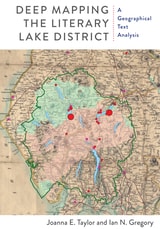
Deep Mapping the Literary Lake District
A Geographical Text AnalysisJoanna E. Taylor
Bucknell University Press, 2022

Deep in the Piney Woods
Southeastern Alabama from Statehood to the Civil War, 1800–1865Tommy Craig Brown
University of Alabama Press, 2018
Beyond the backwoods—uncovering the Civil War legacy of Alabama’s forgotten frontier.
Much of Alabama’s written history concentrates on the Tennessee Valley, the hill counties, and the Black Belt, while the piney woods of south central and southeastern Alabama, commonly known as the wiregrass region today, is one of the most understudied areas in Alabama history. Deep in the Piney Woods: Southeastern Alabama from Statehood to the Civil War, 1800–1865 offers a comprehensive and long overdue account of a historically rich region of the state, challenging many commonly held assumptions about the area’s formation and settlement, economy, politics, race relations, and its role in both the secession of the state and the Civil War.
Historians routinely depict this part of the state as an isolated, economically backward wilderness filled with poor whites who showed little interest in supporting the Confederacy once civil war erupted in 1861. Tommy Craig Brown challenges those traditional interpretations, arguing instead that many white Alabamians in this territory participated in the market economy, supported slavery, favored secession, and supported the Confederate war effort for the bulk of the conflict, sending thousands of soldiers to fight in some of the bloodiest campaigns of the war.
This thorough and expansive account of southeastern Alabama’s role in the Civil War also discusses its advocacy for state secession in January 1861; the effects of Confederate conscription on the home front; the economic devastation wrought on the area; and the participation of local military companies in key campaigns in both the eastern and western theaters, including Shiloh, the Peninsula Campaign, the Overland Campaign, Atlanta, and Franklin-Nashville. Brown argues that the lasting effects of the war on the region’s politics, identity, economy, and culture define it in ways that are still evident today.

Defining Métis
Catholic Missionaries and the Idea of Civilization in Northwestern Saskatchewan, 1845–1898Timothy P. Foran
University of Manitoba Press, 2017
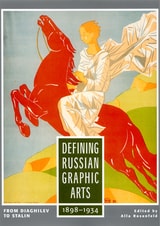
Defining Russian Graphic Arts
From Diaghilev to Stalin, 1898-1934Rosenfeld, Alla
Rutgers University Press, 1999
Defining Russian Graphic Arts explores the energy and innovation of Russian graphic arts during the period which began with the explosion of artistic creativity initiated by Serge Diaghilev at the end of the nineteenth century and which ended in the mid-1930s with Stalin's devastating control over the arts. This beautifully illustrated book represents the development of Russian graphic arts as a continuum during these forty years, and places Suprematism and Constructivism in the context of the other major, but lesser-known, manifestations of early twentieth-century Russian art.
The book includes such diverse categories of graphic arts as lubki (popular prints), posters and book designs, journals, music sheets, and ephemera. It features not only standard types of printed media and related studies and maquettes, but also a number of watercolor and gouache costume and stage designs.
About 100 works borrowed from the National Library of Russia and the Research Museum of the Academy of Fine Arts in St. Petersburg, Russia-many seen here for the first time outside of Russia-are featured in this book. Additional works have been drawn from the Zimmerli Art Museum, The New York Public Library, and from other public and private collections. Together they provide a rare opportunity to view and learn about a wide variety of artists, from the acclaimed to the lesser known.
This book is a companion volume to an exhibition appearing at the Jane Voorhees Zimmerli Art Museum at Rutgers University.

Democracy Moving
Bill T. Jones, Contemporary American Performance, and the Racial PastAriel Nereson
University of Michigan Press, 2022
The project addresses how different communities choose to commemorate historical figures, events, and places through art—whether performance, oratory, song, statuary, or portraiture—and in particular, Black US American counter-memorial practices that address histories of slavery. Advancing the theory of oscillation as Black aesthetic praxis, author Ariel Nereson celebrates Bill T. Jones as a public intellectual whose practice has contributed to the project of understanding America’s relationship to its troubled past. The book features materials from Bill T. Jones/Arnie Zane Company’s largely unexplored archive, interviews with artists, and photos that document this critical stage of Jones’s career as it explores how aesthetics, as ideas in action, can imagine more just and equitable social formations.

Democracy in America
Alexis de Tocqueville
University of Chicago Press, 2000
Alexis de Tocqueville (1805-59) came to America in 1831 to see what a great republic was like. What struck him most was the country's equality of conditions, its democracy. The book he wrote on his return to France, Democracy in America, is both the best ever written on democracy and the best ever written on America. It remains the most often quoted book about the United States, not only because it has something to interest and please everyone, but also because it has something to teach everyone.
Democracy in America
Alexis de Tocqueville
University of Chicago Press, 2000
This is an auto-narrated audiobook edition of this book.

Democracy in Latin America, 1760-1900
Volume 1, Civic Selfhood and Public Life in Mexico and PeruCarlos A. Forment
University of Chicago Press, 2003
This first volume of Democracy in Latin America considers the development of democratic life in Mexico and Peru from independence to the late 1890s. Forment traces the emergence of hundreds of political, economic, and civic associations run by citizens in both nations and shows how these organizations became models of and for democracy in the face of dictatorship and immense economic hardship. His is the first book to show the presence in Latin America of civic democracy, something that gave men and women in that region an alternative to market- and state-centered forms of life.
In looking beneath institutions of government to uncover local and civil organizations in public life, Forment ultimately uncovers a tradition of edification and inculcation that shaped democratic practices in Latin America profoundly. This tradition, he reveals, was stronger in Mexico than in Peru, but its basic outlines were similar in both nations and included a unique form of what Forment calls Civic Catholicism in order to distinguish itself from civic republicanism, the dominant political model throughout the rest of the Western world.

Democratic Discourses
The Radical Abolition Movement and Antebellum American LiteratureBennett, Michael
Rutgers University Press, 2005
Ever since the hallowed statement, "All men are created equal," was penned in the Declaration of Independence, it has become a historical tenet that freedom and equality were brought to American shores by the so-called Founding Fathers.
In this path-breaking study, Michael Bennett departs from tradition to argue that the democratic ideal of equality and the actual ways in which it has been practiced are grounded less in the fledgling government documents written by a handful of white men than in the actions and writings of the radical abolitionists of the nineteenth century. Bringing together key texts of both African American and European American authors, Democratic Discourses shows the important ways that abolitionist writing shaped a powerful counterculture within a slave-holding society. Bennett offers fresh new analysis through unusual pairings of authors, including Frederick Douglass with Henry David Thoreau, Frances Ellen Watkins Harper with Walt Whitman, and Margaret Fuller with Sojourner Truth. These rereadings avoid the tendency to view antebellum writing as a product primarily of either European American or African American influences and, instead, illustrate the interconnections of white and black literature in the creation and practice of democracy.
Drawing on discourses about race, the body, gender, economics, and aesthetics, this unique study encourages readers to reconsider the reality and roots of freedoms experienced in the United States today.