Results by title
64 books match the query 'African Diaspora' and 2 start with d
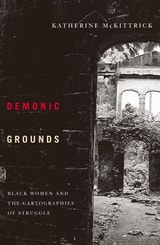
Demonic Grounds
Black Women And The Cartographies Of StruggleKatherine McKittrick
University of Minnesota Press, 2006
IIn a long overdue contribution to geography and social theory, Katherine McKittrick offers a new and powerful interpretation of black women’s geographic thought. In Canada, the Caribbean, and the United States, black women inhabit diasporic locations marked by the legacy of violence and slavery. Analyzing diverse literatures and material geographies, McKittrick reveals how human geographies are a result of racialized connections, and how spaces that are fraught with limitation are underacknowledged but meaningful sites of political opposition.
Demonic Grounds moves between past and present, archives and fiction, theory and everyday, to focus on places negotiated by black women during and after the transatlantic slave trade. Specifically, the author addresses the geographic implications of slave auction blocks, Harriet Jacobs’s attic, black Canada and New France, as well as the conceptual spaces of feminism and Sylvia Wynter’s philosophies.
Central to McKittrick’s argument are the ways in which black women are not passive recipients of their surroundings and how a sense of place relates to the struggle against domination. Ultimately, McKittrick argues, these complex black geographies are alterable and may provide the opportunity for social and cultural change.
Katherine McKittrick is assistant professor of women’s studies at Queen’s University.
[more]
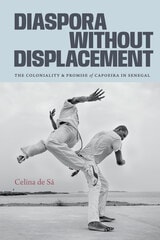
Diaspora Without Displacement
The Coloniality and Promise of Capoeira in SenegalCelina de Sá
Duke University Press, 2025
Capoeira—a game of combat primarily developed by enslaved West Central Africans—has become an icon of both Brazilian national culture and pride in the country’s diasporic African heritage. Yet the sport remains less accessible in Africa itself, overshadowed in large part by participants in the Global North. In Diaspora Without Displacement, Celina de Sá tells the story of capoeira as it "returns" to the African continent through the creative initiatives of young urban professionals in Senegal. De Sá demonstrates how a new generation of African capoeiristas are taking up their own Afro-diasporic performance tradition, effectively reframing notions of diaspora and race through their social practice. Though capoeira has largely Angolan roots and the agents of return are typically white Brazilians and Europeans, the West African practitioners de Sá documents nonetheless form an exceptional relationship to capoeira that, in turn, becomes a mode of political and social consciousness. Analyzing a capoeira network across West Africa, de Sá shows how urban West Africans use capoeira to explore the relationship between Blackness, diaspora, and African heritage.
[more]