Results by title
653 books match the query 'Animals' and 27 start with d
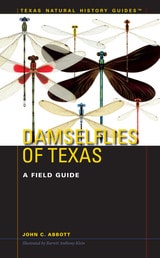
Damselflies of Texas
A Field GuideBy John C. Abbott
University of Texas Press, 2011
On any warm summer day, you can easily observe damselflies around a vegetated pond or the rocks along the banks of a stream. Like the more familiar dragonfly, damselflies are among the most remarkably distinctive insects in their appearance and biology, and they have become one of the most popular creatures sought by avocational naturalists.
Damselflies of Texas is the first field guide dedicated specifically to the species found in Texas. It covers 77 of the 138 species of damselflies known in North America, making it a very useful guide for the entire United States. Each species account includes:
- illustrations of as many forms (male, female, juvenile, mature, and color morphs) as possible
- common and scientific names, with pronunciation
- distribution map
- key features
- identifying characteristics
- discussion of similar species
- status in Texas
- habitat, seasonality, and general comments
In addition to photographing damselflies in the wild, the author and illustrator have developed a new process for illustrating each species by scanning preserved specimens and digitally painting them. The resulting illustrations show detail that is not visible in photographs. The book also contains chapters on damselfly anatomy, life history, conservation, names, and photography, as well as a list of species that may eventually be discovered in Texas, state and global conservation rankings, seasonality of all species in chronological order, and additional resources and publications on the identification of damselflies.
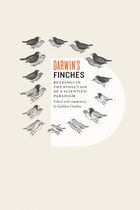
Darwin's Finches
Readings in the Evolution of a Scientific ParadigmEdited, with Commentary, by Kathleen Donohue
University of Chicago Press, 2011
Two species come to mind when one thinks of the Galapagos Islands—the giant tortoises and Darwin’s fabled finches. While not as immediately captivating as the tortoises, these little brown songbirds and their beaks have become one of the most familiar and charismatic research systems in biology, providing generations of natural historians and scientists a lens through which to view the evolutionary process and its role in morphological differentiation.
In Darwin’s Finches, Kathleen Donohue excerpts and collects the most illuminating and scientifically significant writings on the finches of the Galapagos to teach the fundamental principles of evolutionary theory and to provide a historical record of scientific debate. Beginning with fragments of Darwin’s Galapagos field notes and subsequent correspondence, and moving through the writings of such famed field biologists as David Lack and Peter and Rosemary Grant, the collection demonstrates how scientific processes have changed over time, how different branches of biology relate to one another, and how they all relate to evolution. As Donohue notes, practicing science today is like entering a conversation that has been in progress for a long, long time. Her book provides the history of that conversation and an invitation to join in. Students of both evolutionary biology and history of science will appreciate this compilation of historical and contemporary readings and will especially value Donohue’s enlightening commentary.
Daughters of Stone and Tide
Loss and Resilience in a Fisherman's FamilyWritten by Maria "Mia" Millefoglie. Read by Maria Marquis.
University of Massachusetts Press, 2026
A powerful family memoir about inheritance, identity, and the pull of the sea
Surrendered as an infant in America, Maria “Mia” was taken in by Sicilian immigrants in Gloucester, Massachusetts—a gritty working-class town steeped in salt and tradition. She inherits a name that traces back to 19th-century Sicily, where her great-grandfather was abandoned as a newborn on la ruota dei proietti, the “wheel of the castoffs.” Christened Millefoglie, “a thousand leaves, a thousand pages,” he crossed the bold Atlantic to America’s shores, carrying with him a legacy of endurance and exile.
For generations, the Millefoglie men went to sea: dorymen who rose before dawn to cast their nets along jagged coastlines, captains of eastern-rig draggers navigating storms that could split a vessel in half, stowaways chasing the promise of a life they could scarcely imagine. They lived by tides, currents, and the unspoken rules of the ocean; their courage and skill tested daily by wind and water. The women, left on shore, learned a different kind of survival, keeping households, raising children, and enduring the constant absence of fathers, brothers, and husbands.
Into this world of fishermen and keepers of the shore, Mia was adopted, learning early that bloodlines dictate identity and tradition shapes fate. College is forbidden; marriages are arranged, and no one abandons the family. By nineteen, trapped in a fish-packing job and lost in a haze of drugs, Mia does the unthinkable: she leaves. Decades later, drawn back to Gloucester’s weathered harbor to care for her aging parents, Mia begins to unearth her family’s buried stories, tracing the lineage from a Sicilian orphanage to a New England fishing port and the invisible inheritance that shaped them all.
Both intimate and historical, Daughters of Stone and Tide is a meditation on identity, abandonment, and belonging—a fisherman’s daughter’s search to understand the forces that bind and break a family across generations and seas.
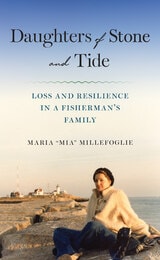
Daughters of Stone and Tide
Loss and Resilience in a Fisherman’s FamilyMaria "Mia" Millefoglie
University of Massachusetts Press, 2026
A powerful family memoir about inheritance, identity, and the pull of the sea
Surrendered as an infant in America, Maria “Mia” was taken in by Sicilian immigrants in Gloucester, Massachusetts—a gritty working-class town steeped in salt and tradition. She inherits a name that traces back to 19th-century Sicily, where her great-grandfather was abandoned as a newborn on la ruota dei proietti, the “wheel of the castoffs.” Christened Millefoglie, “a thousand leaves, a thousand pages,” he crossed the bold Atlantic to America’s shores, carrying with him a legacy of endurance and exile.
For generations, the Millefoglie men went to sea: dorymen who rose before dawn to cast their nets along jagged coastlines, captains of eastern-rig draggers navigating storms that could split a vessel in half, stowaways chasing the promise of a life they could scarcely imagine. They lived by tides, currents, and the unspoken rules of the ocean; their courage and skill tested daily by wind and water. The women, left on shore, learned a different kind of survival, keeping households, raising children, and enduring the constant absence of fathers, brothers, and husbands.
Into this world of fishermen and keepers of the shore, Mia was adopted, learning early that bloodlines dictate identity and tradition shapes fate. College is forbidden; marriages are arranged, and no one abandons the family. By nineteen, trapped in a fish-packing job and lost in a haze of drugs, Mia does the unthinkable: she leaves. Decades later, drawn back to Gloucester’s weathered harbor to care for her aging parents, Mia begins to unearth her family’s buried stories, tracing the lineage from a Sicilian orphanage to a New England fishing port and the invisible inheritance that shaped them all.
Both intimate and historical, Daughters of Stone and Tide is a meditation on identity, abandonment, and belonging—a fisherman’s daughter’s search to understand the forces that bind and break a family across generations and seas.
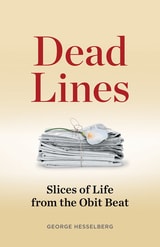
Dead Lines
Slices of Life from the Obit BeatGeorge Hesselberg
Wisconsin Historical Society Press, 2021
In more than forty years at the Wisconsin State Journal, Hesselberg frequently found himself writing about fatal accidents, crime investigations, and the deaths of the wealthy, famous, or notorious. But he was most drawn to the curious, the unknown, and the unsung—the deaths that normally wouldn’t make much of a splash, if any mention at all, in the news columns of a daily paper.
Digging deeper, he uncovered the extraordinary among the ordinary, memorializing the lives of a sword designer, a radio villain, a pioneering female detective, a homeless woman who spoke fluent French, a beloved classroom tarantula, and many more. Their stories are alternately amusing, sad, surprising, and profound. Together they speak to a shared human experience and inspire us to see the people around us with new eyes, valuing the lives while they are still being lived.
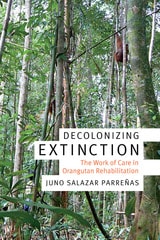
Decolonizing Extinction
The Work of Care in Orangutan RehabilitationJuno Salazar Parreñas
Duke University Press, 2018
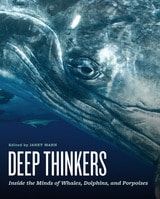
Deep Thinkers
Inside the Minds of Whales, Dolphins, and PorpoisesEdited by Janet Mann
University of Chicago Press, 2017
Diving into our current understanding of and dynamic research on dolphin and whale cognition, communication, and culture, Deep Thinkers reveals how incredibly sophisticated these mammals are—and how much we can learn about other animal minds by studying cetacean behavior. Through a combination of fascinating text and more than 150 beautiful and informative illustrations, chapters compare the intelligence markers of cetaceans with those of birds, bats, and primates, asking how we might properly define intelligence in nonhumans. As all-encompassing and profound as the seas in which these deep cetacean cultures have evolved, Deep Thinkers is an awesome and inspiring journey into the fathoms—a reminder of what we gain through their close study, and of what we lose when the great minds of the sea disappear.
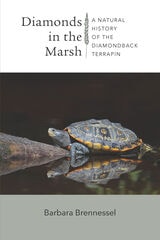
Diamonds in the Marsh
A Natural History of the Diamondback TerrapinBarbara Brennessel
Brandeis University Press, 2021
She’s the mascot for the University of Maryland’s sports teams and her ancestors were nearly driven to extinction by Victorians who indulged in turtle soup. But as she buries herself in the mud every night to sleep, the diamondback terrapin knows none of this. The size of a dinner plate and named for the beautiful concentric rings on her shell, she can live at least forty years and is the only turtle in North America who can live in brackish and salty waters. Several diamondback populations have been the subjects of ecological studies in recent years, but most of that information was buried in scientific literature and various state and federal reports—until this book.
Synthesizing all known research on this remarkable animal, Diamonds in the Marsh is the first full-scale natural history of the diamondback terrapin. Focusing on the northern diamondback, Barbara Brennessel examines its evolution, physiology, adaptations, behavior, growth patterns, life span, genetic diversity, land use, reproduction, and early years. She also discusses its relationship to humans, first as an important food source from colonial times through the nineteenth century, and more recently as a cultural icon, frequently depicted in Native American art and design. She concludes with a look at contemporary hazards to the terrapin and urges continued study of this marvelous creature. Updated with a new introduction by Brennessel, and with a foreword by Bob Prescott, former executive director of Massachusett’s Audubon Wellfleet Bay Sanctuary, Diamonds of the Marsh is perfect for those interested in the conservation of a species.
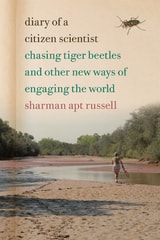
Diary of a Citizen Scientist
Chasing Tiger Beetles and Other New Ways of Engaging the WorldSharman Apt-Russell
Oregon State University Press, 2014
In the exploding world of citizen science, hundreds of thousands of volunteers are monitoring climate change, tracking bird migrations, finding stardust for NASA, and excavating mastodons. The sheer number of citizen scientists, combined with new technology, has begun to shape how research gets done. Non-professionals become acknowledged experts: dentists turn into astronomers and accountants into botanists.
Diary of a Citizen Scientist is a timely exploration of the phenomenon of citizen science, told through the lens of nature writer Sharman Apt Russell’s yearlong study of a little-known species, the Western red-bellied tiger beetle. In a voice both humorous and lyrical, Russell recounts her persistent and joyful tracking of an insect she calls “charismatic,” “elegant,” and “fierce.” Patrolling the Gila River in southwestern New Mexico, collector’s net in hand, she negotiates the realities of climate change even as she celebrates the beauty of a still-wild and rural landscape.
Russell’s self-awareness—of her occasionally-misplaced confidence, her quest to fill in “that blank spot on the map of tiger beetles,” and her desire to become newly engaged in her life—creates a portrait not only of the tiger beetle she tracks, but of the mindset behind self-driven scientific inquiry. Falling in love with the diversity of citizen science, she participates in crowdsourcing programs that range from cataloguing galaxies to monitoring the phenology of native plants, applauds the growing role of citizen science in environmental activism, and marvels at the profusion of projects around the world.
Diary of a Citizen Scientist offers its readers a glimpse into the transformative properties of citizen science—and documents the transformation of the field as a whole.
Digital Animalities
Mediating Life in an Age of Planetary DomesticationJody Berland
University of Minnesota Press, 2026
Exploring where animality meets digital media in the shadow of climate crisis
Digital Animalities is a groundbreaking investigation into the entanglements of animal life, media infrastructures, and digital technologies in a time of environmental precarity and digital saturation. Revealing the digital as a dynamic site where animal agency and technological systems collide, the contributors eschew simplistic binaries to emphasize complex mediations between animals and digital media.
From wildlife camera traps and virtual zoos to gaming environments and animation tools, these essays explore how animals are captured, played with, and consumed through digital technologies, elaborating their agency in these mediations of ecological and biopolitical processes. Rethinking animality as a fluid and contested terrain shaped by climate change, extinction pressures, and emerging ecopolitical paradigms, Digital Animalities shifts how we consider the impact of the digital on sentient lives and their futures.
Contributors: Giovanni Aloi, Art Institute of Chicago; Etienne S. Benson, Max Planck Institute for the History of Science, Berlin; Sarah Bezan, U College Cork; Michael Fisch, U of Chicago; Kate Galloway, Rensselaer Polytechnic Institute; Christine L. Marran, U of Minnesota; Brian McCormack; Jonathan Osborn; Hannah Tollefson, U of Toronto Scarborough; Tom Tyler, U of Leeds; Paul Wells, Loughborough U; Hang Wu.
Retail e-book files for this title are screen-reader friendly with images accompanied by short alt text and/or extended descriptions.
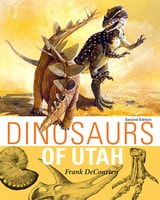
Dinosaurs Of Utah
Second EditionFrank DeCourten
University of Utah Press, 2013
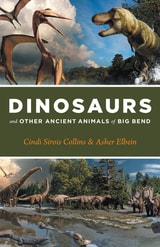
Dinosaurs and Other Ancient Animals of Big Bend
Cindi Sirois Collins and Asher Elbein
University of Texas Press, 2023
A time-traveling field guide to the ancient version of Big Bend National Park.
The sheer beauty of Big Bend National Park, along the shores of the Rio Grande in west Texas, never fails to astonish. Yet what lies beneath this natural treasure may be even more extraordinary than what meets the eye. Hidden in the rocks of Big Bend are the remains of giants: toothy sea lizards, enormous flying reptiles, and dinosaurs.
Dinosaurs and Other Ancient Animals of Big Bend is a field guide to what once was. Inspired by the latest research, Cindi Sirois Collins and Asher Elbein imagine what it was like to walk among the plants and animals whose fossil remains tell the story of evolution and geological transformation in this singular landscape. We glimpse the drama of Big Bend’s rugged landscape in creation—the desert’s emergence from retreating oceans and volcanic eruptions. Immersive vignettes introduce dinosaurs, giant fish, and saber-toothed cats. And the history of discovery in the park proves a gripping tale, as paleontologists sifted major scientific insights from the soils, rocks, and riverbeds. Complete with vivid illustrations, this is a wholly original sensory and narrative experience that will deepen any reader’s knowledge and sense of wonder.
Displaying Death and Animating Life
Human-Animal Relations in Art, Science, and Everyday LifeJane C. Desmond
University of Chicago Press, 2016
Desmond, a pioneer in the field of animal studies, builds the book on a number of case studies. She conducts research on-site at major museums, taxidermy conventions, pet cemeteries, and even at a professional conference for writers of obituaries. She goes behind the scenes at zoos, wildlife clinics, and meetings of pet cemetery professionals. We journey with her as she meets Kanzi, the bonobo artist, and a host of other animal-artists—all of whom are preparing their artwork for auction. Throughout, Desmond moves from a consideration of the visual display of unindividuated animals, to mourning for known animals, and finally to the marketing of artwork by individual animals. The first book in the new Animal Lives series, Displaying Death and Animating Life is a landmark study, bridging disciplines and reaching across divisions from the humanities and social sciences to chart new territories of investigation.
Do Bats Drink Blood?
Fascinating Answers to Questions about BatsSchmidt-French, Barbara A
Rutgers University Press, 2009
Highly beneficial animals, bats are critical to global ecological, economic, and public health. Do Bats Drink Blood? illuminates the role bats play in the ecosystem, their complex social behavior, and how they glide through the night sky using their acute hearing: echolocation skills that have helped in the development of navigational aids for the blind. Personal in voice with the perspective of a skilled bat researcher, this book explores wide-ranging topics as well as common questions people have about bats, providing a trove of fascinating facts.
Featuring rare color and black-and-white photographs, including some by renowned biologist, photographer, and author Merlin Tuttle, Do Bats Drink Blood? provides a comprehensive resource for general readers, students, teachers, zoo and museum enthusiasts, farmers and orchardists, or anyone who may encounter or be fascinated by these extraordinary animals.
Do Butterflies Bite?
Fascinating Answers to Questions about Butterflies and MothsDavies, Hazel
Rutgers University Press, 2008
Every year, thousands of people visit butterfly conservatories to stand in quiet awe of the simple beauty displayed by these magical creatures. Hazel Davies and Carol A. Butler capture the sense of wonderment and curiosity experienced by adults and children alike in this book about butterflies and their taxonomic cousins, the moths and the skippers. Beautifully illustrated with color and black and white photographs, and drawings by renowned artist William Howe, this book is an essential resource for parents, teachers, students, or anyone who has ever been entranced by these fascinating, fluttering creatures.
Covering everything from their basic biology to their complex behaviors at every stage of life to issues in butterfly conservation, Davies and Butler explore wide-ranging topics and supply a trove of intriguing facts. You'll find tips on how to attract more butterflies to your garden, how to photograph them, and even how to raise them in your own home. Arranged in a question and answer format, the book provides detailed information written in an accessible style that brings to life the science and natural history of these insects. In addition, sidebars throughout the book detail an assortment of butterfly trivia, while extensive appendices direct you to organizations, web sites, and more than 200 indoor and outdoor public exhibits, where you can learn more or connect with other lepidopterophiles (butterfly lovers).
Do Fish Sleep?
Fascinating Answers to Questions about FishesWeis, Judith S
Rutgers University Press, 2011
From the fifty-one-foot whale shark Rhincodon typus to a less-than-one-half-inch fish in the minnow family--the tiny Paedocypris progenetica--fish certainly carry a lot of weight . . . or do they?
A fish's heft in water may vary, but these diverse aquatic animals certainly carry a lot of weight in our ecosystems and environment. From freshwater to ocean habitats, Judith S. Weis offers a fascinating look at these deceptively simple creatures. Fishes may appear to live a dull existence, but appearances change once we understand more about how they survive. These wonders actually possess attributes that would make us superpowers--they can change color, sex, produce light and electricity, regenerate injured fins, prevent themselves from sinking, and some can even walk on land.
Do Fish Sleep? is organized in an easy-to-read and accessible question-and-answer format, filled with more than 55 photographs and over 100 interesting facts from fish biology basics to the importance of preserving and restoring fish diversity and healthy populations. A captivating read for fish enthusiasts of all ages--naturalists, environmentalists, aquarists, scuba divers, and students--this is also the perfect primer for those just about to get their feet wet. Dive in!
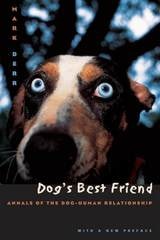
Dog's Best Friend
Annals of the Dog-Human RelationshipMark Derr
University of Chicago Press, 2004
Passionate about his subject and intent on sharing his zeal, Derr defends dogs with wit and flare, producing here a quirky, informative, and fitting tribute to our love affair with canines big and small.
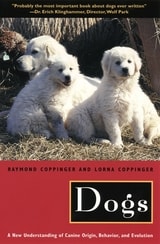
Dogs
A New Understanding of Canine Origin, Behavior and EvolutionRaymond Coppinger and Lorna Coppinger
University of Chicago Press, 2002
For both dogs and humans to get the most out of each other, we need to understand and adapt to the biological needs and dispositions of our canine companions, just as they have to ours.
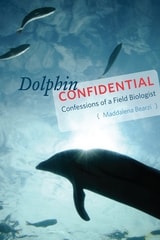
Dolphin Confidential
Confessions of a Field BiologistMaddalena Bearzi
University of Chicago Press, 2012
In this intimate narrative, Bearzi recounts her experiences at sea, tracing her own evolution as a woman and a scientist from her earliest travails to her transformation into an advocate for conservation and dolphin protection. These compelling, in-depth descriptions of her fieldwork also present a captivating look into dolphin social behavior and intelligence. The central part of the book is devoted to the metropolitan bottlenose dolphins of California, as Bearzi draws on her extensive experience to offer insights into the daily lives of these creatures—as well as the difficulties involved in collecting the data that transforms hunches into hypotheses and eventually scientific facts. The book closes by addressing the critical environmental and conservation problems facing these magnificent, socially complex, highly intelligent, and emotional beings.
An honest, down-to-earth analysis of what it means to be a marine biologist in the field today, Dolphin Confidential offers an entertaining, refreshingly candid, and always informative description of life among the dolphins.
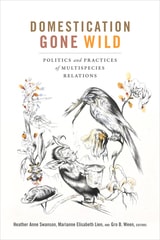
Domestication Gone Wild
Politics and Practices of Multispecies RelationsHeather Anne Swanson, Gro B. Ween, and Marianne E. Lien, editors
Duke University Press, 2018
Contributors. Inger Anneberg, Natasha Fijn, Rune Flikke, Frida Hastrup, Marianne Elisabeth Lien, Knut G. Nustad, Sara Asu Schroer, Heather Anne Swanson, Anna Lowenhaupt Tsing, Mette Vaarst, Gro B. Ween, Jon Henrik Ziegler Remme
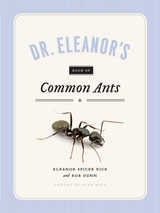
Dr. Eleanor's Book of Common Ants
Eleanor Spicer Rice, Alex Wild, and Rob Dunn
University of Chicago Press, 2017
No longer! In this witty, accessible, and beautifully illustrated guide, Eleanor Spicer Rice, Alex Wild, and Rob Dunn metamorphose creepy-crawly revulsion into myrmecological wonder. Emerging from Dunn’s ambitious citizen science project Your Wild Life (an initiative based at North Carolina State University), Dr. Eleanor’s Book of Common Ants provides an eye-opening entomological overview of the natural history of species most noted by project participants—and even offers tips on keeping ant farms in your home. Exploring species from the spreading red imported fire ant to the pavement ant, and featuring Wild’s stunning photography, this guide will be a tremendous resource for teachers, students, and scientists alike. But more than this, it will transform the way we perceive the environment around us by deepening our understanding of its littlest inhabitants, inspiring everyone to find their inner naturalist, get outside, and crawl across the dirt—magnifying glass in hand.
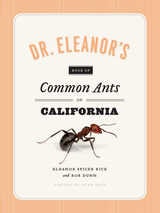
Dr. Eleanor's Book of Common Ants of California
Eleanor Spicer Rice, Alex Wild, and Rob Dunn
University of Chicago Press, 2017
No longer! In this witty, accessible, and beautifully illustrated guide, Eleanor Spicer Rice, Alex Wild, and Rob Dunn metamorphose creepy-crawly revulsion into myrmecological wonder. Emerging from Dunn’s ambitious citizen science project Your Wild Life (an initiative based at North Carolina State University) and the work of Brian Fisher with the California Academy of Sciences, Dr. Eleanor’s Book of Common Ants of California provides an eye-opening entomological overview of the natural history of California’s species most noted by project participants—and even offers tips on keeping ant farms in your home. Exploring species from the high noon and harvester ants to the honeypot and acrobat ants, and featuring Wild’s stunning photography, this guide will be a tremendous resource for teachers, students, and scientists alike. But more than this, it will transform the way Californians perceive the environment around them by deepening their understanding of its littlest inhabitants, inspiring everyone to find their inner naturalist, get outside, and crawl across the dirt—magnifying glass in hand.
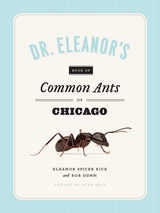
Dr. Eleanor's Book of Common Ants of Chicago
Eleanor Spicer Rice, Alex Wild, and Rob Dunn
University of Chicago Press, 2017
No longer! In this witty, accessible, and beautifully illustrated guide, Eleanor Spicer Rice, Alex Wild, and Rob Dunn metamorphose creepy-crawly revulsion into myrmecological wonder. Emerging from Dunn’s ambitious citizen science project Your Wild Life (an initiative based at North Carolina State University), Dr. Eleanor’s Book of Common Ants of Chicago provides an eye-opening entomological overview of the natural history of Chicago’s species most noted by project participants—and even offers tips on keeping ant farms in your home. Exploring species from the hobbit ant to the tiny trapjaw ant, and featuring contributions from E. O. Wilson and Field Museum ant scientist Corrie Moreau as well as Wild’s stunning photography, this guide will be a tremendous resource for teachers, students, and scientists alike. But more than this, it will transform the way Chicagoans perceive the environment around them by deepening their understanding of its littlest inhabitants, inspiring everyone to find their inner naturalist, get outside, and crawl across the dirt—magnifying glass in hand.
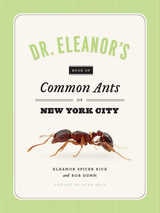
Dr. Eleanor's Book of Common Ants of New York City
Eleanor Spicer Rice, Alex Wild, and Rob Dunn
University of Chicago Press, 2017
No longer! In this witty, accessible, and beautifully illustrated guide, Eleanor Spicer Rice, Alex Wild, and Rob Dunn metamorphose creepy-crawly revulsion into myrmecological wonder. Emerging from Dunn’s ambitious citizen science project Your Wild Life (an initiative based at North Carolina State University), Dr. Eleanor’s Book of Common Ants of New York City provides an eye-opening entomological overview of the natural history of New York’s species most noted by project participants—and even offers insight into the ant denizens of the city’s subways and Central Park. Exploring species from the honeyrump ant to the Japanese crazy ant, and featuring Wild’s stunning photography as well as tips on keeping ant farms in your home, this guide will be a tremendous resource for teachers, students, and scientists alike. But more than this, it will transform the way New Yorkers perceive the environment around them by deepening their understanding of its littlest inhabitants, inspiring everyone to find their inner naturalist, get outside, and crawl across the dirt—magnifying glass in hand.
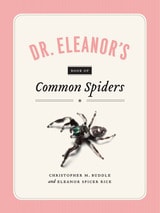
Dr. Eleanor's Book of Common Spiders
Christopher M. Buddle and Eleanor Spicer Rice
University of Chicago Press, 2018
No longer! In this witty, accessible, and beautifully illustrated guide, Christopher M. Buddle and Eleanor Spicer Rice metamorphose creepy-crawly revulsion into spider wonder. Emerging from ambitious citizen science project Your Wild Life (an initiative based at North Carolina State University), Dr. Eleanor's Book of Common Spiders provides an eye-opening arachnological overview of the natural history of species most noted by project participants, showcasing some of the fascinating spiders found in our attics and tents, front lawns and forests—and even introducing us to spiders that fish. Exploring species from the tiny (but gymnastic) zebra jumping spider to the naturally shy and woefully misunderstood black widow, this guide will be a tremendous resource for teachers, students, and scientists alike. But more than this, it will transform the way we perceive the environment around us by deepening our understanding of its littlest inhabitants, inspiring all of us to find our inner naturalist, get outside, and crawl across the dirt—magnifying glass in hand.
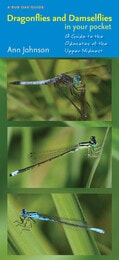
Dragonflies and Damselflies in Your Pocket
A Guide to the Odonates of the Upper MidwestAnn Johnson
University of Iowa Press, 2009
Just as more and more people enjoy watching birds and butterflies, watching the many shimmering dragonflies and damselflies—collectively called odonates, from Odonata, the name of this order of aquatic insects—has become a popular pastime. Now Dragonflies and Damselflies in Your Pocket introduces us to 50 of the showiest odonates of the Upper Midwest.
Ann Johnson’s text is clear and informative and her photographs are stunning; it is impossible to look at them without wanting to head out for the nearest stream and search for the living insects. In addition to providing useful general information about broad-winged damsels, spreadwings, pond damsels, darners, clubtails, cruisers, emeralds, and skimmers, she includes common and scientific names, sizes, general flight seasons, and the best habitats in which to find each species: rocky rivers, wetlands, ponds, still waters, and so on.
With their extremely large eyes, elongated transparent wings, long and slender abdomens, and prehensile extendible jaws, dragonflies and damselflies are efficient hunters and quick, darting fliers. Their beauty and their behavior make them delightful subjects for birdwatchers and other nature lovers. Dragonflies and Damselflies in Your Pocket will greatly enhance your appreciation of these winged marvels.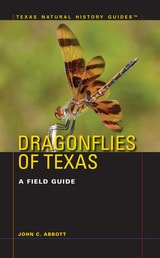
Dragonflies of Texas
A Field GuideBy John C. Abbott
University of Texas Press, 2015
Dragonflies and damselflies (together known as Odonata) are among the most remarkably distinctive insects in their appearance and biology, and they have become some of the most popular creatures sought by avocational naturalists. Texas hosts 160 species of dragonflies, nearly half of the 327 species known in North America, making the state a particularly good place to observe dragonflies in their natural habitats.
Dragonflies of Texas is the definitive field guide to these insects. It covers all 160 species with in situ photographs and detailed anatomical images as needed. Each species is given a two-page spread that includes photographs of both sexes and known variations when possible, key features, a distribution map, identification, discussion of similar species, status in Texas, habitat, seasonality, and general comments. Many of the groups also have comparative plates that show anatomically distinctive characteristics. In addition to the species accounts, John Abbott discusses dragonfly anatomy, life history, conservation, names, and photography. He also provides information on species that may eventually be discovered in Texas, state and global conservation rankings, seasonality of all species in chronological order, and additional resources and publications on the identification of dragonflies.