Results by title
71 books match the query 'Armed Forces' and 5 start with d
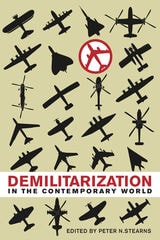
Demilitarization in the Contemporary World
Edited by Peter N. Stearns
University of Illinois Press, 2013
In nine insightful chapters, this volume's contributors outline each nation's demilitarization choices and how they were made. They investigate factors such as military defeat, border security risks, economic pressures, and the development of strong peace cultures among citizenry. Also at center stage is the influence of the United States, which fills a paradoxical role as both an enabler of demilitarization and a leader in steadily accelerating militarization.
Bookended by Peter N. Stearns' thought-provoking historical introduction and forward-looking conclusion, the chapters in this volume explore what true demilitarization means and how it impacts a society at all levels, military and civilian, political and private. The examples chosen reveal that successful demilitarization must go beyond mere troop demobilization or arms reduction to generate significant political and even psychological shifts in the culture at large. Exemplifying the political difficulties of demilitarization in both its failures and successes, Demilitarization in the Contemporary World provides a possible roadmap for future policies and practices.
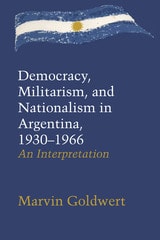
Democracy, Militarism, and Nationalism in Argentina, 1930–1966
An InterpretationBy Marvin Goldwert
University of Texas Press, 1972
Until 1930, Argentina was one of the great hopes for stable democracy in Latin America. Argentines themselves believed in the destiny of their nation to become the leading Latin American country in wealth, power, and culture. But the revolution of 1930 unleashed the scourges of modern militarism and chronic instability in the land. Between 1930 and 1966, the Argentine armed forces, or factions of the armed forces, overthrew the government five times.
For several decades, militarism was the central problem in Argentine political life. In this study, Marvin Goldwert interprets the rise, growth, and development of militarism in Argentina from 1930 to 1966. The tortuous course of Argentine militarism is explained through an integrating hypothesis. The army is viewed as a “power factor,” torn by a permanent dichotomy of values, which rendered it incapable of bringing modernization to Argentina. Caught between conflicting drives for social order and modernization, the army was an ambivalent force for change. First frustrated by incompetent politicians (1916–1943), the army was later driven by Colonel Juan D. Perón into an uneasy alliance with labor (1943–1955). Peronism initially represented the means by which army officers could have their cake—nationalistic modernization—and still eat it in peace, with the masses organized in captive unions tied to an authoritarian state.
After 1955, when Perón was overthrown, a deeply divided army struggled to contain the remnants of its own dictatorial creation. In 1966, the army, dedicated to staunch anti-Peronism, again seized the state and revived the dream of reconciling social order and modernization through military rule.
Although militarism has been a central problem in Argentine political life, it is also the fever that suggests deeper maladies in the body politic. Marvin Goldwert seeks to relate developments in the military to the larger political, social, and economic developments in Argentine history. The army and its factions are viewed as integral parts of the whole political spectrum during the period under study.
Democratizing Communist Militaries
The Cases of the Czech and Russian Armed ForcesMarybeth Peterson Ulrich
University of Michigan Press, 2000
In a groundbreaking study, Marybeth Peterson Ulrich explores the attitudes of the leaders of the armed forces in Russia and the Czech Republic toward the new democratic governments and suggests ways in which we might encourage the development of politically neutral militaries in these states. Building on the work of Samuel Huntington and others on the relationship between the military and the state, the author suggests that norms of military professionalism must change if the armies in countries making a transition from communist rule are to become strong supporters of the democratic state. The Czech Republic and Russia are interesting cases, because they have had very different experiences in the transition; they have different geopolitical goals; and they experienced different military-civilian relationships during the Soviet period. The author also explores American and NATO programs to promote democratization in these militaries and suggests changes in the programs.
Marybeth Peterson Ulrich is Associate Professor of Government, U.S. Army War College.
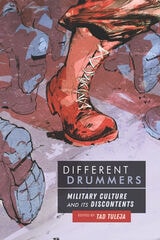
Different Drummers
Military Culture and Its DiscontentsTad Tuleja
Utah State University Press, 2020
This multidisciplinary collection brings in the perspectives of scholars from folklore, literary studies, psychology, and media studies, as well as the first-person perspectives of veterans. It includes chapters on the vernacular genres of bodylore, folksong, personal narrative, and legend; literary items like soldiers’ memoirs and poetry; the artwork of soldier cartoonists; and accounts of defying the chain of command in the field. Ideally, the goal of military basic training is to replace recruits’ focus on their own individuality with an unquestioned devotion to group solidarity. In reality, unit cohesion is constantly challenged by humans clinging obstinately to their non-collective personalities. Different Drummers focuses on those in uniform who feel themselves to be both of the military culture and at odds with it. It shows how these loyal “discontents” find ways of communicating and interacting with others that sometimes defy institutional expectations.
Contributors:
Ron Ben-Tovim, Carol Burke, Richard Allen Burns, Catherine Calloway, James I. Deutsch, Ronald Fry, Angus Kress Gillespie, Christina M. Knopf, Jay Mechling, Matthew David Perry, Mark C. Russell, John Paul Wallis
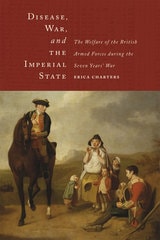
Disease, War, and the Imperial State
The Welfare of the British Armed Forces during the Seven Years' WarErica Charters
University of Chicago Press, 2014
In Disease, War, and the Imperial State, Erica Charters demonstrates how disease played a vital role in shaping strategy and campaigning, British state policy, and imperial relations during the Seven Years’ War. Military medicine was a crucial component of the British war effort; it was central to both eighteenth-century scientific innovation and the moral authority of the British state. Looking beyond the traditional focus of the British state as a fiscal war-making machine, Charters uncovers an imperial state conspicuously attending to the welfare of its armed forces, investing in medical research, and responding to local public opinion. Charters shows military medicine to be a credible scientific endeavor that was similarly responsive to local conditions and demands.
Disease, War, and the Imperial State is an engaging study of early modern warfare and statecraft, one focused on the endless and laborious task of managing manpower in the face of virulent disease in the field, political opposition at home, and the clamor of public opinion in both Britain and its colonies.