Results by title
109 books match the query 'Artificial intelligence' and 6 start with d

Deep Learning in Medical Image Processing and Analysis
Khaled Rabie
The Institution of Engineering and Technology, 2023

DeepAesthetics
Computational Experience in a Time of Machine LearningAnna Munster
Duke University Press, 2025

Defending AI Research
A Collection of Essays and ReviewsEdited by John McCarthy
CSLI, 1996

Democracy in a Pandemic
Participation in Response to CrisisGraham Smith, Tim Hughes, Lizzie Adams and Charlotte Obijiaku
University of Westminster Press, 2021
Covid-19 has highlighted limitations in our democratic politics – but also lessons for how to deepen our democracy and more effectively respond to future crises. In the face of an emergency, the working assumption all too often is that only a centralised, top-down response is possible. This book exposes the weakness of this assumption, making the case for deeper participation and deliberation in times of crises. During the pandemic, mutual aid and self-help groups have realised unmet needs. And forward-thinking organisations have shown that listening to and working with diverse social groups leads to more inclusive outcomes.
Participation and deliberation are not just possible in an emergency. They are valuable, perhaps even indispensable.
This book draws together a diverse range of voices of activists, practitioners, policy makers, researchers and writers. Together they make visible the critical role played by participation and deliberation during the pandemic and make the case for enhanced engagement during and beyond emergency contexts.
Another, more democratic world can be realised in the face of a crisis. The contributors to this book offer us meaningful insights into what this could look like.

Digital Twin Technologies for Healthcare 4.0
Rajesh Kumar Dhanaraj
The Institution of Engineering and Technology, 2022
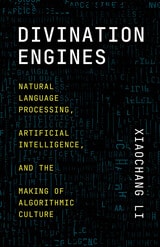
Divination Engines
Natural Language Processing, Artificial Intelligence, and the Making of Algorithmic CultureXiaochang Li
University of Chicago Press, 2026
A revealing and surprising origin story, showing how attempts to render human speech and language computable led from the era of big data to today’s AI.
Since the advent of computers, society has fantasized about conversing with machines. In this eye-opening book, technology expert Xiaochang Li shows readers how that dream both fueled the demand for data and set the stage for today’s generative AI. With original research and clear explanations, Li elucidates the origins of what’s known as natural language processing (NLP) and the heated twentieth-century debates between computer scientists, linguists, and communication engineers that shaped today’s technology. Starting with early devices that recorded, analyzed, and attempted to interpret human speech, she demonstrates how computer speech recognition, particularly efforts led by Bell Labs and IBM, advanced technology by deemphasizing linguistic meaning in favor of statistical prediction. In other words, researchers gradually abandoned systems that sought to understand human language, opting instead for work-arounds that simply predicted patterns in speech and text data. That solution became incredibly and surprisingly adaptable. As Li reveals, transforming linguistic questions into engineering ones ushered in the routine operation of search engines, spam filters, and the varied content sorting and recommendation mechanisms that regulate the access, circulation, and legitimacy of information across every platform. But this has all come at the cost of forever requiring copious and ever-growing amounts of new data.
At its core, Divination Engines illuminates how the artifacts of human communication—speech, text, and images—have become both the fodder for and products of computers. This connection between communication and computation, Li shows, has given rise to data-driven analytics, machine learning, and today’s algorithmic culture.