Results by title
197 books match the query 'Arts' and 4 start with d
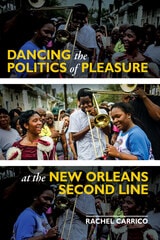
Dancing the Politics of Pleasure at the New Orleans Second Line
Rachel Carrico
University of Illinois Press, 2024
On many Sundays, Black New Orleanians dance through city streets in Second Lines. These processions invite would-be spectators to join in, grooving to an ambulatory brass band for several hours. Though an increasingly popular attraction for tourists, parading provides the second liners themselves with a potent public expression of Black resistance.
Rachel Carrico examines the parading bodies in motion as a form of negotiating and understanding power. Seeing pleasure as a bodily experience, Carrico reveals how second liners’ moves link joy and liberation, self and communal identities, play and dissent, and reclamations of place. As she shows, dancers’ choices allow them to access the pleasure of reclaiming self and city through motion and rhythm while expanding a sense of the possible in the present and for the future.
In-depth and empathetic, Dancing the Politics of Pleasure at the New Orleans Second Line blends analysis with a chorus of Black voices to reveal an indelible facet of Black culture in the Crescent City.

Dark Matter
Art and Politics in the Age of Enterprise CultureGregory Sholette
Pluto Press, 2011
Gregory Sholette, a politically engaged artist, argues that imagination and creativity in the art world originate thrive in the non-commercial sector shut off from prestigious galleries and champagne receptions. This broader creative culture feeds the mainstream with new forms and styles that can be commodified and used to sustain the few artists admitted into the elite.
This dependency, and the advent of inexpensive communication, audio and video technology, has allowed this 'dark matter' of the alternative art world to increasingly subvert the mainstream and intervene politically as both new and old forms of non-capitalist, public art. This book is essential for anyone interested in interventionist art, collectivism, and the political economy of the art world.
Database Aesthetics
Art in the Age of Information OverflowVictoria Vesna
University of Minnesota Press, 2007
Database Aesthetics examines the database as cultural and aesthetic form, explaining how artists have participated in network culture by creating data art. The essays in this collection look at how an aesthetic emerges when artists use the vast amounts of available information as their medium. Here, the ways information is ordered and organized become artistic choices, and artists have an essential role in influencing and critiquing the digitization of daily life.
Contributors: Sharon Daniel, U of California, Santa Cruz; Steve Deitz, Carleton College; Lynn Hershman Leeson, U of California, Davis; George Legrady, U of California, Santa Barbara; Eduardo Kac, School of the Art Institute of Chicago; Norman Klein, California Institute of the Arts; John Klima; Lev Manovich, U of California, San Diego; Robert F. Nideffer, U of California, Irvine; Nancy Paterson, Ontario College of Art and Design; Christiane Paul, School of Visual Arts in New York; Marko Peljhan, U of California, Santa Barbara; Warren Sack, U of California, Santa Cruz; Bill Seaman, Rhode Island School of Design; Grahame Weinbren, School of Visual Arts, New York.
Victoria Vesna is a media artist, and professor and chair of the Department of Design and Media Arts at the University of California, Los Angeles.
Developing a Sense of Place
The Role of the Arts in Regenerating CommunitiesEdited by Tamara Ashley and Alexis Weedon
University College London, 2020
Developing a Sense of Place offers a range of viewpoints, including those of the arts strategist, the academic, the practice-researcher, and the artist. Through its innovative models, from performing arts to architectural design, the book serves diverse interests, such as the arts and cultural policy managers, master planners, and arts workers, as well as students of human geography, cultural planning, business and the creative industries, and arts administration, at the undergraduate and postgraduate levels.