Results by title
50 books match the query 'Athens (Greece)' and 11 start with d
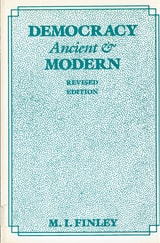
Democracy Ancient and Modern
Finley, M. I.
Rutgers University Press, 1985
The two new essays, "Athenian Dialogues" and "Censorship in Classical Antiquity" combine with "Leaders and Followers," "Democracy, Consensus, and the National Interest," "Socrates and After" to make this book an unusual inquiry. Few contemporary writers are able to bring to the subject the depth of learning and the persuasive power of language that Sir M. I. Finley brings.
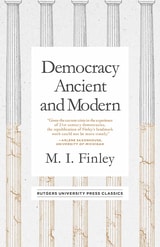
Democracy Ancient and Modern
Finley, M. I.
Rutgers University Press, 2019
This classic study of democratic principles is thus now more relevant than ever. A renowned historian of antiquity and political philosophy, Sir M.I. Finley offers a comparative analysis of Greek and modern conceptions of democracy. As he puts the ancient Greeks in dialogue with their contemporary counterparts, Finley tackles some of the most pressing issues of our day, including public apathy, partisanship, consensus politics, distrust of professional politicians, and the limits of free speech.
Including three lectures that Finley delivered at Rutgers University, plus two additional essays that further illuminate his thinking, Democracy Ancient and Modern explores the dramatic differences between the close-knit civil society of the ancient Greeks and our own atomized mass societies. By mapping out democracy’s past and its present manifestations, this book helps us plot a course for democracy’s future.
Democratic Law in Classical Athens
By Michael Gagarin
University of Texas Press, 2020
The democratic legal system created by the Athenians was completely controlled by ordinary citizens, with no judges, lawyers, or jurists involved. It placed great importance on the litigants’ rhetorical performances. Did this make it nothing more than a rhetorical contest judged by largely uneducated citizens that had nothing to do with law, a criticism that some, including Plato, have made?
Michael Gagarin argues to the contrary, contending that the Athenians both controlled litigants’ performances and incorporated many other unusual features into their legal system, including rules for interrogating slaves and swearing an oath. The Athenians, Gagarin shows, adhered to the law as they understood it, which was a set of principles more flexible than our current understanding allows. The Athenians also insisted that their legal system serve the ends of justice and benefit the city and its people. In this way, the law ultimately satisfied most Athenians and probably produced just results as often as modern legal systems do. Comprehensive and wide-ranging, Democratic Law in Classical Athens offers a new perspective for viewing a legal system that was democratic in a way only the Athenians could achieve.
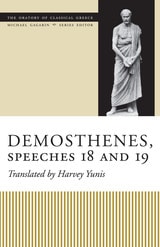
Demosthenes, Speeches 18 and 19
Translated by Harvey Yunis
University of Texas Press, 2005
2006 — Soeurette Diehl Fraser Award for Best Translation of a Book, Texas Institute of Letters
This is the ninth volume in the Oratory of Classical Greece. This series presents all of the surviving speeches from the late fifth and fourth centuries BC in new translations prepared by classical scholars who are at the forefront of the discipline. These translations are especially designed for the needs and interests of today's undergraduates, Greekless scholars in other disciplines, and the general public.
Classical oratory is an invaluable resource for the study of ancient Greek life and culture. The speeches offer evidence on Greek moral views, social and economic conditions, political and social ideology, law and legal procedure, and other aspects of Athenian culture that have recently been attracting particular interest: women and family life, slavery, and religion, to name just a few.
Demosthenes is regarded as the greatest orator of classical antiquity. The two speeches translated here grew out of his longtime rivalry with the orator Aeschines. In Speech 19 (On the Dishonest Embassy) delivered in 343 BC, Demosthenes attacks Aeschines for corruption centered around an ultimately disastrous embassy to Philip of Macedon that both men took part in. This speech made Demosthenes the leading politician in Athens for a time. Speech 18 (On the Crown or De Corona), delivered in 330 BC, is Demosthenes' most famous and influential oration. It resulted not only in Demosthenes receiving one of Athens' highest political honors but also in the defeat and disgrace of Aeschines, who retired from public life and left Athens forever.
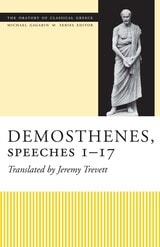
Demosthenes, Speeches 1–17
Translated by Jeremy Trevett
University of Texas Press, 2011
This is the fourteenth volume in the Oratory of Classical Greece. This series presents all of the surviving speeches from the late fifth and fourth centuries BC in new translations prepared by classical scholars who are at the forefront of the discipline. These translations are especially designed for the needs and interests of today's undergraduates, Greekless scholars in other disciplines, and the general public.
Classical oratory is an invaluable resource for the study of ancient Greek life and culture. The speeches offer evidence on Greek moral views, social and economic conditions, political and social ideology, law and legal procedure, and other aspects of Athenian culture that have recently been attracting particular interest: women and family life, slavery, and religion, to name just a few.
This volume contains translations of all the surviving deliberative speeches of Demosthenes (plus two that are almost certainly not his, although they have been passed down as part of his corpus), as well as the text of a letter from Philip of Macedon to the Athenians. All of the speeches were purportedly written to be delivered to the Athenian assembly and are in fact almost the only examples in Attic oratory of the genre of deliberative oratory. In the Olynthiac and Philippic speeches, Demosthenes identifies the Macedonian king Philip as a major threat to Athens and urges direct action against him. The Philippic speeches later inspired the Roman orator Cicero in his own attacks against Mark Antony, and became one of Demosthenes' claims to fame throughout history.
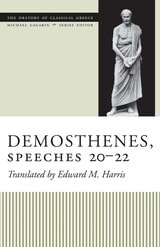
Demosthenes, Speeches 20-22
Translated by Edward M. Harris
University of Texas Press, 2008
This is the twelfth volume in the Oratory of Classical Greece. This series presents all of the surviving speeches from the late fifth and fourth centuries BC in new translations prepared by classical scholars who are at the forefront of the discipline. These translations are especially designed for the needs and interests of today's undergraduates, Greekless scholars in other disciplines, and the general public.
Classical oratory is an invaluable resource for the study of ancient Greek life and culture. The speeches offer evidence on Greek moral views, social and economic conditions, political and social ideology, law and legal procedure, and other aspects of Athenian culture that have recently been attracting particular interest: women and family life, slavery, and religion, to name just a few.
Demosthenes is regarded as the greatest orator of classical antiquity. This volume contains three important speeches from the earliest years of his political career: Against Leptines, a prosecution brought against a law repealing all exemptions from liturgies; Against Meidias, a prosecution for aggravated insult (hybris) brought against an influential politician; and Against Androtion, an indictment of a decree of honors for the Council of Athens. Edward M. Harris provides contemporary English translations of these speeches, two of which (Leptines and Androtion) have not been translated into English in over sixty years, along with introductions and extensive notes that take account of recent developments in Classical scholarship.
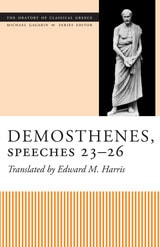
Demosthenes, Speeches 23-26
Translated by Edward M. Harris
University of Texas Press, 2018
This is the fifteenth volume in the Oratory of Classical Greece. This series presents all of the surviving speeches from the late fifth and fourth centuries BC in new translations prepared by classical scholars who are at the forefront of the discipline. These translations are especially designed for the needs and interests of today’s undergraduates, Greekless scholars in other disciplines, and the general public.
Classical oratory is an invaluable resource for the study of ancient Greek life and culture. The speeches offer evidence on Greek moral views, social and economic conditions, political and social ideology, law and legal procedure, and other aspects of Athenian culture that have recently been attracting particular interest: women and family life, slavery, and religion, to name just a few.
This volume provides introductions, translations, and notes for four speeches found in the Demosthenic corpus that have not been translated in recent times. Against Aristocrates deals with matters of foreign policy involving a mercenary general, Charidemus, and is a valuable source for Athenian homicide law. Against Timocrates involves domestic politics and provides important information about Athenian procedures for enacting legislation. In both speeches, the litigants stress the importance of the rule of law in Athenian democracy and emphasize key ideas, such as the monopoly of legitimate force by the state, the need for consistency in statutes, and the principle of no punishment without a written law. The remaining two speeches, Against Aristogeiton, are forgeries composed in the Hellenistic period, as Edward Harris demonstrates conclusively through a study of laws and legal procedures and an analysis of style and vocabulary.
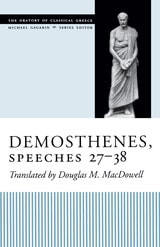
Demosthenes, Speeches 27-38
Translated by Douglas M. MacDowell
University of Texas Press, 2004
This is the eighth volume in the Oratory of Classical Greece. This series presents all of the surviving speeches from the late fifth and fourth centuries BC in new translations prepared by classical scholars who are at the forefront of the discipline. These translations are especially designed for the needs and interests of today's undergraduates, Greekless scholars in other disciplines, and the general public.
Classical oratory is an invaluable resource for the study of ancient Greek life and culture. The speeches offer evidence on Greek moral views, social and economic conditions, political and social ideology, law and legal procedure, and other aspects of Athenian culture that have recently been attracting particular interest: women and family life, slavery, and religion, to name just a few.
Demosthenes is regarded as the greatest orator of classical antiquity. This volume contains five speeches written for lawsuits in which Demosthenes sought to recover his inheritance, which he claimed was fraudulently misappropriated and squandered by the trustees of the estate. These speeches shed light on Athenian systems of inheritance, marriage, and dowry. The volume also contains seven speeches illustrating the legal procedure known as paragraphe, or "counter-indictment." Four of these are for lawsuits involving commercial shipping, a vital aspect of the Athenian economy that was crucial to maintaining the city's imported food supply. Another concerns the famous Athenian silver mines.
Demosthenes, Speeches 39-49
Translated by Adele C. Scafuro
University of Texas Press, 2011
This is the thirteenth volume in the Oratory of Classical Greece. This series presents all of the surviving speeches from the late fifth and fourth centuries BC in new translations prepared by classical scholars who are at the forefront of the discipline. These translations are especially designed for the needs and interests of today's undergraduates, Greekless scholars in other disciplines, and the general public.
Classical oratory is an invaluable resource for the study of ancient Greek life and culture. The speeches offer evidence on Greek moral views, social and economic conditions, political and social ideology, law and legal procedure, and other aspects of Athenian culture that have recently been attracting particular interest: women and family life, slavery, and religion, to name just a few.
Demosthenes is regarded as the greatest orator of classical antiquity. This volume contains eleven law court speeches ascribed to Demosthenes, though modern scholars believe that only two or three of them are actually his. Most of the speeches here concern inheriting an estate, recovering debts owed to an estate, or exchanging someone else's estate for one's own. Adele Scafuro's supplementary material allows even non-specialists to follow the ins and outs of the legal arguments as she details what we know about the matters involved in each case, including marriage laws, adoptions, inheritances, and the financial obligations of the rich. While Athenian laws and family institutions (e.g., the marriages of heiresses) differ from ours in quite interesting ways, nevertheless the motives and strategies of the litigants often have a contemporary resonance.
Demosthenes, Speeches 50-59
Translated by Victor Bers
University of Texas Press, 2003
This is the sixth volume in the Oratory of Classical Greece. This series presents all of the surviving speeches from the late fifth and fourth centuries BC in new translations prepared by classical scholars who are at the forefront of the discipline. These translations are especially designed for the needs and interests of today's undergraduates, Greekless scholars in other disciplines, and the general public.
Classical oratory is an invaluable resource for the study of ancient Greek life and culture. The speeches offer evidence on Greek moral views, social and economic conditions, political and social ideology, law and legal procedure, and other aspects of Athenian culture that have been largely ignored: women and family life, slavery, and religion, to name just a few.
Demosthenes is regarded as the greatest orator of classical antiquity; indeed, his very eminence may be responsible for the inclusion under his name of a number of speeches he almost certainly did not write. This volume contains four speeches that are most probably the work of Apollodorus, who is often known as "the Eleventh Attic Orator." Regardless of their authorship, however, this set of ten law court speeches gives a vivid sense of public and private life in fourth-century BC Athens. They tell of the friendships and quarrels of rural neighbors, of young men joined in raucous, intentionally shocking behavior, of families enduring great poverty, and of the intricate involvement of prostitutes in the lives of citizens. They also deal with the outfitting of warships, the grain trade, challenges to citizenship, and restrictions on the civic role of men in debt to the state.
Demosthenes, Speeches 60 and 61, Prologues, Letters
Translated by Ian Worthington
University of Texas Press, 2006
This is the tenth volume in the Oratory of Classical Greece. This series presents all of the surviving speeches from the late fifth and fourth centuries BC in new translations prepared by classical scholars who are at the forefront of the discipline. These translations are especially designed for the needs and interests of today's undergraduates, Greekless scholars in other disciplines, and the general public.
Classical oratory is an invaluable resource for the study of ancient Greek life and culture. The speeches offer evidence on Greek moral views, social and economic conditions, political and social ideology, law and legal procedure, and other aspects of Athenian culture that have recently been attracting particular interest: women and family life, slavery, and religion, to name just a few.
Demosthenes is regarded as the greatest orator of classical antiquity. This volume contains his Funeral Oration (Speech 60) for those who died in the Battle of Chaeronea in 338 BC, in which Philip of Macedonia secured his dominance over Greece, as well as the so-called Erotic Essay (Speech 61), a rhetorical exercise in which the speaker eulogizes the youth Epicrates for his looks and physical prowess and encourages him to study philosophy in order to become a virtuous and morally upright citizen. The volume also includes fifty-six prologues (the openings to political speeches to the Athenian Assembly) and six letters apparently written during the orator's exile from Athens. Because so little literature survives from the 330s and 320s BC, these works provide valuable insights into Athenian culture and politics of that era.