Results by title
79 books match the query 'Avant-garde (Aesthetics)' and 3 start with d
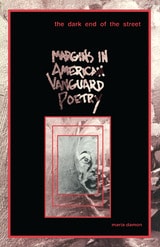
Dark End Of The Street
Margins in American Vanguard PoetryMaria Damon
University of Minnesota Press, 1993
Damon foregrounds a number of modern American poets work and lives in order to argue that the American avant-garde is located in the experimental literary works of social "outsiders." Discussed is the work of Black/Jewish surrealist street poet Bob Kaufman, Boston-Brahmin Robert Lowell and three teenaged women writing from a South Boston housing project, pre-Stonewall gay poets Jack Spicer and Robert Duncan, and Jewish lesbian-in-exile Gertrude Stein.
"An engaging and important book. Damon's sophisticated, theoretical approaches to American verse, coupled with her fresh, writerly style in The Dark End of The Street, put her on the forefront of American poetry's next generation of literary criticism." -American Literature"A work of art as well as a work of criticism. Addresses important questions about art and social life, about the margins and the center, and about oppression and suppression." -George Lipsitz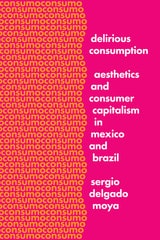
Delirious Consumption
Aesthetics and Consumer Capitalism in Mexico and BrazilBy Sergio Delgado Moya
University of Texas Press, 2017
In the decades following World War II, the creation and expansion of massive domestic markets and relatively stable economies allowed for mass consumption on an unprecedented scale, giving rise to the consumer society that exists today. Many avant-garde artists explored the nexus between consumption and aesthetics, questioning how consumerism affects how we perceive the world, place ourselves in it, and make sense of it via perception and emotion.
Delirious Consumption focuses on the two largest cultural economies in Latin America, Mexico and Brazil, and analyzes how their artists and writers both embraced and resisted the spirit of development and progress that defines the consumer moment in late capitalism. Sergio Delgado Moya looks specifically at the work of David Alfaro Siqueiros, the Brazilian concrete poets, Octavio Paz, and Lygia Clark to determine how each of them arrived at forms of aesthetic production balanced between high modernism and consumer culture. He finds in their works a provocative positioning vis-à-vis urban commodity capitalism, an ambivalent position that takes an assured but flexible stance against commodification, alienation, and the politics of domination and inequality that defines market economies. In Delgado Moya’s view, these poets and artists appeal to uselessness, nonutility, and noncommunication—all markers of the aesthetic—while drawing on the terms proper to a world of consumption and consumer culture.
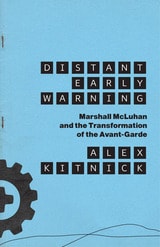
Distant Early Warning
Marshall McLuhan and the Transformation of the Avant-GardeAlex Kitnick
University of Chicago Press, 2021
Kitnick builds the story of McLuhan’s entanglement with artists by carefully drawing out the connections among McLuhan, his theories, and the artists themselves. The story is packed with big names: Marcel Duchamp, Niki de Saint Phalle, Jasper Johns, Andy Warhol, Nam June Paik, and others. Kitnick masterfully weaves this history with McLuhan’s own words and his provocative ideas about what art is and what artists should do, revealing McLuhan’s influence on the avant-garde through the confluence of art and theory. The illuminating result sheds light on new aspects of McLuhan, showing him not just as a theorist, or an influencer, but as a richly multifaceted figure who, among his many other accolades, affected multiple generations of artists and their works. The book finishes with Kitnick overlaying McLuhan’s ethos onto the state of contemporary and post-internet art. This final channeling of McLuhan is a swift and beautiful analysis, with a personal touch, of art’s recent transgressions and what its future may hold.