Results by title
131 books match the query 'Baseball' and 5 start with d

Danny Litwhiler
Living the Baseball DreamDaniel Litwhiler
Temple University Press, 2006
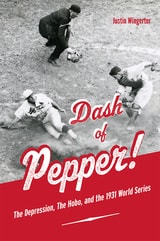
Dash of Pepper!
The Depression, The Hobo, and the 1931 World SeriesJustin Wingerter
University of Missouri Press, 2027
Dash of Pepper!: The Depression, The Hobo, and the 1931 World Series is the first book about the 1931 World Series and its unlikely star, Johnnie Leonard Roosevelt “Pepper” Martin. Born in Oklahoma in 1904, Martin grew up in poverty, performing farm labor with his family and attending school only sporadically (he was eventually expelled for his lack of shoes). Local sandlots served as his introduction to baseball, bringing him into an unpretentious world of hand-me-down leather, battered balls bursting at the seams, and boyhood. He was immediately hooked.
Martin spent his adolescence working a variety of odd jobs and playing for even odder baseball teams before making a living as a player for the East Texas League beginning in 1925, the owner of which sold him to the St. Louis Cardinals later that year. Martin played for the Cardinals’ minor league affiliates for the next two years, all while continuing his boyhood habit of “hoboing” freight trains to travel to games. Promoted to the major leagues in 1927, Martin was sent back down to the minors two years later, making his return to the Big Leagues in 1931 and soon thereafter emerging as the star of that year’s World Series. Historians still credit Martin, with his .500 batting average, 4 doubles, 1 home run, and 5 RBIs, for the Cardinals’ taking the championship.
Author Justin Wingerter documents the words of reporters from every state who told of a Depression-weary nation enthralled by the self-described hobo with endless hustle — “Don’t say Pepper, say STAR,” wrote The St. Louis Star (a play on its motto, “Don’t say ‘paper,’ say STAR”) after the Cardinals’ Game Three win. As Wingerter argues, Martin became a symbol of the forgotten man at a time when his fellow Americans needed a hero. His performance in the 1931 Series was followed obsessively by farmers, businesspeople, industrial workers, and even inmates, all of whom found in Martin a source of solace in a time of widespread misery. As one sportswriter opined in Waterloo, Iowa, “The Pepper Martins have a way of making us forget it all.”
In Dash of Pepper!, Wingerter explores the 1931 World Series in the context of the era’s national mood, populating the book’s pages with a host of colorful characters reaching far beyond Martin: One-Eyed Connelly, the famed gatecrasher who eventually met his match; the masked assailants of the St. Louis Milk War, a violent labor action that shared the city’s frontpages with the Series; banking regulators rushing to save deposits at Philadelphia’s Franklin Trust, and more.
With Dash of Pepper!, Wingerter makes an original contribution to the field, its focus on American society making it particularly valuable to lovers of United States history in addition to baseball fans.
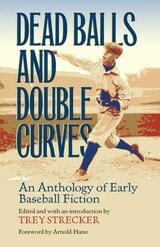
Dead Balls and Double Curves
An Anthology of Early Baseball FictionEdited and with an Introduction by Trey Strecker. Foreword by Arnold Hano
Southern Illinois University Press, 2004
Dead Balls and Double Curves: An Anthology of Early Baseball Fiction collects twenty-two classic stories from baseball’s youth, presented in chronological order to capture the development of this most American of sports. Many of these tales have never before been reprinted, adding historical value to the rich literary merits of this anthology.
Editor Trey Strecker’s collection begins with an informal village match in an excerpt from James Fenimore Cooper’s Home as Found (1838), published the year prior to Abner Doubleday’s alleged invention of the game outside Cooperstown, New York, and concludes with the arrival of the superstar slugger that signaled the end of the dead-ball era in Heywood Broun’s The Sun Field (1923). The sampling of fiction from the eighty-five-year interim loads the bases with the humor, realism, and athletic gallantry of the sport’s earliest years. Not all grandstanding and heroism, these stories also explore cultural and class conflicts, racial strife, town rivalries, labor disputes, gambling scandals, and the striking personalities that decorated a simple game’s evolution into a national pastime.
Dead Balls and Double Curves presents a lineup of first-division writers, including Mark Twain, Frank Norris, Christy Mathewson, Edna Ferber, and the game’s poet laureate, Ring Lardner, plus legendary characters such as Baseball Joe, South-Paw Skaggs, Tin Can Tommy, and the sole artiste of the mythic double curve, Frank Merriwell. Throughout the volume, each author’s abiding affection for the game and its characters shines through with diamond-like focus.
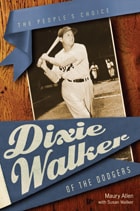
Dixie Walker of the Dodgers
The People's ChoiceMaury Allen and Susan Walker
University of Alabama Press, 2010
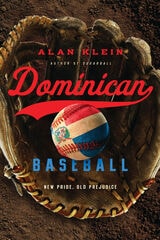
Dominican Baseball
New Pride, Old PrejudiceAlan Klein
Temple University Press, 2014
Pedro Martínez. Sammy Sosa. Manny Ramírez. By 2000, Dominican baseball players were in every Major League clubhouse, and regularly winning every baseball award. In 2002, Omar Minaya became the first Dominican general manager of a Major League team. But how did this codependent relationship between MLB and Dominican talent arise and thrive?
In his incisive and engaging book, Dominican Baseball, Alan Klein examines the history of MLB's presence and influence in the Dominican Republic, the development of the booming industry and academies, and the dependence on Dominican player developers, known as buscones. He also addresses issues of identity fraud and the use of performance-enhancing drugs as hopefuls seek to play professionally.
Dominican Baseball charts the trajectory of the economic flows of this transnational exchange, and the pride Dominicans feel in their growing influence in the sport. Klein also uncovers the prejudice that prompts MLB to diminish Dominican claims on legitimacy. This sharp, smartly argued book deftly chronicles the uneasy and often contested relations of the contemporary Dominican game and industry.