63 books match the query 'Bolivia' and 4 start with d
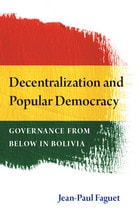
cover of Decentralization and Popular Democracy: Governance from Below in Bolivia

Decentralization and Popular Democracy

Governance from Below in Bolivia

Jean-Paul Faguet

University of Michigan Press, 2013

Bolivia decentralized in an effort to deepen democracy, improve public services, and make government more accountable. Unlike many countries, Bolivia succeeded. Over the past generation, public investment shifted dramatically toward primary services and resource distribution became far more equitable, partly due to the creation of new local governments. Many municipalities responded to decentralization with transparent, accountable government, yet others suffered ineptitude, corruption, or both. Why? Jean-Paul Faguet combines broad econometric data with deep qualitative evidence to investigate the social underpinnings of governance. He shows how the interaction of civic groups and business interests determines the quality of local decision making.

In order to understand decentralization, Faguet argues, we must understand governance from the ground up. Drawing on his findings, he offers an evaluation of the potential benefits of decentralization and recommendations for structuring successful reform.
[more]
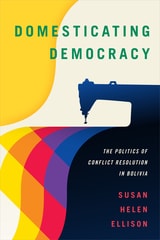
cover of Domesticating Democracy: The Politics of Conflict Resolution in Bolivia

Domesticating Democracy

The Politics of Conflict Resolution in Bolivia

Susan Helen Ellison

Duke University Press, 2018
In Domesticating Democracy Susan Helen Ellison examines foreign-funded alternate dispute resolution (ADR) organizations that provide legal aid and conflict resolution to vulnerable citizens in El Alto, Bolivia. Advocates argue that these programs help residents cope with their interpersonal disputes and economic troubles while avoiding an overburdened legal system and cumbersome state bureaucracies. Ellison shows that ADR programs do more than that—they aim to change the ways Bolivians interact with the state and with global capitalism, making them into self-reliant citizens. ADR programs frequently encourage Bolivians to renounce confrontational expressions of discontent, turning away from courtrooms, physical violence, and street protest and coming to the negotiation table. Nevertheless, residents of El Alto find creative ways to take advantage of these micro-level resources while still seeking justice and a democratic system capable of redressing the structural violence and vulnerability that ADR fails to treat.
[more]
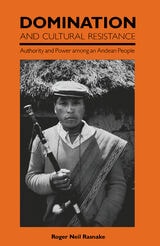
cover of Domination and Cultural Resistance: Authority and Power Among an Andean People

Domination and Cultural Resistance

Authority and Power Among an Andean People

Roger Neil Rasnake

Duke University Press, 1988

Domination and Cultural Resistance examines the social life of the Yura, a Quechua-speaking Andean ethnic group of central Bolivia, and focuses especially on their indigenous authorities, the kuraqkuna or elders. Combining ethnohistorical research with contemporary fieldwork, Roger Neil Rasnake traces the evolution of leadership roles within the changing composition of the native Andean social groupings, the ayllus—from the consolidation of pre-Hispanic Aymara polities, through the pressures of the Spanish colonial regime and the increasing fragmentation of the republican era, to the present.
[more]
cover of Drum and stethoscope: integrating ethnomedicine and biomedicine in Bolivia

Drum and stethoscope

integrating ethnomedicine and biomedicine in Bolivia

Joseph William Bastien

University of Utah Press, 1992

[more]