Results by title
379 books match the query 'Botany' and 7 start with d
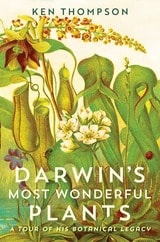
Darwin's Most Wonderful Plants
A Tour of His Botanical LegacyKen Thompson
University of Chicago Press, 2019
For many people, the story of Charles Darwin goes like this: he ventured to the Galapagos Islands on the Beagle, was inspired by the biodiversity of the birds he saw there, and immediately returned home to write his theory of evolution. But this simplified narrative is inaccurate and lacking: it leaves out a major part of Darwin’s legacy. He published On the Origin of Species nearly thirty years after his voyages. And much of his life was spent experimenting with and observing plants.
Darwin was a brilliant and revolutionary botanist whose observations and theories were far ahead of his time. With Darwin’s Most Wonderful Plants, biologist and gardening expert Ken Thompson restores this important aspect of Darwin’s biography while also delighting in the botanical world that captivated the famous scientist. Thompson traces how well Darwin’s discoveries have held up, revealing that many are remarkably long-lasting. Some findings are only now being confirmed and extended by high-tech modern research, while some have been corrected through recent analysis.
We learn from Thompson how Darwin used plants to shape his most famous theory and then later how he used that theory to further push the boundaries of botanical knowledge. We also get to look over Darwin’s shoulder as he labors, learning more about his approach to research and his astonishing capacity for hard work. Darwin’s genius was to see the wonder and the significance in the ordinary and mundane, in the things that most people wouldn’t look at twice.
Both Thompson and Darwin share a love for our most wonderful plants and the remarkable secrets they can unlock. This book will instill that same joy in casual gardeners and botany aficionados alike.
[more]
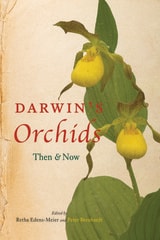
Darwin's Orchids
Then and NowEdited by Retha Edens-Meier and Peter Bernhardt
University of Chicago Press, 2014
For biologists, 2009 was an epochal year: the bicentennial of Charles Darwin’s birth and the 150th anniversary of the publication of a book now known simply as The Origin of Species. But for many botanists, Darwin’s true legacy starts with the 1862 publication of another volume: On the Various Contrivances by Which British and Foreign Orchids Are Fertilised by Insects and on the Good Effects of Intercrossing, or Fertilisation of Orchids. This slim but detailed book with the improbably long title was the first in a series of plant studies by Darwin that continues to serve as a global exemplar in the field of evolutionary botany. In Darwin’s Orchids, an international group of orchid biologists unites to celebrate and explore the continuum that stretches from Darwin’s groundbreaking orchid research to that of today.
Mirroring the structure of Fertilisation of Orchids, Darwin’s Orchids investigates flowers from Darwin’s home in England, through the southern hemisphere, and on to North America and China as it seeks to address a set of questions first put forward by Darwin himself: What pollinates this particular type of orchid? How does its pollination mechanism work? Will an orchid self-pollinate or is an insect or other animal vector required? And how has this orchid’s lineage changed over time? Diverse in their colors, forms, aromas, and pollination schemes, orchids have long been considered ideal models for the study of plant evolution and conservation. Looking to the past, present, and future of botany, Darwin’s Orchids will be a vital addition to this tradition.
Mirroring the structure of Fertilisation of Orchids, Darwin’s Orchids investigates flowers from Darwin’s home in England, through the southern hemisphere, and on to North America and China as it seeks to address a set of questions first put forward by Darwin himself: What pollinates this particular type of orchid? How does its pollination mechanism work? Will an orchid self-pollinate or is an insect or other animal vector required? And how has this orchid’s lineage changed over time? Diverse in their colors, forms, aromas, and pollination schemes, orchids have long been considered ideal models for the study of plant evolution and conservation. Looking to the past, present, and future of botany, Darwin’s Orchids will be a vital addition to this tradition.
[more]

Deceptive Beauties
The World of Wild OrchidsChristian Ziegler
University of Chicago Press, 2011
Confucius called them the “king of fragrant plants,” and John Ruskin condemned them as “prurient apparitions.” Across the centuries, orchids have captivated us with their elaborate exoticism, their powerful perfumes, and their sublime seductiveness.
But the disquieting beauty of orchids is an unplanned marvel of evolution, and the story of orchids is as captivating as any novel. As acclaimed writer Michael Pollan and National Geographic photographer Christian Ziegler spin tales of orchid conquest in Deceptive Beauties: The World of Wild Orchids, we learn how these flowers can survive and thrive in the harshest of environments, from tropical cloud forests to the Arctic, from semi-deserts to rocky mountainsides; how their shapes, colors, and scents are, as Darwin put it, “beautiful contrivances” meant to dupe pollinating male insects in the strangest ways. What other flowers, after all, can mimic the pheromones and even appearance of female insects, so much so that some male bees prefer sex with the orchids over sex with their own kind?
And insects aren’t the only ones to fall for the orchids’ charms. Since the “orchidelirium” of the Victorian era, humans have braved the wilds to search them out and devoted copious amounts of time and money propagating and hybridizing, nurturing and simply gazing at them. This astonishing book features over 150 unprecedented color photographs taken by Christian Ziegler himself as he trekked through wilderness on five continents to capture the diversity and magnificence of orchids in their natural habitats. His intimate and astonishing images allow us to appreciate up close nature’s most intoxicating and deceptive beauties.
[more]
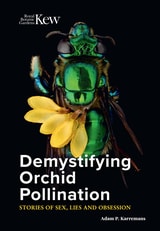
Demystifying Orchid Pollination
Stories of Sex, Lies and ObsessionAdam P. Karremans
Royal Botanic Gardens, Kew, 2023
An engaging and authoritative account of the fertilization of orchid flowers.
Demystifying Orchid Pollination explores the fascinating history of orchids and the means by which they reproduce. Adam P. Karremans reveals orchids’ hidden secrets, highlights the key role of pollinators in securing the survival of these delicate plants, and provides past and present scientific knowledge that challenges common beliefs about orchid reproduction. Demystifying Orchid Pollination celebrates biodiversity while stressing the importance of further ecological study and advocating for increased conservation efforts and thorough research and development.
Demystifying Orchid Pollination explores the fascinating history of orchids and the means by which they reproduce. Adam P. Karremans reveals orchids’ hidden secrets, highlights the key role of pollinators in securing the survival of these delicate plants, and provides past and present scientific knowledge that challenges common beliefs about orchid reproduction. Demystifying Orchid Pollination celebrates biodiversity while stressing the importance of further ecological study and advocating for increased conservation efforts and thorough research and development.
[more]
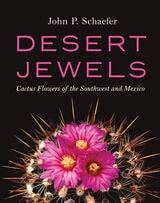
Desert Jewels
Cactus Flowers of the Southwest and MexicoJohn P. Schaefer
University of Arizona Press, 2023
2024 Southwest Books of the Year Winner
Stunning up-close images by a renowned desert photographer
Cactus flowers are jewels of the desert—they add brilliant pops of color to our arid surroundings. In this book, renowned Tucson photographer John P. Schaefer brings the exquisite and unexpected beauty of the cactus flower to the page. Hundreds of close-up photographs of cactus flowers native to the U.S. Southwest and Mexico offer a visual feast of color and texture, nuance and light.
These stunning photographs allow us to appreciate the spectacular range of color and form cactus flowers have to offer. For the cactus enthusiast, the book offers a comprehensive collection of high-quality flower photographs unlike any other. The photographs cover more than 250 cactus species organized by genus. The book starts with an introduction by the photographer that is both autobiographical and informative. It offers a glimpse into his process for capturing these elusive desert gems, resulting in photographs so beautiful they were featured as a book of stamps issued by the U.S. Postal Service.
This collection of cactus flowers in bloom is a one-of-a-kind work by a master photographer.
[more]
Discoveries in the Garden
James B. Nardi
University of Chicago Press, 2018
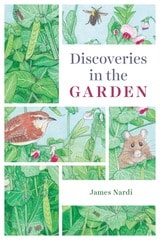
Every square inch of soil is rich with energy and life, and nowhere is this more evident than in the garden. At the tips of our trowels, a sun-driven world of microbes, insects, roots, and stems awaits—and it is a world no one knows better than James Nardi. A charming guide to all things green and growing, Nardi is as at home in prairies, forests, and wetlands as he is in the vegetable patch. And with Discoveries in the Garden, he shows us that these spaces aren’t as different as we might think, that nature flourishes in our backyards, schoolyards, and even indoors. To find it, we’ve only got to get down into the dirt.
Leading us through the garden gate, Nardi reveals the extraordinary daily lives and life cycles of a quick-growing, widely available, and very accommodating group of study subjects: garden plants. Through close observations and simple experiments we all can replicate at home, we learn the hidden stories behind how these plants grow, flower, set seeds, and produce fruits, as well as the vital role dead and decomposing plants play in nourishing the soil. From pollinators to parasites, plant calisthenics to the wisdom of weeds, Nardi’s tale also introduces us to our fellow animal and microbial gardeners, the community of creatures both macro- and microscopic with whom we share our raised beds. Featuring a copse of original, informative illustrations that are as lush as the garden plants themselves, Discoveries in the Garden is an enlightening romp through the natural history, science, beauty, and wonder of these essential green places.
Leading us through the garden gate, Nardi reveals the extraordinary daily lives and life cycles of a quick-growing, widely available, and very accommodating group of study subjects: garden plants. Through close observations and simple experiments we all can replicate at home, we learn the hidden stories behind how these plants grow, flower, set seeds, and produce fruits, as well as the vital role dead and decomposing plants play in nourishing the soil. From pollinators to parasites, plant calisthenics to the wisdom of weeds, Nardi’s tale also introduces us to our fellow animal and microbial gardeners, the community of creatures both macro- and microscopic with whom we share our raised beds. Featuring a copse of original, informative illustrations that are as lush as the garden plants themselves, Discoveries in the Garden is an enlightening romp through the natural history, science, beauty, and wonder of these essential green places.
[more]

Distribution of Illinois Vascular Plants
Robert H. Mohlenbrock and Douglas M. Ladd
Southern Illinois University Press, 1978
This new distribution list— the first since Winterringer and Evers (1960)— brings up-to-date every vascular plant known to occur in Illinois as a native, naturalized, or escaped species, some 3,001 taxa of vascular plants within the boundaries of the state.
There are 251 pages of distribution maps included in this book. The plants are arranged alphabetically by genus, and under each genus alphabetically by species. The nomenclature follows Mohlenbrock, Guide to the Vascular Flora of Illinois (1975).
In addition, a list of synonyms applied to Illinois taxa by Fernald (1950), Gleason (1952), and Jones (1963) follows the distribution maps.
Finally, in order to gain an understanding of relationships of the plants in the Illinois flora, all 3,001 taxa are arranged in a phylogenetic sequence at the end of the book.
[more]