Results by title
60 books match the query 'Britain' and 4 start with d

Directory of World Cinema
BritainEdited by Emma Bell and Neil Mitchell
Intellect Books, 2012
Bringing to mind rockers and royals, Buckingham Palace and the Scottish Highlands, Britain holds a special interest for international audiences who have flocked in recent years to quality exports like Fish Tank, Trainspotting, and The King’s Speech. A series of essays and articles exploring the definitive films of Great Britain, this addition to Intellect’s Directory of World Cinema series turns the focus on England together with Northern Ireland, Scotland, and Wales.
With a focus on the most cerebral and critically important films to have come out of Britain, this volume explores the diversity of genres found throughout British film, highlighting important regional variations that reflect the distinctive cultures of the countries involved. Within these genres, Emma Bell and Neil Mitchell have curated a rich collection of films for review—from Hitchcock’s spy thriller The 39 Steps to Emeric Pressburger’s art classic The Red Shoes to the gritty but heartfelt This is England. Interspersed throughout the book are critical essays by leading experts in the field providing insight into shifting notions of Britishness, important industry developments, and the endurance of the British film industry. For those up on their Brit film facts and seeking to test their expertise, the book concludes with a series of trivia questions.
A user-friendly look at the cultural and artistic significance of British cinema from the silent era to the present, Directory of World Cinema: Britain will be an essential companion to the country’s bright and resurgent film industry.
[more]
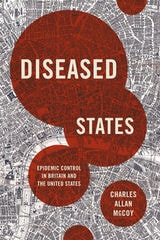
Diseased States
Epidemic Control in Britain and the United StatesCharles Allan McCoy
University of Massachusetts Press, 2020
Outbreaks of Ebola, SARS, MERS, coronavirus, and pandemic influenza are brutal reminders of the dangers of infectious disease. Comparing the development of disease control in Britain and the United States, from the 1793 yellow fever outbreak in Philadelphia to the H1N1 panics of more recent times, Diseased States provides a blueprint for managing pandemics in the twenty-first century.
To understand why these two nations have handled contemporary disease threats in such different ways, Charles Allan McCoy examines when and how disease control measures were adopted in each country from the nineteenth century onward, which medical theory of disease was dominant at the time, and where disease control was located within the state apparatus. Particular starting conditions put Britain and the United States on distinct trajectories of institutionalization that led to their respective systems of disease control. As McCoy shows, even the seemingly objective matter of contagion is deeply enmeshed in social and political realities, and by developing unique systems of biopower to control the spread of disease, Britain and the United States have established different approaches of exerting political control over citizens' lives and bodies.
To understand why these two nations have handled contemporary disease threats in such different ways, Charles Allan McCoy examines when and how disease control measures were adopted in each country from the nineteenth century onward, which medical theory of disease was dominant at the time, and where disease control was located within the state apparatus. Particular starting conditions put Britain and the United States on distinct trajectories of institutionalization that led to their respective systems of disease control. As McCoy shows, even the seemingly objective matter of contagion is deeply enmeshed in social and political realities, and by developing unique systems of biopower to control the spread of disease, Britain and the United States have established different approaches of exerting political control over citizens' lives and bodies.
[more]

Dismembering the Male
Men's Bodies, Britain, and the Great WarJoanna Bourke
University of Chicago Press, 1996
Some historians contend that femininity was "disrupted, constructed and reconstructed" during World War I, but what happened to masculinity? Using the evidence of letters, diaries, and oral histories of members of the military and of civilians, as well as contemporary photographs and government propoganda, Dismembering the Male explores the impact of the First World War on the male body.
Each chapter explores a different facet of the war and masculinity in depth. Joanna Bourke discovers that those who were dismembered and disabled by the war were not viewed as passive or weak, like their civilian counterparts, but were the focus of much government and public sentiment. Those suffering from disease were viewed differently, often finding themselves accused of malingering.
Joanna Bourke argues convincingly that military experiences led to a greater sharing of gender identities between men of different classes and ages. Dismembering the Male concludes that ultimately, attempts to reconstruct a new type of masculinity failed as the threat of another war, and with it the sacrifice of a new generation of men, intensified.
[more]

Dreams, Questions, Struggles
South Asian Women in BritainAmrit Wilson
Pluto Press, 2006
From schoolgirls to matriarchs, single mothers to extended families, and businesswomen to factory workers, the experience of Asian women in Britain today is polarised by class and religion.
This book explores the lives and struggles of two generations of British Asian women to present a political account of their experiences: personal and public, individual and collective, their struggles take on power structures within the family, the community and, on occasion, the British state.
Combining their personal testimony within a theoretical framework, Amrit Wilson locates their experiences in the wider context of global and regional politics. She examines what impact the feminist movement has had on their lives, and explores issues such as domestic violence, Asian marriages, representations of Asian women, mental disturbance and suicide.
[more]