Results by title
282 books match the query 'Caribbean & West Indies' and 7 start with d
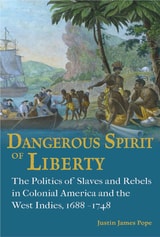
Dangerous Spirit of Liberty
The Politics of Slaves and Rebels in Early America and the West Indies, 1688-1748Justin James Pope
University of Missouri Press, 2024
Dangerous Spirit of Liberty's distinguishing feature is its focus on the role of communication in the development of a rebellious early eighteenth-century Atlantic. Most historians of slavery have presupposed that slave unrest was confined to small locales in the first half of the eighteenth century. In fact, slaves found ways to share news across provinces to great effect. Benefiting from research in the archives of Great Britain, Spain, Barbados, Bermuda, Jamaica, Antigua, the U.S. Virgin Islands, and the mainland United States, the book reveals new evidence of slave communication networks and shows how people of African ancestry shared rumors of emancipation and rebellion in this period. Slaves laboring in colonial commerce and working aboard ships helped foster an increasingly restive Black community. Banished slaves, convicted conspirators accused of plotting insurrection, carried their experiences with them in exile to neighboring colonies. By reconstructing the path of news, the book reveals rumors and reports that particularly resonated among slaves in the early eighteenth century.
Dark Side of the Light
Slavery and the French EnlightenmentLouis Sala-Molins
University of Minnesota Press, 2006
Translated into English for the first time, Dark Side of the Light scrutinizes Condorcet’s Reflections on NegroSlavery and the works of Montesquieu, Rousseau, and Diderot side by side with the Code Noir (the royal document that codified the rules of French Caribbean slavery) in order to uncover attempts to uphold the humanist project of the Enlightenment while simultaneously justifying slavery. Wielding the pen of both the ironist and the moralist, Sala-Molins demonstrates the flawed nature of these attempts and the reasons given for this denial of rights, from the imperatives of public order to the incomplete humanity of the slave (and thus the need for his progressive humanization through slavery), to the economic prosperity that depended on his labor. At the same time, Sala-Molins uses the techniques of literature to give equal weight to the perspective of the “barefooted, the starving, and the slaves” through expository prose and scenes between slave and philosopher, giving moral agency and flesh-and-blood dimensions to issues most often treated as abstractions.
Both an urgent critique and a measured analysis, Dark Side of the Light reveals the moral paradoxes of Enlightenment philosophies and their world-changing consequences.
Louis Sala-Molins is a moral and political philosopher and emeritus professor at the University of Toulouse. He is the author of many books, including Le Code Noir, ou Le calvaire de Canaan and L’Afrique aux Amériques.
John Conteh-Morgan is associate professor of French and Francophone, African-American, and African studies at Ohio State University. He is the author of Theatre and Drama in Francophone Africa: A Critical Introduction.
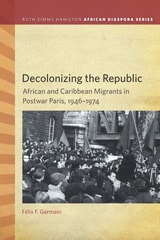
Decolonizing the Republic
African and Caribbean Migrants in Postwar Paris, 1946–1974Félix F. Germain
Michigan State University Press, 2016
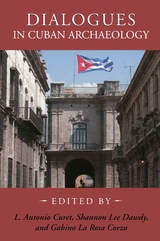
Dialogues in Cuban Archaeology
Edited by L. Antonio Curet, Shannon Lee Dawdy, and Gabino La Rosa Corzo
University of Alabama Press, 2005
A critical, dialogic examination of Cuban and Caribbean archaeology, advancing contemporary interpretations of heritage and identity.
Many Americans are aware of the political, economic, and personal impacts of the U.S. embargo on Cuba. But the communication blockade between scholars has also affected the historical course of academic disciplines and research in general. With the easing of restrictions in the 1990s, academics are now freer to conduct research in Cuba, and the Cuban government has been more receptive to collaborative projects.
This volume provides a forum for the principal Cuban and American archaeologists to update the current state of Cuban archaeological research--from rock art and potsherds to mortuary practices and historical renovation--thereby filling in the information gap created by the political separation. Each group of researchers brings significant new resources to the effort, including strong conservation regulations, innovative studies of lithic and shell assemblages, and transculturation theories. Cuban research on the hacienda system, slavery, and urban processes has in many ways anticipated developments in North American archaeology by a decade or more. Of special interest are the recent renovation projects in Old Havana that fully integrate the work of historians, architects, and archaeologists--a model project conducted by agreement between the Cuban government and UNESCO.
The selection of papers for this collection is based on a desire to answer pressing research questions of interest for North American Caribbeanists and to present a cross-section of Cuban archaeological work. With this volume, then, the principal players present results of recent collaborations and begin a renewed conversation, a dialogue, that can provide a foundation for future coordinated efforts.
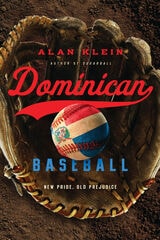
Dominican Baseball
New Pride, Old PrejudiceAlan Klein
Temple University Press, 2014
Pedro Martínez. Sammy Sosa. Manny Ramírez. By 2000, Dominican baseball players were in every Major League clubhouse, and regularly winning every baseball award. In 2002, Omar Minaya became the first Dominican general manager of a Major League team. But how did this codependent relationship between MLB and Dominican talent arise and thrive?
In his incisive and engaging book, Dominican Baseball, Alan Klein examines the history of MLB's presence and influence in the Dominican Republic, the development of the booming industry and academies, and the dependence on Dominican player developers, known as buscones. He also addresses issues of identity fraud and the use of performance-enhancing drugs as hopefuls seek to play professionally.
Dominican Baseball charts the trajectory of the economic flows of this transnational exchange, and the pride Dominicans feel in their growing influence in the sport. Klein also uncovers the prejudice that prompts MLB to diminish Dominican claims on legitimacy. This sharp, smartly argued book deftly chronicles the uneasy and often contested relations of the contemporary Dominican game and industry.
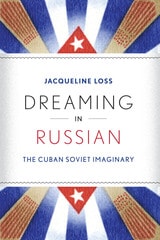
Dreaming in Russian
The Cuban Soviet ImaginaryBy Jacqueline Loss
University of Texas Press, 2013
The specter of the Soviet Union lingers in Cuba, yet until now there has been no book-length work on the ways Cubans process their country’s relationship with the Soviet bloc. Dreaming in Russian at last brings into the light the reality that for nearly three decades, the Soviet Union subsidized the island economically, intervened in military matters, and exported distinct pedagogical and cultural models to Cuba. Drawing on interviews with Cuban artists and intellectuals, as well as treasures from cinematographic and bibliographic archives, Jacqueline Loss delivers the first book to show that Cuba remembers and retains many aspects of the Soviet era, far from shedding those cultural facets as relics of the Cold War.
Weaving together intriguing, seldom-seen images, Dreaming in Russian showcases the ways in which Cuba’s relationship to its Soviet benefactors lingered after the disintegration of the U.S.S.R. in 1991. Analyzing numerous literary texts and works of visual art, Loss also incorporates aspects of architecture, popular culture, the space race, and other strands to create a captivating new perspective on Cuban society. Among the luminaries featured are poet Reina María Rodríguez, writer Antonio José Ponte, visual artist Tonel, and novelist Wendy Guerra. A departure from traditional cultural history, Loss’s approach instead presents a kaleidoscopic series of facets, reflecting the hybrid nature of the self-images that emerged in the aftermath of the Soviet aegis. As speculations about Cuba’s future under Fidel Castro’s heir apparent continue, the portrait that emerges in Dreaming in Russian is both timely and mesmerizing.
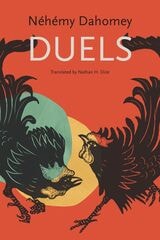
Duels
Néhémy Dahomey
Seagull Books, 2025
Set in 1842, this novel foregrounds a Haiti that is grappling with the weight of an onerous debt imposed by France, forcing its citizens to pay reparations to French colonists in exchange for diplomatic recognition of the first Black republic of the Americas. In the town of Boën, a prosperous notary, Ludovic Possible, decides to take a bold step to secure the future of his community. He opens a schoolhouse where local children can learn both artisanal skills and the essential ability to read and write. For Ludovic, education represents the best chance for the people of Boën to rise above their hardships and build a prosperous future—especially for Aïda, a quiet and enigmatic girl whose mother’s marvelous stories captivate him.
The tranquility of Boën is soon shattered, however, by a series of duels that pit families, neighbors, and even animals against each other. As tensions rise, Ludovic’s vision for a better future is threatened by the escalating violence. In Duels, Néhémy Pierre-Dahomey introduces readers to a rich and unforgettable cast of characters—Aïda, Ludovic, Balthazar Possible, Pépé the Tempest, and many others—who find themselves at the crossroads of a nation on the brink of transformative change.