Results by title
63 books match the query 'Cases' and 4 start with d
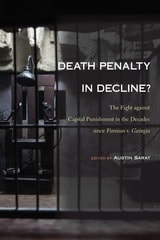
Death Penalty in Decline?
The Fight against Capital Punishment in the Decades since Furman v. GeorgiaAustin Sarat
Temple University Press, 2024
At a time when the United States is undertaking an unprecedented national reconsideration of the death penalty, Death Penalty in Decline? seeks to evaluate how abolitionists might succeed today.
Contributors: John Bessler, Corinna Barrett Lain, James R. Martel, Linda Ross Meyer, Carol S. Steiker, Jordan M. Steiker, and the editor

Democratizing Communist Militaries
The Cases of the Czech and Russian Armed ForcesMarybeth Peterson Ulrich
University of Michigan Press, 2000
In a groundbreaking study, Marybeth Peterson Ulrich explores the attitudes of the leaders of the armed forces in Russia and the Czech Republic toward the new democratic governments and suggests ways in which we might encourage the development of politically neutral militaries in these states. Building on the work of Samuel Huntington and others on the relationship between the military and the state, the author suggests that norms of military professionalism must change if the armies in countries making a transition from communist rule are to become strong supporters of the democratic state. The Czech Republic and Russia are interesting cases, because they have had very different experiences in the transition; they have different geopolitical goals; and they experienced different military-civilian relationships during the Soviet period. The author also explores American and NATO programs to promote democratization in these militaries and suggests changes in the programs.
Marybeth Peterson Ulrich is Associate Professor of Government, U.S. Army War College.

Disorder in the Court
Morality, Myth, and the Insanity DefenseAndrea L. Alden
University of Alabama Press, 2018
The first book-length rhetorical history and analysis of the legal and moral questions behind the insanity defense.
The insanity defense is considered one of the most controversial, most misunderstood, and least straightforward subjects in the American legal system. Disorder in the Court: Morality, Myth, and the Insanity Defense traces the US legal standards for the insanity defense as they have evolved from 1843, when they were first codified in England, to 1984, when the US government attempted to revise them through the Insanity Defense Reform Act. Throughout this period “insanity” existed primarily as a legal term rather than a medical one; yet the testimony of psychiatric experts is required in cases in which an insanity defense is raised.
The adjudication of such cases by courtroom practice is caught between two different but overlapping discourses, the legal and the medical, both of which have historically sought to assert and maintain firm disciplinary boundaries. Both expert and lay audiences have struggled to understand and apply commonplace definitions of sanity, and the portrayal of the insanity defense in popular culture has only served to further frustrate such understandings.
Andrea L. Alden argues that the problems with understanding the insanity defense are, at their foundation, rhetorical. The legal concept of what constitutes insanity and, therefore, an abdication of responsibility for one’s actions does not map neatly onto the mental health professions’ understandings of mental illness and how that affects an individual’s ability to understand or control his or her actions. Additionally, there are multiple layers of persuasion involved in any effort to convince a judge, jury—or a public, for that matter—that a defendant is or is not responsible for his or her actions at a particular moment in time.
Alden examines landmark court cases such as the trial of Daniel McNaughtan, Durham v. United States, and the trial of John Hinckley Jr. that signal the major shifts in the legal definitions of the insanity defense. Combining archival, textual, and rhetorical analysis, Alden offers a close reading of texts including trial transcripts, appellate court opinions, and relevant medical literature from the time period. She contextualizes these analyses through popular texts—for example, newspaper articles and editorials—showing that while all societies have maintained some version of mental illness as a mitigating factor in their penal systems, the insanity defense has always been fraught with controversy.

Doing Rhetorical History
Concepts and CasesKathleen J. Turner
University of Alabama Press, 1998
and as a perspective, offers insights that are central to the study of
communication and unavailable through other approaches.
The current field of communication derives from the historical study
of rhetoric. Over the last few decades, however, as the trend toward theoretical
conceptions has driven analysis and as a host of "isms" has defined
criticism, communication studies have moved away from a predominantly historical
perspective.
Yet many scholars in the field continue to find benefits in rhetorical
history. In the thirteen essays gathered here, eminent scholars address
the ongoing dialogue over the regrounding of rhetorical study and the relationship
between theory and history as well as history and criticism in the field.
Some examine the conceptual issues involved in the juncture of rhetoric
and history; others offer case studies, often based on research with primary
documents, to illustrate the process and promise of rhetorical history.
Collectively, their work tests theory and complements criticism while standing
as a distinct and valid approach in and of itself.
The conceptualizations and methodologies of rhetorical history will
increase in significance during the burgeoning "Communication Age"
as we seek to cope with the present and prepare for the future by better
understanding the past. This volume serves as an excellent overview of
a recently neglected methodological approach and acts as the first step
in ending that neglect.