Results by title
475 books match the query 'Catholic' and 8 start with d
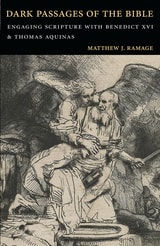
Dark Passages of the Bible
Matthew J. Ramage
Catholic University of America Press, 2013
Following the lead of Pope Benedict XVI, in Dark Passages of the Bible Matthew Ramage weds the historical-critical approach with a theological reading of Scripture based in the patristic-medieval tradition. Whereas these two approaches are often viewed as mutually exclusive or even contradictory, Ramage insists that the two are mutually enriching and necessary for doing justice to the Bibles most challenging texts.
[more]
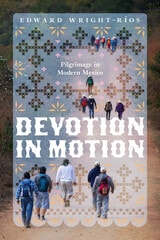
Devotion in Motion
Pilgrimage in Modern MexicoEdward Wright-Ríos
University of Chicago Press, 2025
A study of contemporary pilgrimage through the elastic history of a shrine in Oaxaca, Mexico.
For many, pilgrimage conjures ideas about ancient traditions and somber journeys of self-discovery—an escape from modern life. In Devotion in Motion, Edward Wright-Ríos argues that we misunderstand pilgrimage (past and present) if we ignore its dynamic relationship with the rhythms of daily life and community.
Through the story of a centuries-old, ever-changing Catholic shrine to Our Lady of Juquila in Oaxaca, Mexico, Wright-Ríos reveals how tradition, innovation, marketing, and devotion coexist and interact in pilgrimage. Devotees, he shows, are not dissuaded by the embeddedness of the sacred site in the complexities, hierarchies, or conflicts of their lives. In fact, the truckers, accountants, and health-care workers we meet in this book actively seek new resources (including social media) to aid and share their devotion. Part microhistory, part ethnography, Devotion in Motion is a celebration of pilgrimage as a living experience in every generation.
[more]
Devotional Activism
Public Religion, Innovation and Culture in the Nineteenth-CenturyRichard Schaefer
St. Augustine's Press, 2023
Modern history has not been neutral in telling the story of religion. Since it presumes the centrality of human motives and machinations as the one and only means of explicating the unfolding of ‘events’, it has helped set the terms for what counts as a viable motive and what does not, and this is evident in the systematic unmasking of religion as only really ever about ‘something else’. By distilling more substantive/primary economic, political or other kinds of motives from the detritus of ‘religion’, the latter is thus consigned to the past as the primitive husk of more substantive and rational ways of thinking and acting. As a set of historical case studies, the essays collected here forgo that tendency, and suggest different possibilities for conceptualizing the fate of religion in the modern world. They chart a different course, one of faith and self-assertion.
The essays take up a variety of episodes from modern European and American history and explore, from various angles, three interrelated themes: 'public religion', and the role of Catholicism as a determined critic of modernity; religion as an impetus for innovation; and the tendency to reduce religion to culture.
The essays take up a variety of episodes from modern European and American history and explore, from various angles, three interrelated themes: 'public religion', and the role of Catholicism as a determined critic of modernity; religion as an impetus for innovation; and the tendency to reduce religion to culture.
[more]
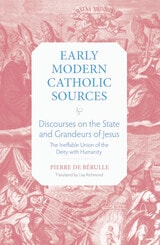
Discourse on the State and Grandeurs of Jesus
The Ineffable Union of the Diety with HumanityPierre de Bérulle
Catholic University of America Press, 2023
Pierre de Bérulle (1575–1629) is one of the foremost personalities of early modern Catholicism. As the founder of the “French school” of spirituality, he has exercised a profound influence on the Church from the seventeenth century to the present day. Until now, however, very little of Bérulle’s writings have been available in English. This volume provides the first complete English translation of his best-known work, first printed in Paris in 1623 and titled Discourses on the State and Grandeurs of Jesus, by the Ineffable Union of the Deity with Humanity, and the Submission and Servitude that Is Due Him and His Most Holy Mother in Response to This Wondrous State. Composed in his maturity, this work expresses Bérulle’s theology of the Man-God, whose self-emptying has enabled us to become “capable” of God.
In contrast to other spiritual writers who taught that mystical union with God follows the extinction of all sensory and conceptual awareness and all activity of willing, Bérulle’s focus is on the faithful soul’s participation in what he calls Jesus’ “states,” or inner dispositions. The state that Bérulle describes and honors supremely in this text is Jesus’ state of self-emptying in the mystery of the Incarnation. In the hypostatic union, our humanity in Christ is lifted up to heaven, and Christ is the first fruit of humanity-made-divine, the “firstborn among many brothers.” Through him we become children of God by adoption, participants in God’s divine being.
This is an outstanding translation, conveying not only the meaning but also the beauty and rhetorical features of the original. The Discourses will repay reading as a poignant source of personal devotion, a primary text of the Catholic Reformation, and a classic of spiritual theology.
[more]

Disturbers of the Twentieth Century
Catholic Social Critics in Modern BritainAdam Schwartz
Catholic University of America Press, 2026
Building on his acclaimed The Third Spring, Adam Schwartz presents a pioneering analysis of the social commentary of G. K. Chesterton, Graham Greene, Christopher Dawson, and David Jones. These four converts were exemplars of the Catholic literary revival as a “counter-politics” that provided a radical, supernaturalist alternative to predominant secularist social ideologies and systems from a distinctly Roman Catholic standpoint. Disturbers of the Twentieth Century explores this facet of each writer’s work more thoroughly than earlier studies have done, and does so in comparison to his counterparts’ thought. The Catholic literary revival hence emerges as a vital, yet largely neglected, voice in historical and sociological discussions of the relationship between religion and politics in the modern era.
In the process, Schwartz uniquely situates these Catholic authors in broader heritages of British and Western protest thought dating to the Romantics, showing how their shared resistance to industrial technocracy (and its socio-political effects) and growing secularization was defined distinctively by Roman Catholicism. The converts’ challenge was bolder than post-Reformation British Catholics had usually uttered in an often-hostile political culture. Nonetheless this quartet’s criticism was always constructive, as they eschewed nostalgia and endeavored consciously to engage twentieth century society in its particular genres and discrete conditions to transform it into an “alternative modernity” governed by Roman Catholic principles.
Schwartz therefore recasts understanding of movements like Chesterton’s distributism while elucidating originally other counterstatements, such as Dawson’s Christian corporatism, and deploying newly discovered and published material, including poetry and prose by Jones and letters and journalism by Greene. Schwartz in turn interrogates misconstruals of the authors’ relationships to totalitarian ideologies, even as he confronts forthrightly controversial subjects such as antisemitism. Disturbers of the Twentieth Century is thus an accurate, textured account of the “public doctrine” these trenchant Catholics proposed as the source of social renewal and cultural regeneration for a “century of bones.”
[more]
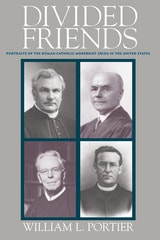
Divided Friends
William L. Portier
Catholic University of America Press, 2013
In two sets of intertwined biographical portraits, spanning two generations, Divided Friends dramatizes the theological issues of the modernist crisis, highlighting their personal dimensions and extensively reinterpreting their long-range effects. The four protagonists are Bishop Denis J. O?Connell, Josephite founder John R. Slattery, together with the Paulists William L. Sullivan and Joseph McSorley. Their lives span the decades from the Americanist crisis of the 1890s right up to the eve of Vatican II. In each set, one leaves the church and one stays. The two who leave come to see their former companions as fundamentally dishonest. Divided Friends entails a reinterpretation of the intellectual fallout from the modernist crisis and a reframing of the 20th century debate about Catholic intellectual life.
[more]
Doctrinal Sermons on the Catechism of the Catholic Church
Kenneth Baker
St. Augustine's Press, 2012
[more]
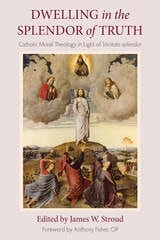
Dwelling in the Splendor of Truth
Catholic Moral Theology in Light of <i>Veritatis splendor</i>James W. Stroud
Catholic University of America Press, 2026
On August 6, 1993, Pope John Paul II promulgated the long-awaited encyclical on moral theology entitled Veritatis splendor. In this landmark encyclical, directed principally toward bishops, Pope John Paul II sought a reset of the discipline of Catholic moral theology after the Second Vatican Council in response to the theological dissent that had called into question the foundations of Catholic morality.
More than thirty years after the promulgation of Veritatis splendor, the essays in this edited volume consider the major themes and topics of this encyclical as it seeks to contribute to the revitalization of moral theology today. These themes and topics include: the rich young man and the renewal of moral theology, freedom, nature, and law, conscience, intrinsically evil acts, the state of revisionism, the moral object, martyrdom and morality, evangelization, the role of the moral theologian, and the role of scripture in moral theology.
Contributors include: William C. Mattison, III, Irene Alexander, Matthew Levering, Matthew Dugandzic, James W. Stroud, Stephen L. Brock, Patrick Clark, Timothy P. O’Malley, Jana Marguerite Bennet, John Grabowski, with a foreword by Archbishop of Sydney Anthony Fisher, OP.
[more]