Results by title
66 books match the query 'Central' and 5 start with d
Defeat Is the Only Bad News
Rwanda under Musinga, 1896–1931Alison Des Forges
University of Wisconsin Press, 2011
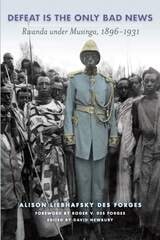
A Rwandan proverb says “Defeat is the only bad news.” For Rwandans living under colonial rule, winning called not only for armed confrontation, but also for a battle of wits—and not only with foreigners, but also with each other. In Defeat Is the Only Bad News Alison Des Forges recounts the ambitions, strategies, and intrigues of an African royal court under Yuhi Musinga, the Rwandan ruler from 1896 to 1931. These were turbulent years for Rwanda, when first Germany and then Belgium pursued an aggressive plan of colonization there. At the time of the Europeans’ arrival, Rwanda was also engaged in a succession dispute after the death of one of its most famous kings. Against this backdrop, the Rwandan court became the stage for a drama of Shakespearean proportions, filled with deceit, shrewd calculation, ruthless betrayal, and sometimes murder.

Developments in Central and East European Politics 4
Stephen White, Judy Batt and Paul G. Lewis, eds.
Duke University Press, 0
The chapters, all of which are new to this edition, focus on key features of the political systems that have emerged following the transition to postcommunist rule and the enlargement of the European Union through 2006. Full attention is given to the pattern of events in individual nations, but the main emphasis is on the framework of politics across the region—constitutions, leadership, parliaments, parties, and electoral systems—and the process of politics, as it is revealed in political participation, civil society, economic change, and the quality of democratic government within and beyond the region.
Clearly written and well supported with references and suggestions for further reading, Developments in Central and East European Politics 4 is the ideal guide to the process of change in a group of states that were formerly modeled on the Soviet Union but are now a distinctive and varied presence within a continent that has been redefining its boundaries, its values, its economic systems, and its international allegiances.
Contributors. Judy Batt, Dirk Berg-Schlosser, Sarah Birch, Heather Grabbe, Tim Haughton, Krzysztof Jasiewicz, Petr Kopecký, Paul G. Lewis, Frances Millard, Cas Mudde, D. Mario Nuti, Mark Pittaway, Ray Taras, Stephen White, Andrew Wilson, Kataryna Wolczuk
Developments in Central and East European Politics 5
Stephen White, Paul G. Lewis, and Judy Batt, eds.
Duke University Press, 0
Central and East Europe is a large, extremely diverse region, encompassing full-fledged EU members—the Czech Republic, Hungary, Poland, Estonia, Latvia, Lithuania, Slovenia, and Slovakia, followed later by Bulgaria and Romania—as well as nations of the Western Balkans that are progressing at various speeds along the EU path—Croatia, about to join; Macedonia, Montenegro and Serbia, with EU candidate status; and Albania, Bosnia and Herzegovina, and Kosovo, struggling to keep up. The region also includes the East European states of Ukraine, Belarus, and Moldova. In this collection, leading authorities examine how these heterogeneous nations have fared since the collapse of communism. The contributors look at executive leadership, elections and voter behavior, parliamentary systems, political parties, citizen engagement in civil society, the effects of neoliberalism, and the quality of life in postcommunist democracies. Most of the essays are new to this edition; the rest have been thoroughly updated.
Contributors. Judy Batt, Sarah Birch, Nathaniel Copsey, Terry Cox, Rick Fawn, Tim Haughton, Krzysztof Jasiewicz, Paul G. Lewis, Frances Millard, David M. Olson, Mitchell A. Orenstein, Andrew Roberts, Ray Taras, Stephen White, Andrew Wilson
Developments in Central and East European Politics 5
Stephen White, Paul G. Lewis, and Judy Batt, eds.
Duke University Press, 0
Central and East Europe is a large, extremely diverse region, encompassing full-fledged EU members—the Czech Republic, Hungary, Poland, Estonia, Latvia, Lithuania, Slovenia, and Slovakia, followed later by Bulgaria and Romania—as well as nations of the Western Balkans that are progressing at various speeds along the EU path—Croatia, about to join; Macedonia, Montenegro and Serbia, with EU candidate status; and Albania, Bosnia and Herzegovina, and Kosovo, struggling to keep up. The region also includes the East European states of Ukraine, Belarus, and Moldova. In this collection, leading authorities examine how these heterogeneous nations have fared since the collapse of communism. The contributors look at executive leadership, elections and voter behavior, parliamentary systems, political parties, citizen engagement in civil society, the effects of neoliberalism, and the quality of life in postcommunist democracies. Most of the essays are new to this edition; the rest have been thoroughly updated.
Contributors. Judy Batt, Sarah Birch, Nathaniel Copsey, Terry Cox, Rick Fawn, Tim Haughton, Krzysztof Jasiewicz, Paul G. Lewis, Frances Millard, David M. Olson, Mitchell A. Orenstein, Andrew Roberts, Ray Taras, Stephen White, Andrew Wilson