Results by title
480 books match the query 'Chicago' and 14 start with d
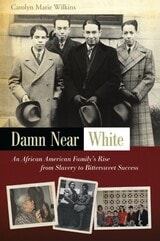
Damn Near White
An African American Family's Rise from Slavery to Bittersweet SuccessCarolyn Marie Wilkins
University of Missouri Press, 2010
Carolyn Wilkins grew up defending her racial identity. Because of her light complexion and wavy hair, she spent years struggling to convince others that she was black. Her family’s prominence set Carolyn’s experiences even further apart from those of the average African American. Her father and uncle were well-known lawyers who had graduated from Harvard Law School. Another uncle had been a child prodigy and protégé of Albert Einstein. And her grandfather had been America's first black assistant secretary of labor.
Carolyn's parents insisted she follow the color-conscious rituals of Chicago's elite black bourgeoisie—experiences Carolyn recalls as some of the most miserable of her entire life. Only in the company of her mischievous Aunt Marjory, a woman who refused to let the conventions of “proper” black society limit her, does Carolyn feel a true connection to her family's African American heritage.
When Aunt Marjory passes away, Carolyn inherits ten bulging scrapbooks filled with family history and memories. What she finds in these photo albums inspires her to discover the truth about her ancestors—a quest that will eventually involve years of research, thousands of miles of travel, and much soul-searching.
Carolyn learns that her great-grandfather John Bird Wilkins was born into slavery and went on to become a teacher, inventor, newspaperman, renegade Baptist minister, and a bigamist who abandoned five children. And when she discovers that her grandfather J. Ernest Wilkins may have been forced to resign from his labor department post by members of the Eisenhower administration, Carolyn must confront the bittersweet fruits of her family's generations-long quest for status and approval.
Damn Near White is an insider’s portrait of an unusual American family. Readers will be drawn into Carolyn’s journey as she struggles to redefine herself in light of the long-buried secrets she uncovers. Tackling issues of class, color, and caste, Wilkins reflects on the changes of African American life in U.S. history through her dedicated search to discover her family’s powerful story.
Defending Their Own in the Cold
The Cultural Turns of U.S. Puerto RicansMarc Zimmerman
University of Illinois Press, 2011
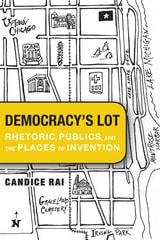
Democracy's Lot
Rhetoric, Publics, and the Places of InventionCandice Rai
University of Alabama Press, 2016
Candice Rai’s Democracy’s Lot is an incisive exploration of the limitations and possibilities of democratic discourse for resolving conflicts in urban communities. Rai roots her study of democratic politics and publics in a range of urban case studies focused on public art, community policing, and urban development. These studies examine the issues that erupted within an ethnically and economically diverse Chicago neighborhood over conflicting visions for a vacant lot called Wilson Yard. Tracing how residents with disparate agendas organized factions and deployed language, symbols, and other rhetorical devices in the struggle over Wilson Yard’s redevelopment and other contested public spaces, Rai demonstrates that rhetoric is not solely a tool of elite communicators, but rather a framework for understanding the agile communication strategies that are improvised in the rough-and-tumble work of democratic life.
Wilson Yard, a lot eight blocks north of Wrigley Field in Chicago’s gentrifying Uptown neighborhood, is a diverse enclave of residents enlivened by recent immigrants from Guatemala, Mexico, Vietnam, Ethiopia, and elsewhere. The neighborhood’s North Broadway Street witnesses a daily multilingual hubbub of people from a wide spectrum of income levels, religions, sexual identifications, and interest groups. When a fire left the lot vacant, this divided community projected on Wilson Yard disparate and conflicting aspirations, the resolution of which not only determined the fate of this particular urban space, but also revealed the lot of democracy itself as a process of complex problem-solving. Rai’s detailed study of one block in an iconic American city brings into vivid focus the remarkable challenges that beset democratic urban populations anywhere on the globe—and how rhetoric supplies a framework to understand and resolve those challenges.
Based on exhaustive field work, Rai uses rhetorical ethnography to study competing publics, citizenship, and rhetoric in action, exploring “rhetorical invention,” the discovery or development by individuals of the resources or methods of engaging with and persuading others. She builds a case for democratic processes and behaviors based not on reflexive idealism but rather on the hard work and practice of democracy, which must address apathy, passion, conflict, and ambivalence.
Democracy's Rebirth
The View from ChicagoDick Simpson. Foreword by Lori Lightfoot
University of Illinois Press, 2022
With a foreword by Mayor Lori E. Lightfoot.
Department and Discipline
Chicago Sociology at One HundredAndrew Abbott
University of Chicago Press, 1999
Abbott analyzes the shifts in social scientific inquiry and discloses the intellectual rivalry and faculty politics that characterized different stages of the Chicago School. Along the way, he traces the rich history of the discipline's main journal, the American Journal of Sociology.
Embedded in this analysis of the school and its practices is a broader theoretical argument, which Abbott uses to redefine social objects as a sequence of interconnected events rather than as fixed entities. Abbott's theories grow directly out of the Chicago School's insistence that social life be located in time and place, a tradition that has been at the heart of the school since its founding one hundred years ago.
Dirty Waters
Confessions of Chicago's Last Harbor BossR. J. Nelson
University of Chicago Press, 2016
In 1987, the city of Chicago hired a former radical college chaplain to clean up rampant corruption on the waterfront. R. J. Nelson thought he was used to the darker side of the law—he had been followed by federal agents and wiretapped due to his antiwar stances in the sixties—but nothing could prepare him for the wretched bog that constituted the world of a Harbor Boss. Dirty Waters is the wry, no-holds-barred memoir of Nelson’s time controlling some of the city’s most beautiful spots while facing some of its ugliest traditions. Nelson takes us through Chicago's beloved “blue spaces” and deep into the city’s political morass, revealing the different moralities underlining three mayoral administrations and navigating the gritty mechanisms of the city’s political machine. Ultimately, Dirty Waters is a tale of morality, of what it takes to be a force for good in the world and what struggles come from trying to stay ethically afloat in a sea of corruption.

Dollhouse
A PlayRebecca Gilman
Northwestern University Press, 2010
Nora seems to have it all: a successful husband, three adorable children, and a beautiful home in the tony Lincoln Park neighborhood of Chicago. But what looks like the perfect life is woefully incomplete, propped up by dark secrets and bitter betrayals. While her husband, Terry, singlemindedly climbs the career ladder, Nora’s compulsive shopping and scheming pushes her ever further from freedom and self-fulfillment. As the lies on which their life is built gradually emerge, Nora comes to realize the true cost of what she thinks she has always wanted. From Ibsen’s masterpiece A Doll’s House, award-winning playwright Rebecca Gilman crafts a bold and insightful update. This contemporary adaptation brings Ibsen’s classic into our century with a sharp eye for social satire and moments of dark comedy coupled with powerful human drama.
Don’t Kill Your Baby
Public Health and the Decline of Breastfeeding in the Nineteenth and Twentieth CenturiesJacqueline H. Wolf
The Ohio State University Press, 2001

Doowop
The Chicago SceneRobert Pruter
University of Illinois Press, 1996
Robert Pruter's classic look at black doowop in the Windy City moves from street corners to South Side clubs to the studios at Chess Records to recapture the doowop scene of the 1950s. Pruter combines long-lost material from fanzines to the Chicago Defender with in-depth interviews to chronicle legendary African American vocal groups like the Flamingos, the Moonglows, the Spaniels, and the El Dorados. But Pruter also delves into the neighborhood scene that produced the likes of the Quintones and Five Chimes, and returns non-recording acts to their rightful place in Chicago music history.
Rich with detail and including an irreplaceable discography, Doowop offers doowop obsessives and fans of early rock 'n' roll and R&B a must-have look at the genre.
Double Cross
Japanese Americans In Black And White ChicagoJacalyn D. Harden
University of Minnesota Press, 2003
Examines relations between peoples of color to offer a compelling new approach to understanding race in America
Since the Great Migration of the early twentieth century, Chicago has been a cauldron of race relations, symbolizing the tenacity of discrimination and segregation. But as in other cities with significant populations of Latinos and Asians, Arabs and Jews, this image belies complex racial dynamics. In Double Cross, Jacalyn D. Harden provides an essential rethinking of the ways we understand and talk about race, using an examination of the Japanese American community of Chicago’s Far North Side to form an innovative new framework for looking at race, identity, and political change.
The Japanese American community in Chicago rapidly expanded between 1940 and 1950 in the aftermath of wartime internment and government relocation programs. Harden tells their story through archival research and interviews with some of the first Japanese Americans who were relocated to Chicago in the 1940s, incorporating her own experiences as an African American scholar who has lived in Japan. The result is a compelling and surprising account of racial interactions, one that clarifies the complex interweaving between black and Asian lives and reclaims a lost history of solidarity between the two groups.Moving from the Great Migration to the “great relocation” to gentrification, Harden explores the shared history of civil rights struggles that firmly links Japanese and African Americans, most importantly the issue of reparations (for internment during World War II and slavery, respectively). She describes the efforts of Japanese Americans to “double-cross the color line” by building coalitions across race, age, and class boundaries, and their vexed position as sometimes “colored,” sometimes white (for example, the Japanese American soldier who was instructed to use the white washrooms at boot camp in Alabama during World War II, while thousands were being relocated to internment camps).Double Cross is a major contribution to our thought about race relations, challenging orthodoxy and shedding new light on the complex identities, conflicting interests, and external forces that have defined the concept of race in the United States.Down on the Killing Floor
Black and White Workers in Chicago's Packinghouses, 1904-54Rick Halpern
University of Illinois Press, 1997

Dr. Eleanor's Book of Common Ants of Chicago
Eleanor Spicer Rice, Alex Wild, and Rob Dunn
University of Chicago Press, 2017
No longer! In this witty, accessible, and beautifully illustrated guide, Eleanor Spicer Rice, Alex Wild, and Rob Dunn metamorphose creepy-crawly revulsion into myrmecological wonder. Emerging from Dunn’s ambitious citizen science project Your Wild Life (an initiative based at North Carolina State University), Dr. Eleanor’s Book of Common Ants of Chicago provides an eye-opening entomological overview of the natural history of Chicago’s species most noted by project participants—and even offers tips on keeping ant farms in your home. Exploring species from the hobbit ant to the tiny trapjaw ant, and featuring contributions from E. O. Wilson and Field Museum ant scientist Corrie Moreau as well as Wild’s stunning photography, this guide will be a tremendous resource for teachers, students, and scientists alike. But more than this, it will transform the way Chicagoans perceive the environment around them by deepening their understanding of its littlest inhabitants, inspiring everyone to find their inner naturalist, get outside, and crawl across the dirt—magnifying glass in hand.
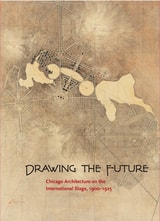
Drawing the Future
Chicago Architecture on the International Stage, 1900-1925David Van Zanten
Northwestern University Press, 2013
Drawing the Future: Chicago Architecture on the International Stage, 1900–1925 is an illustrated catalog with companion essays for an exhibition of the same name at the Mary and Leigh Block Museum of Art at Northwestern University. Drawing the Future explores the creative ferment among Chicago architects in the early twentieth century, coinciding with similar visions around the world. The essays focus on the highlights of the exhibition. David Van Zanten profiles Walter Burley Griffin and Marion Mahony Griffin, Chicago architects who created an influential, prize-winning plan for Canberra, the new capital of Australia. Ashley Dunn looks at the two exhibits at the Musée des Arts Décoratifs in Paris, one devoted to the Griffins in 1914 and the other to the French architect Tony Garnier in 1925, demonstrating the impact of World War I on city planning and architecture. Leslie Coburn examines Chicago’s Neighborhood Center Competition of 1914–15, which sought to redress gaps in Daniel Burnham’s plan of 1909. The ambition and reach of Chicago architecture in this epoch would have lasting influence on cities of the future.
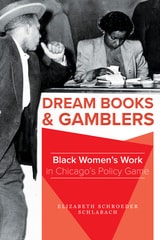
Dream Books and Gamblers
Black Women's Work in Chicago's Policy GameElizabeth Schroeder Schlabach
University of Illinois Press, 2022
Elizabeth Schroeder Schlabach examines the complexities of Black women’s work in policy gambling. Policy provided Black women with a livelihood for themselves and their families. At the same time, navigating gender expectations, aggressive policing, and other hazards of the infromal economy led them to refashion ideas about Black womanhood and respectability. Policy earnings also funded above-board enterprises ranging from neighborhood businesses to philanthropic institutions, and Schlabach delves into the various ways Black women straddled the illegal policy business and reputable community involvement.
Vivid and revealing, Dream Books and Gamblers tells the stories of Black women in the underground economy and how they used their work to balance the demands of living and laboring in Black Chicago.