Results by title
152 books match the query 'Childhood and youth' and 7 start with d

Degas at the Gas Station
EssaysThomas Beller
Duke University Press, 2025
Deliver Us
Luigi Meneghello, Translated from the Russian by Frederika Randall
Northwestern University Press, 2011
Only loosely chronological, Deliver Us proceeds by themes—childhood games, Fascist symbols, religious precepts, and the rites of poverty, of death, of eros, and of love. Meneghello’s ironic musings and profoundly honest recollections make an utterly unsentimental human comedy of that was the whole world to his dawning consciousness.
Dining at the Lineman's Shack
John Weston
University of Arizona Press, 2003
The place is Skull Valley in central Arizona, the time the 1930s. Taking food as his theme, Weston paints an instructive and often hilarious portrait of growing up, of rural family life under difficult circumstances, and of a remote Arizona community trying to hold body and soul together during tough times. His book recalls life in a lineman's shack, interlaced with "disquisitions on swamp life, rotting water, and the complex experience of finding enough to eat during the Great Depression."
Central to Weston's account is his mother Eloine, a valiant woman rearing a large brood in poverty with little help from her husband. Eloine cooks remarkably well—master of a small repertory from which she coaxes ideas surprising even to herself—and feeds her family on next to nothing. She is a woman whose first instinct is to cry out "Lord, what am I going to feed them" whenever visitors show up close to mealtime. Recalls Weston, "Her strength lay in a practical- and poverty-born sense that there must be more edible food in the world than most people realized," and he swears that six out of seven meals were from parts of four or five previous meals coming round again, like the buckets on a Ferris wheel.
Although Weston evokes a fond remembrance of a bygone era that moves from Depression-era Skull Valley to wartime Prescott, rest assured: food—its acquisition, its preparation, its wholehearted enjoyment—is the foundation of this book. "I did not have a deprived childhood, despite its slim pickings," writes Weston. "If I recall a boiling pig's head now and then, it is not to be read as some Jungian blip from Lord of the Flies but simply a recurring flicker of food-memory." Whether remembering his father's occasional deer poaching or his community's annual Goat Picnic, Weston laces his stories with actual recipes—even augmenting his instructions for roasted wild venison with tips for preparing jerky.
Dining at the Lineman's Shack teems with sparkling allusions, both literary and culinary, informed by Weston's lifetime of travels. Even his nagging memory of desperate boyhood efforts to trade his daily peanut-butter sandwich for bacon-and-egg, baloney, jelly, or most anything else is tempered by his acquaintance with "the insidious sa-teh sauce in Keo Sananikone's hole-in-the-wall restaurant on Kapahulu Street"—a peanut-butter-based delicacy for which he obligingly provides the ingredients (and which he promises will keep, refrigerated in a jar, for several weeks before baroque things begin to grow on it).
Through this tantalizing smorgasbord of memories, stories, and recipes, John Weston has fashioned a wholly captivating commentary on American culture, both in an earlier time and in our own. Dining at the Lineman's Shack is a book that will satisfy any reader's hunger for the unusual—and a book to savor, in every sense of the word.
Disowned by Memory
Wordsworth's Poetry of the 1790sDavid Bromwich
University of Chicago Press, 1998
"This very Wordsworthian combination of apparently low subjects with extraordinary 'high argument' makes for very rewarding, though often challenging reading."—Kenneth R. Johnston, Washington Times
"Wordsworth emerges from this short and finely written book as even stranger than we had thought, and even more urgently our contemporary."—Grevel Lindop, Times Literary Supplement
"[Bromwich's] critical interpretations of the poetry itself offer readers unusual insights into Wordworth's life and work."—Library Journal
"An added benefit of this book is that it restores our faith that criticism can actually speak to our needs. Bromwich is a rigorous critic, but he is a general one whose insights are broadly applicable. It's an intellectual pleasure to rise to his complexities."—Vijay Seshadri, New York Times Book Review
Dragging Wyatt Earp
A Personal History of Dodge CityRobert Rebein
Ohio University Press, 2013
In Dragging Wyatt Earp essayist Robert Rebein explores what it means to grow up in, leave, and ultimately return to the iconic Western town of Dodge City, Kansas. In chapters ranging from memoir to reportage to revisionist history, Rebein contrasts his hometown’s Old West heritage with a New West reality that includes salvage yards, beefpacking plants, and bored teenagers cruising up and down Wyatt Earp Boulevard.
Along the way, Rebein covers a vast expanse of place and time and revisits a number of Western myths, including those surrounding Francisco Vasquez de Coronado, the Cheyenne chief Black Kettle, George Armstrong Custer, and of course Wyatt Earp himself. Rebein rides a bronc in a rodeo, spends a day as a pen rider at a local feedlot, and attempts to “buck the tiger” at Dodge City’s new Boot Hill Casino and Resort.
Funny and incisive, Dragging Wyatt Earp is an exciting new entry in what is sometimes called the nonfiction of place. It is a must- read for anyone interested in Western history, contemporary memoir, or the collision of Old and New West on the High Plains of Kansas.

Drawing to an Inside Straight
The Legacy of an Absent FatherJodi Varon
University of Missouri Press, 2006
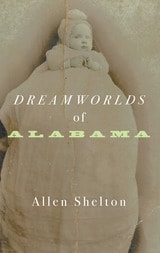
Dreamworlds of Alabama
Allen Shelton
University of Minnesota Press, 2007
“I speak in what others often hear as a strange accent. My past can’t be located. I live in Buffalo, New York, an exile from the South. But these aren’t Yankee dreams, even though my past seems like a fabrication, a dreamworld in which I’m a paper character and not a historical participant, with scars from barbed wire ripping under the pressure and flying through the air like a swarm of bees, or a horse rearing up and banging its head into mine from within, exploding my forehead.” —from the Preface
Wisteria draped on a soldier’s coffin, sent home to Alabama from a Virginia battlefield. The oldest standing house in the county, painted gray and flanked by a pecan orchard. A black steel fence tool, now perched atop a pile of books like a prehistoric bird of prey. In Dreamworlds of Alabama, Allen Shelton explores physical, historical, and social landscapes of northeastern Alabama. His homeplace near the Appalachian foothills provides the setting for a rich examination of cultural practices, a place where the language of place and things resonates with as much vitality and emotional urgency as the language of humans.
Throughout the book, Shelton demonstrates how deeply culture is inscribed in the land and in the most intimate spaces of the person—places of belonging and loss, insight and memory.
Born and raised in Jacksonville, Alabama, Allen Shelton is associate professor of sociology at Buffalo State College.