Results by title
267 books match the query 'Children' and 8 start with d
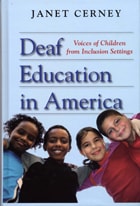
Deaf Education in America
Voices of Children from Inclusion SettingsJanet Cerney
Gallaudet University Press, 2007
Deaf Education in America: Voices of Children from Inclusion Settings provides a detailed examination of the complex issues surrounding the integration of deaf students into the general classroom. Author Janet Cerney begins her comprehensive work by stressing to parents, educators, and policymakers the importance of learning the circumstances in which mainstreaming and inclusion can be successful for deaf students. This process requires stakeholders to identify and evaluate the perceived benefits and risks before making placement and implementation decisions. The influences of the quality of communication and the relationships built by and with the students are of paramount importance in leading to success.
In conjunction with these principles, this thorough study examines the theory and history behind inclusion, including the effects of the No Child Left Behind education act. Cerney incorporates this knowledge with interviews of the deaf students themselves as well as with their interpreters and teachers. To ensure complete candidness, the students were surveyed in their homes, and the interpreters and educators were questioned separately. Through these exchanges, Cerney could determine what worked well for the deaf students, what barriers interfered with their access to communication, and what support structures were needed to eliminate those barriers. As a result, Deaf Education in America offers concrete information on steps that can be taken to ensure success in an inclusion setting, results that reverberate through the voices of the deaf students.

Decolonizing Discipline
Children, Corporal Punishment, Christian Theologies, and ReconciliationValerie E. Michaelson
University of Manitoba Press, 2020
Dependent States
The Child's Part in Nineteenth-Century American CultureKaren Sánchez-Eppler
University of Chicago Press, 2005
Dependent States examines the ties between children's literacy training and the growing cultural prestige of the novel; the way children functioned rhetorically in reform literature to enforce social norms; the way the risks of death to children shored up emotional power in the home; how Sunday schools socialized children into racial, religious, and national identities; and how class identity was produced, not only in terms of work, but also in the way children played. For Sánchez-Eppler, nineteenth-century childhoods were nothing less than vehicles for national reform. Dependent on adults for their care, children did not conform to the ideals of enfranchisement and agency that we usually associate with historical actors. Yet through meticulously researched examples, Sánchez-Eppler reveals that children participated in the making of social meaning. Her focus on childhood as a dependent state thus offers a rewarding corrective to our notions of autonomous individualism and a new perspective on American culture itself.
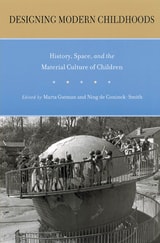
Designing Modern Childhoods
History, Space, and the Material Culture of ChildrenGutman, Marta
Rutgers University Press, 2008
In Designing Modern Childhoods, architectural historians, social historians, social scientists, and architects examine the history and design of places and objects such as schools, hospitals, playgrounds, houses, cell phones, snowboards, and even the McDonald's Happy Meal. Special attention is given to how children use and interpret the spaces, buildings, and objects that are part of their lives, becoming themselves creators and carriers of culture. The authors extract common threads in children's understandings of their material worlds, but they also show how the experience of modernity varies for young people across time, through space, and according to age, gender, social class, race, and culture.
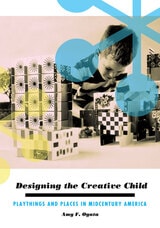
Designing the Creative Child
Playthings and Places in Midcentury AmericaAmy F. Ogata
University of Minnesota Press, 2013
The postwar American stereotypes of suburban sameness, traditional gender roles, and educational conservatism have masked an alternate self-image tailor-made for the Cold War. The creative child, an idealized future citizen, was the darling of baby boom parents, psychologists, marketers, and designers who saw in the next generation promise that appeared to answer the most pressing worries of the age.
Designing the Creative Child reveals how a postwar cult of childhood creativity developed and continues to this day. Exploring how the idea of children as imaginative and naturally creative was constructed, disseminated, and consumed in the United States after World War II, Amy F. Ogata argues that educational toys, playgrounds, small middle-class houses, new schools, and children’s museums were designed to cultivate imagination in a growing cohort of baby boom children. Enthusiasm for encouraging creativity in children countered Cold War fears of failing competitiveness and the postwar critique of social conformity, making creativity an emblem of national revitalization.
Ogata describes how a historically rooted belief in children’s capacity for independent thinking was transformed from an elite concern of the interwar years to a fully consumable and aspirational ideal that persists today. From building blocks to Gumby, playhouses to Playskool trains, Creative Playthings to the Eames House of Cards, Crayola fingerpaint to children’s museums, material goods and spaces shaped a popular understanding of creativity, and Designing the Creative Child demonstrates how this notion has been woven into the fabric of American culture.
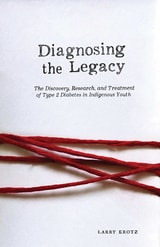
Diagnosing the Legacy
The Discovery, Research, and Treatment of Type 2 Diabetes in Indigenous YouthLarry Krotz
University of Manitoba Press, 2018
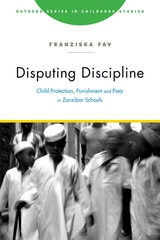
Disputing Discipline
Child Protection, Punishment, and Piety in Zanzibar SchoolsFranziska Fay
Rutgers University Press, 2021
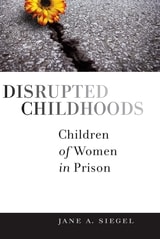
Disrupted Childhoods
Children of Women in PrisonSiegel, Jane A
Rutgers University Press, 2011
Millions of children in the United States have a parent who is incarcerated and a growing number of these nurturers are mothers. Disrupted Childhoods explores the issues that arise from a mother's confinement and provides first-person accounts of the experiences of children with moms behind bars. Jane A. Siegel offers a perspective that recognizes differences over the long course of a family's interaction with the criminal justice system.
Presenting an unparalleled view into the children's lives both before and after their mothers are imprisoned, this book reveals the many challenges they face from the moment such a critical caregiver is arrested to the time she returns home from prison. Based on interviews with nearly seventy youngsters and their mothers conducted at different points of their parent's involvement in the process, the rich qualitative data of Disrupted Childhoods vividly reveals the lived experiences of prisoners' children, telling their stories in their own words. Siegel places the mother's incarceration in context with other aspects of the youths' experiences, including their family life and social worlds, and provides a unique opportunity to hear the voices of a group that has been largely silent until now.