Results by title
236 books match the query 'Children's Studies' and 9 start with d

Deaf Adolescents
Inner Lives and Lifeworld DevelopmentMartha Sheridan
Gallaudet University Press, 2008
In her landmark book Inner Lives of Deaf Children: Interviews and Analysis, Martha A. Sheridan explored the lifeworlds — the individual and collective elements and realities that are present within the participants’ existential experiences, their relationships, and their truths — of seven deaf and hard of hearing children between the ages of seven and ten. What she discovered were deaf children with strengths, positive experiences, and positive relationships. Sheridan’s new book Deaf Adolescents: Inner Lives and Lifeworld Development returns to these seven individuals, now between the ages of 13 and 17, to see how their lives have progressed since their first interviews.
Establishing an identity is said to be a primary and necessary task of adolescence. Deaf Adolescents reveals how these young adults all have begun to deal with tasks and situations that lead them to rely more on themselves and others outside of their families. Many of them talk about the athletic challenges that they face, and how their success depends upon their own efforts. They also think about the future while biding their time, taking “a break” from the furious growth that they are experiencing and also enjoying time spent with other deaf friends.
In this volume, Sheridan examines the similarities and differences that these deaf young adults reveal in their views at two developmental points in their lives. Her renewed study has advanced the quest to determine what pathways and spaces can foster productive, healthy, satisfying, actualized deaf lives.
Defining Student Success
The Role of School and CultureLisa M. Nunn
Rutgers University Press, 2014
The key to success, our culture tells us, is a combination of talent and hard work. Why then, do high schools that supposedly subscribe to this view send students to college at such dramatically different rates? Why do students from one school succeed while students from another struggle? To the usual answer—an imbalance in resources—this book adds a far more subtle and complicated explanation. Defining Student Success shows how different schools foster dissimilar and sometimes conflicting ideas about what it takes to succeed—ideas that do more to preserve the status quo than to promote upward mobility.
Lisa Nunn’s study of three public high schools reveals how students’ beliefs about their own success are shaped by their particular school environment and reinforced by curriculum and teaching practices. While American culture broadly defines success as a product of hard work or talent (at school, intelligence is the talent that matters most), Nunn shows that each school refines and adapts this American cultural wisdom in its own distinct way—reflecting the sensibilities and concerns of the people who inhabit each school. While one school fosters the belief that effort is all it takes to succeed, another fosters the belief that hard work will only get you so far because you have to be smart enough to master course concepts. Ultimately, Nunn argues that these school-level adaptations of cultural ideas about success become invisible advantages and disadvantages for students’ college-going futures. Some schools’ definitions of success match seamlessly with elite college admissions’ definition of the ideal college applicant, while others more closely align with the expectations of middle or low-tier institutions of higher education.
With its insights into the transmission of ideas of success from society to school to student, this provocative work should prompt a reevaluation of the culture of secondary education. Only with a thorough understanding of this process will we ever find more consistent means of inculcating success, by any measure.

Designed for Play
Children’s Playgrounds and the Politics of Urban Space, 1840–2010Jon Winder
University of London Press, 2024
This book is an original and accessible history of the modern playground in Britain and beyond, charting its journey from marginal obscurity to popular ubiquity. Tracing the playground’s history from the mid-nineteenth century to 2010, Designed for Play demonstrates how a diverse set of actors across the philanthropic, voluntary, state, and commercial sectors all sought to reimagine and reshape the urban landscape to improve childhood outcomes.
Designing Modern Childhoods
History, Space, and the Material Culture of ChildrenGutman, Marta
Rutgers University Press, 2008
In Designing Modern Childhoods, architectural historians, social historians, social scientists, and architects examine the history and design of places and objects such as schools, hospitals, playgrounds, houses, cell phones, snowboards, and even the McDonald's Happy Meal. Special attention is given to how children use and interpret the spaces, buildings, and objects that are part of their lives, becoming themselves creators and carriers of culture. The authors extract common threads in children's understandings of their material worlds, but they also show how the experience of modernity varies for young people across time, through space, and according to age, gender, social class, race, and culture.
Designing the Creative Child
Playthings and Places in Midcentury AmericaAmy F. Ogata
University of Minnesota Press, 2013
The postwar American stereotypes of suburban sameness, traditional gender roles, and educational conservatism have masked an alternate self-image tailor-made for the Cold War. The creative child, an idealized future citizen, was the darling of baby boom parents, psychologists, marketers, and designers who saw in the next generation promise that appeared to answer the most pressing worries of the age.
Designing the Creative Child reveals how a postwar cult of childhood creativity developed and continues to this day. Exploring how the idea of children as imaginative and naturally creative was constructed, disseminated, and consumed in the United States after World War II, Amy F. Ogata argues that educational toys, playgrounds, small middle-class houses, new schools, and children’s museums were designed to cultivate imagination in a growing cohort of baby boom children. Enthusiasm for encouraging creativity in children countered Cold War fears of failing competitiveness and the postwar critique of social conformity, making creativity an emblem of national revitalization.
Ogata describes how a historically rooted belief in children’s capacity for independent thinking was transformed from an elite concern of the interwar years to a fully consumable and aspirational ideal that persists today. From building blocks to Gumby, playhouses to Playskool trains, Creative Playthings to the Eames House of Cards, Crayola fingerpaint to children’s museums, material goods and spaces shaped a popular understanding of creativity, and Designing the Creative Child demonstrates how this notion has been woven into the fabric of American culture.

Difficult Attachments
Anxieties of Kinship and CareKathryn E. Goldfarb
Rutgers University Press, 2025

Discretionary Justice
Looking Inside a Juvenile Drug CourtPaik, Leslie
Rutgers University Press, 2011
Juvenile drug courts are on the rise in the United States, as a result of a favorable political climate and justice officials' endorsement of the therapeutic jurisprudence movement--the concept of combining therapeutic care with correctional discipline. The goal is to divert nonviolent youth drug offenders into addiction treatment instead of long-term incarceration. Discretionary Justice overviews the system, taking readers behind the scenes of the juvenile drug court. Based on fifteen months of ethnographic fieldwork and interviews at a California court, Leslie Paik explores the staff's decision-making practices in assessing the youths' cases, concentrating on the way accountability and noncompliance are assessed. Using the concept of "workability," Paik demonstrates how compliance, and what is seen by staff as "noncompliance," are the constructed results of staff decisions, fluctuating budgets, and sometimes questionable drug test results.
While these courts largely focus on holding youths responsible for their actions, this book underscores the social factors that shape how staff members view progress in the court. Paik also emphasizes the perspectives of children and parents. Given the growing emphasis on individual responsibility in other settings, such as schools and public welfare agencies, Paik's findings are relevant outside the juvenile justice system.
Disputing Discipline
Child Protection, Punishment, and Piety in Zanzibar SchoolsFranziska Fay
Rutgers University Press, 2021
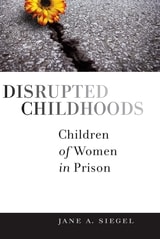
Disrupted Childhoods
Children of Women in PrisonSiegel, Jane A
Rutgers University Press, 2011
Millions of children in the United States have a parent who is incarcerated and a growing number of these nurturers are mothers. Disrupted Childhoods explores the issues that arise from a mother's confinement and provides first-person accounts of the experiences of children with moms behind bars. Jane A. Siegel offers a perspective that recognizes differences over the long course of a family's interaction with the criminal justice system.
Presenting an unparalleled view into the children's lives both before and after their mothers are imprisoned, this book reveals the many challenges they face from the moment such a critical caregiver is arrested to the time she returns home from prison. Based on interviews with nearly seventy youngsters and their mothers conducted at different points of their parent's involvement in the process, the rich qualitative data of Disrupted Childhoods vividly reveals the lived experiences of prisoners' children, telling their stories in their own words. Siegel places the mother's incarceration in context with other aspects of the youths' experiences, including their family life and social worlds, and provides a unique opportunity to hear the voices of a group that has been largely silent until now.