Results by title
662 books match the query 'China' and 21 start with d
Daily Giving Service
A History of the Diocesan Girls’ SchoolMoira M. W. Chan-Yeung
Hong Kong University Press, 2022
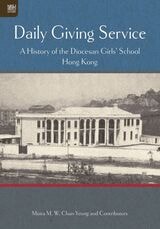
The Diocesan Girls’ School is one of Hong Kong’s oldest girls’ schools, founded during British rule in 1860. As an alumna of the school’s Class of 1955, Professor Moira Chan-Yeung traces the history of her alma mater from its establishment through its development over the last 150 years in Daily Giving Service. Having grown alongside Hong Kong as it expanded from a small city to a global metropolitan center, Diocesan has become one of the most prominent girl’s schools in the city and serves a significant role in the history of education and growth in the region. With contributions from other alumni, this book recounts various aspects of school life throughout different eras, illustrating the connection between the socioeconomic development of Hong Kong and this cornerstone of regional education.

Dance Studies in China
Selected Writings from the Journal of Beijing Dance AcademyEdited by Deng Youling and Zhang Yanjie
Intellect Books, 2022
Officially founded in 1978, the Beijing Dance School was the first professional dance school established after the creation of the People’s Republic of China. In the years since, the Beijing Dance Academy has become the only institution of higher learning for professional dance education in the country, as well as the largest prestigious dance school in the world. It is a full-time institution of higher learning with commitments to developing excellent professional dancers, choreographers, and dance researchers. Dance Studies in China is a collection of articles selected from issues of the Journal of Beijing Dance Academy, the only academic journal of dance studies in China. The collection also includes an interview with Shen Wei, the Chinese American choreographer, painter, and director living in New York.
Dancing for Their Lives
The Pursuit of Meaningful Aging in Urban ChinaClaudia Huang
Rutgers University Press, 2025
Dark Governance
Illegal Organizations and State PowerJavier Auyero
University of Chicago Press, 2027
A revelatory account of the ways covert, nefarious relationships between state officials and criminal groups shape daily life for all.
Far too often, the line between legal and illegal action is crossed by actors and organizations on both sides of the law. From the old Chicago Machine getting rich off criminal activity to Mexican drug cartels placing politicians in office, these relationships between criminals and the government coordinate forms of power in ways that affect where people live, what opportunities they can pursue, how they spend money, and how they treat one another. In Dark Governance, sociologist Javier Auyero describes how this kind of governance works and what it means for civic life.
Auyero analyzes instances of dark governance, including gangs in Ecuador and paramilitaries in Colombia who exert territorial control through violent specialists and government actors. He then turns to the less-studied case of the “colectivos” in Venezuela to show the scope of political work clandestine connections can achieve by thwarting grassroots organizations. In El Salvador and Honduras, the ties between gang members on the one hand, and politicians and elected officials on the other, serve to illustrate the impact dark governance has on urban spatial arrangements and on electoral campaigns. Dark Governance also offers an in-depth study of police-trafficker collusion in Argentina, which allows Auyero to identify the ways covert connections between state actors and drug traffickers operate in marginalized communities, affecting interpersonal violence. In addition to these examples in Latin America, Auyero also shares case studies in the United States and China. Dark governance can be seen in US organizations that patrol the borders and assert their control over migrants through their illicit connections with state authorities. In China, land expropriation and development projects are sometimes delayed when some households refuse to leave their properties. Enter the thugs-for-hire frequently contracted by local governments across the country to coerce residents into complying with government orders.
Demonstrating the very real effects of dark governance, Auyero argues that though the organizations involved in these dark arrangements differ, their collaboration results in a singular effect: the ability to control populations. But when these relationships come out of the shadows, collective action can bring them down.
Deaf Children in China
Alison Callaway
Gallaudet University Press, 1999
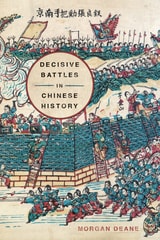
Decisive Battles in Chinese History
Morgan Deane
Westholme Publishing, 2024
“If you know the enemy and know yourself, you need not fear the result of a hundred battles. If you know yourself but not the enemy, for every victory gained you will also suffer a defeat. If you know neither the enemy nor yourself, you will succumb in every battle.”― Sun Tzu, The Art of War
The study of Chinese battles faces many hurdles that include different spelling systems, a haze of seemingly impenetrable names, places, and ideas, and different approaches to recording history. Early indigenous Chinese histories were written by Confucians with an antimilitary bias, and used rather laconic phrases to describe battles. These accounts were then transmitted to Jesuit missionaries who shared the Confucian disdain for martial matters. The modern discipline of history developed in the West during a time of particular Chinese weakness and political division, resulting in the lack of parallel material. Decisive Battles in Chinese History by Morgan Deane overcomes these obstacles to present the vast span of recorded Chinese history through key battles, from Maling, fought in 342 BC during the Warring States period, to Hengyang in 1944, which marked the end of major Japanese operations in China. Each of the twelve chapters highlights a significant conflict that selectively focuses on unique Chinese characteristics of the time, including belief systems, ruling ideology, the connection between technology and warfare, military theory, political events and rulers, and foreign policy, including China’s eventual interaction with the West. The book pushes back on a variety of ideas and stereotypes, ranging from the Chinese use of gunpowder, their supposedly weak reaction to the West, the viability of the Dynastic Cycle in studying history, the context of Chinese military theory, the exclusivity of martial and cultural spheres, and the uniqueness of Western imperialism. It also offers a groundbreaking reassessment of Mao Zedong’s leadership and his impact on the development of guerilla warfare. In a world filled with disturbing reports of conflict and potential warfare, Decisive Battles in Chinese History offers a unique addition to students, historians, and general readers wishing to better understand Chinese history.
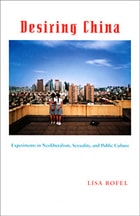
Desiring China
Experiments in Neoliberalism, Sexuality, and Public CultureLisa Rofel
Duke University Press, 2007
Drawing on her research over the past two decades among urban residents and rural migrants in Hangzhou and Beijing, Rofel analyzes the meanings that individuals attach to various public cultural phenomena and what their interpretations say about their understandings of post-socialist China and their roles within it. She locates the first broad-based public debate about post-Mao social changes in the passionate dialogues about the popular 1991 television soap opera Yearnings. She describes how the emergence of gay identities and practices in China reveals connections to a transnational network of lesbians and gay men at the same time that it brings urban/rural and class divisions to the fore. The 1999–2001 negotiations over China’s entry into the World Trade Organization; a controversial women’s museum; the ways that young single women portray their longings in relation to the privations they imagine their mothers experienced; adjudications of the limits of self-interest in court cases related to homoerotic desire, intellectual property, and consumer fraud—Rofel reveals all of these as sites where desiring subjects come into being.
Destruction and Sorrow beneath the Heavens
ReportageLászló Krasznahorkai
Seagull Books, 2016
Known for his brilliantly dark fictional visions, László Krasznahorkai is one of the most respected European writers of his generation and the winner of the 2015 Man Booker International Prize. Here, he brings us on a journey through China at the dawn of the new millennium. On the precipice of its emergence as a global power, China is experiencing cataclysms of modernity as its harsh Maoist strictures meet the chaotic flux of globalism. What remains of the Middle Kingdom’s ancient cultural riches? And can a Westerner truly understand China’s past and present—or the murky waters where the two meet?
Destruction and Sorrow beneath the Heavens is both a travel memoir and the chronicle of a distinct intellectual shift as one of the most captivating contemporary writers and thinkers begins to engage with the cultures of Asia and the legacies of its interactions with Europe in a newly globalized society. Rendered in English by award-winning translator Ottilie Mulzet, Destruction and Sorrow beneath the Heavens is an important work, marking the emergence of Krasznahorkai as a truly global novelist.
Praise for Krasznahorkai
“The contemporary Hungarian master of the apocalypse.”—Susan Sontag
“Krasznahorkai delights in unorthodox description; no object is too insignificant for his worrying gaze. . . . He offers us stories that are relentlessly generative and defiantly irresolvable. They are haunting, pleasantly weird, and ultimately, bigger than the worlds they inhabit.”—New York Times
“Krasznahorkai is an expert with the complexity of human obsessions. Each of his books feel like an event, a revelation.”—Daily Beast
Dialogues in Paradise
Can Xue
Northwestern University Press, 1989
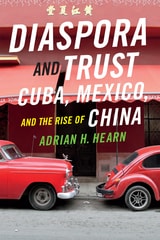
Diaspora and Trust
Cuba, Mexico, and the Rise of ChinaAdrian H. Hearn
Duke University Press, 2016
Diaspora's Homeland
Modern China in the Age of Global MigrationShelly Chan
Duke University Press, 2018
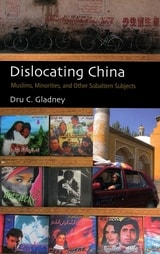
Dislocating China
Muslims, Minorities, and Other Subaltern SubjectsDru C. Gladney
University of Chicago Press, 2004
Gladney locates China and Chinese culture not in some unchanging, essential "Chinese-ness," but in the context of historical and contemporary multicultural complexity. He investigates how this complexity plays out among a variety of places and groups, examining representations of minorities and majorities in art, movies, and theme parks; the invention of folklore and creation myths; the role of pilgrimages in constructing local identities; and the impact of globalization and economic reforms on non-Han groups such as the Muslim Hui. In the end, Gladney argues that just as peoples in the West have defined themselves against ethnic others, so too have the Chinese defined themselves against marginalized groups in their own society.
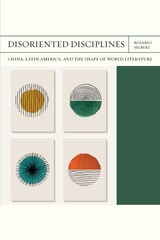
Disoriented Disciplines
China, Latin America, and the Shape of World LiteratureRosario Hubert
Northwestern University Press, 2024
In the absence of specialized programs of study, abstract discussions of China in Latin America took shape in contingent critical infrastructures built at the crossroads of the literary market, cultural diplomacy, and commerce. As Rosario Hubert reveals, modernism flourishes comparatively, in contexts where cultural criticism is a creative and cosmopolitan practice.
Disoriented Disciplines: China, Latin America, and the Shape of World Literature understands translation as a material act of transfer, decentering the authority of the text and connecting seemingly untranslatable cultural traditions. In this book, chinoiserie, “coolie” testimonies, Maoist prints, visual poetry, and Cold War memoirs compose a massive archive of primary sources that cannot be read or deciphered with the conventional tools of literary criticism. As Hubert demonstrates, even canonical Latin American authors, including Jorge Luis Borges, Octavio Paz, and Haroldo de Campos, write about China from the edges of philology, mediating the concrete as well as the sensorial.
Advocating for indiscipline as a core method of comparative literary studies, Disoriented Disciplines challenges us to interrogate the traditional contours of the archives and approaches that define the geopolitics of knowledge.

Disorienting Politics
Chimerican Media and Transpacific EntanglementsFan Yang
University of Michigan Press, 2024
Examining how Chimerican media are shaped by and perpetuate uneven power relations, Disorienting Politics argues that the pervasive tendency among wide-ranging cultural producers to depict the Chinese state as a racialized Other in American media life diminishes the possibility of engaging transpacific entanglements as a basis for envisioning new political horizons. Such othering of China not only results in overt racism against people of Asian descent, Yang argues, but also impacts the wellbeing of people of color more generally. This interdisciplinary book demonstrates the ways in which race is embedded in geopolitics even when the subject of discussion is not the people, but the (Chinese) state. Bridging media and cultural studies, Asian and Asian American studies, geography, and globalization studies, Disorienting Politics calls for a relational politics that acknowledges the multifarious interconnectivity between people, places, media, and environment.
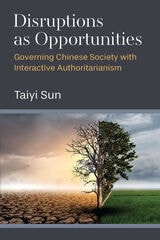
Disruptions as Opportunities
Governing Chinese Society with Interactive AuthoritarianismTaiyi Sun
University of Michigan Press, 2023
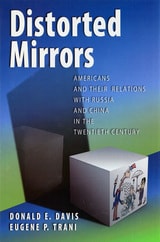
Distorted Mirrors
Americans and Their Relations with Russia and China in the Twentieth CenturyDonald E. Davis & Eugene P. Trani
University of Missouri Press, 2009
Divine Meets Digital
Tech Workers and Religion in the U.S. and ChinaDi Di
Rutgers University Press, 2026
What role does religion play in the tech industry? Based on nearly one hundred interviews, Divine Meets Digital uncovers the ways tech workers engage with religion and make sense of their work through religious and spiritual worldviews. While most identify as nonreligious, they are far from antireligious. Instead, they navigate competing religious and nonreligious views, often distinguishing between what they see as the controversial elements of religion—such as belief in the supernatural in China and its politicized and dogmatic aspects in the United States—and its more noncontroversial aspects. In doing so, they justify their religious engagement by embracing religion's noncontroversial elements while distancing themselves from its controversial features. This book offers a powerful new lens for understanding one of the most influential industries of our time, inviting readers to better understand the people who live and work at the intersection between science, religion, and technology.
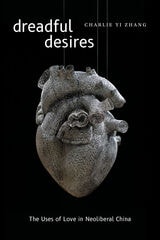
Dreadful Desires
The Uses of Love in Neoliberal ChinaCharlie Yi Zhang
Duke University Press, 2022
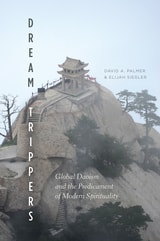
Dream Trippers
Global Daoism and the Predicament of Modern SpiritualityDavid A. Palmer and Elijah Siegler
University of Chicago Press, 2017
Dream Trippers draws on more than a decade of ethnographic work with Daoist monks and Western seekers to trace the spread of Westernized Daoism in contemporary China. David A. Palmer and Elijah Siegler take us into the daily life of the monastic community atop the mountain of Huashan and explore its relationship to the socialist state. They follow the international circuit of Daoist "energy tourism," which connects a number of sites throughout China, and examine the controversies around Western scholars who become practitioners and promoters of Daoism. Throughout are lively portrayals of encounters among the book’s various characters—Chinese hermits and monks, Western seekers, and scholar-practitioners—as they interact with each other in obtuse, often humorous, and yet sometimes enlightening and transformative ways. Dream Trippers untangles the anxieties, confusions, and ambiguities that arise as Chinese and American practitioners balance cosmological attunement and radical spiritual individualism in their search for authenticity in a globalized world.
Dreams of Flight
The Lives of Chinese Women Students in the WestFran Martin
Duke University Press, 2022
Dying for an iPhone
Apple, Foxconn and the Lives of China's WorkersPluto Press, 2020