Results by title
303 books match the query 'Church history' and 5 start with d
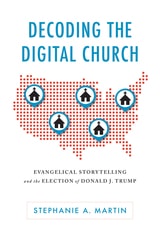
Decoding the Digital Church
Evangelical Storytelling and the Election of Donald J. TrumpStephanie A. Martin
University of Alabama Press, 2021
"This investigation tries to understand why many Evangelical pastors were blamed for endorsing Trump when, in fact, most did not. This book joins other attempts by scholars and journalists to analyze the relationship between Trump and Evangelicals. Recommended.” —CHOICE
Tracing the digital narratives that shaped evangelical identity in a pivotal political moment.
As a political constituency, white conservative evangelicals are generally portrayed as easy to dupe, disposed to vote against their own interests, and prone to intolerance and knee-jerk reactions. In Decoding the Digital Church: Evangelical Storytelling and the Election of Donald J. Trump, Stephanie A. Martin challenges this assumption and moves beyond these overused stereotypes to develop a refined explanation for this constituency’s voting behavior.
This volume offers a fresh perspective on the study of religion and politics and stems from the author’s personal interest in the ways her experiences with believers differ from how scholars often frame this group’s rationale and behaviors. To address this disparity, Martin examines sermons, drawing on her expertise in rhetoric and communication studies with the benefits of ethnographic research in an innovative hybrid approach she terms a “digital rhetorical ethnography.” Martin’s thorough research surveys more than 150 online sermons from America’s largest evangelical megachurches in 37 different states. Through listening closely to the words of the pastors who lead these conservative congregations, Martin describes a gentler discourse less obsessed with issues like abortion or marriage equality than stereotypes of evangelicals might suggest. Instead, the politicaleconomic sermons and stories from pastors encourage true believers
to remember the exceptional nature of the nation’s founding while also deemphasizing how much American citizenship really means.
Martin grapples with and pays serious, scholarly attention to a seeming contradiction: while the large majority of white conservative evangelicals voted in 2016 for Donald J. Trump, Martin shows that many of their pastors were deeply concerned about the candidate, the divisive nature of the campaign, and the potential effect of the race on their congregants’ devotion to democratic process itself. In-depth chapters provide a fuller analysis of our current political climate, recapping previous scholarship on the history of this growing divide and establishing the groundwork to set up the dissonance between the political commitments of evangelicals and their faith that the rhetorical ethnography addresses.
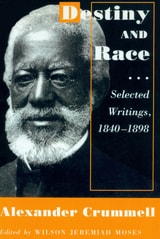
Destiny and Race
Selected Writings, 1840-1898Alexander Crummell
University of Massachusetts Press, 1992
A major reformer and intellectual, Alexander Crummell (1819–1898) was the first black American to graduate from Cambridge University. From 1858 to 1872, he lived in Liberia, where he worked as a farmer, educator, and Episcopal missionary. Returning to America, he established St. Luke’s Episcopal Church in Washington D.C., serving as its pastor until 1894. In 1897 he founded the American Negro Academy, which he intended as a challenge to the accommodationist philosophy of Booker T. Washington.
A prolific writer, Crummell produced pioneering works on black nationalism, black self-determination, and Pan Africanism that influenced W.E.B. Du Bois and other African-American leaders of the time. His surviving papers include over four hundred sermons and political essays and a voluminous correspondence.
Yet despite his importance to American and African-American history, Crummell is little known today, and there have been virtually no modern printings of his writing. This volume is intended to restore Crummell’s voice and to prompt a reevaluation of his work.
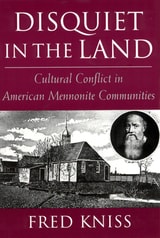
Disquiet in the Land
Cultural Conflict in American Mennonite CommunitiesKniss, Fred
Rutgers University Press, 1997
Mennonites have long referred to themselves as "The Quiet in the Land," but their actual historical experience has been marked by internal disquiet and contention over religious values and cultural practice. As Fred Kniss argues in his impressive study of Mennonite history, the story of this sectarian pacifist group is a story of conflict. How can we understand the ironic phenomenon of Mennonite conflict? How do ideas and symbols-both those of the American mainstream and those that are specifically Mennonite-influence the emergence and course of this conflict? What is the relationship betweenintra-Mennonite conflict and the changing historical context in which Mennonites are situated?
Through a rigorous analysis of a century of disputes over dress codes, congregational authority, and religious practice, Kniss offers the tools both to understand conflict within a specific religious group and to answer larger questions about culture, ideology, and social and historical change.

Divine Presence in Spain and Western Europe 1500–1960
Visions, Religious Images and PhotographsWilliam A. Christian Jr.
Central European University Press, 2012
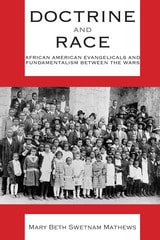
Doctrine and Race
African American Evangelicals and Fundamentalism between the WarsMary Beth Swetnam Mathews
University of Alabama Press, 2017
Doctrine and Race examines the history of African American Baptists and Methodists of the early twentieth century and their struggle for equality in the context of white Protestant fundamentalism.
By presenting African American Protestantism in the context of white Protestant fundamentalism, Doctrine and Race: African American Evangelicals and Fundamentalism between the Wars demonstrates that African American Protestants were acutely aware of the manner in which white Christianity operated and how they could use that knowledge to justify social change. Mary Beth Swetnam Mathews’s study scrutinizes how white fundamentalists wrote blacks out of their definition of fundamentalism and how blacks constructed a definition of Christianity that had, at its core, an intrinsic belief in racial equality. In doing so, this volume challenges the prevailing scholarly argument that fundamentalism was either a doctrinal debate or an antimodernist force. Instead, it was a constantly shifting set of priorities for different groups at different times.
A number of African American theologians and clergy identified with many of the doctrinal tenets of the fundamentalism of their white counterparts, but African Americans were excluded from full fellowship with the fundamentalists because of their race. Moreover, these scholars and pastors did not limit themselves to traditional evangelical doctrine but embraced progressive theological concepts, such as the Social Gospel, to help them achieve racial equality. Nonetheless, they identified other forward-looking theological views, such as modernism, as threats to “true” Christianity.
Mathews demonstrates that, although traditional portraits of “the black church” have provided the illusion of a singular unified organization, black evangelical leaders debated passionately among themselves as they sought to preserve select aspects of the culture around them while rejecting others. The picture that emerges from this research creates a richer, more profound understanding of African American denominations as they struggled to contend with a white American society that saw them as inferior.
Doctrine and Race melds American religious history and race studies in innovative and compelling ways, highlighting the remarkable and rich complexity that attended to the development of African American Protestant movements.